

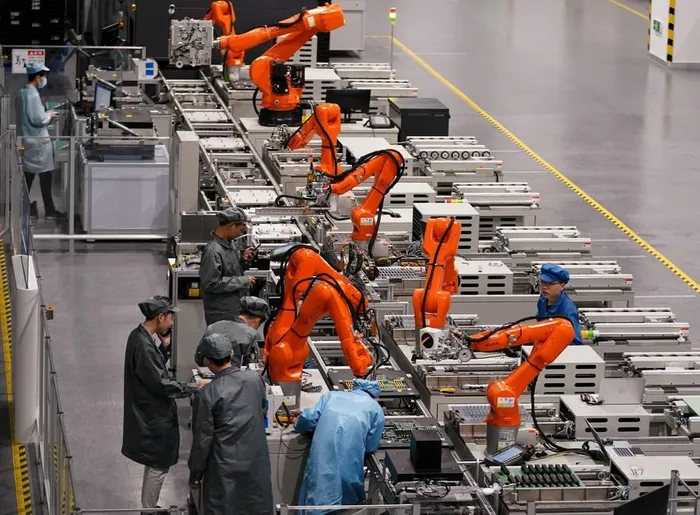
As South Africa accelerates its manufacturing modernisation strategy, experts warn that digitalising factories without equipping workers with the right information and skills could undermine the country's reindustrialisation ambitions.
Image: Xinhua
South Africa's drive to modernise its manufacturing sector through digitalisation risks falling short unless equal attention is given to equipping factory workers with the information and skills needed to operate increasingly advanced production environments.
That is the warning emerging in the wake of the Manufacturing Indaba, where digitalisation featured prominently as one of the key pillars underpinning South Africa's reindustrialisation strategy.
Deputy Minister of Trade, Industry and Competition John Steenhuisen identified digitalisation, alongside diversification and decarbonisation, as central to rebuilding the country's manufacturing base.
However, concerns have been raised that much of the discussion around Industry 4.0 continues to focus almost exclusively on robotics, artificial intelligence and factory automation, while overlooking the workers responsible for keeping those systems running.
"One of the underlying themes of this week's Manufacturing Indaba was touched on well by Deputy Minister of Trade, Industry and Competition John Steenhuisen when he named digitalisation as one of three pillars, alongside diversification and decarbonisation, underpinning South Africa's reindustrialisation strategy."
The commentary argues that discussions around vocational training have also largely centred on educational curricula and equipment, while existing factory employees receive comparatively little attention.
"The Indaba, though, generally finds itself discussing that pillar almost entirely in terms of robotics, AI and automation on the production line. Vocational training and workforce readiness conversations also tend to circle around curricula and equipment, while the frontline employees who already run today's factory floors rarely feature. I think it's a blind spot we shouldn't ignore."
The challenge comes as South Africa seeks to reverse decades of manufacturing decline while simultaneously undertaking major infrastructure investment programmes that will require a significant expansion of technical skills.
Electricity and Energy Minister Kgosientsho Ramokgopa recently highlighted the scale of that challenge, noting that the country's planned R430 billion electricity transmission expansion would require a substantial pipeline of skilled technical workers.
According to the commentary, Ramokgopa made it clear that delivering the programme would require "a significant number of technical people" at the peak of construction, while acknowledging that developing those skills from scratch would take years that the programme simply does not have.
The urgency is underscored by the long term decline in manufacturing's contribution to the South African economy.
"South Africa's manufacturing contribution to GDP has already slipped from 22% in 1994 to about 12% today, and that drives home the point that the country can't afford to keep waiting for a future workforce while under informing the one it has."
Rather than focusing solely on future graduates entering the sector, manufacturers are being encouraged to invest in the employees already operating production lines by ensuring they have access to real time information, digital tools and continuous workplace learning.
The commentary argues that technology alone will not secure South Africa's industrial revival.
"Digitalising the machines is just one part, and maybe even the easy one. Reindustrialisation will actually be won or lost on how fast the people operating those digitised machines get the information they need to keep the wheels turning."
As manufacturers increasingly adopt artificial intelligence, automation and smart factory technologies to improve productivity and competitiveness, the success of South Africa's broader reindustrialisation strategy may ultimately depend less on the sophistication of its machinery and more on how effectively it empowers the workforce responsible for using it.
Follow Business Report on Facebook, X and on LinkedIn for the latest Business and tech news.