

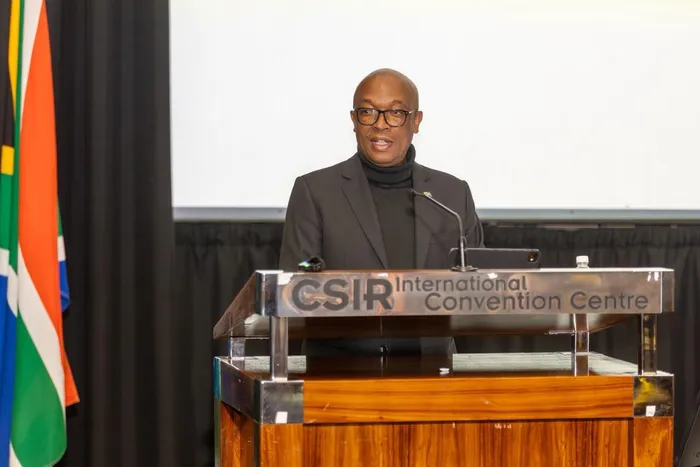
Trade, Industry and Competition Minister Parks Tau delivering the keynote address at the Defence Industry Lekgotla on Monday.
Image: Supplied
Trade, Industry and Competition Minister Parks Tau has called for a coordinated "South Africa Inc" approach to revitalise the country's defence industry, arguing that the sector should be treated as a strategic pillar of South Africa's industrialisation agenda rather than a niche manufacturing industry.
Delivering the keynote address at the Defence Industry Lekgotla on Monday, Tau said South Africa's defence industry remains one of the country's most advanced manufacturing sectors despite decades of declining investment, shrinking employment and reduced government procurement.
Tau said the defence sector possessed sophisticated capabilities spanning air, sea, land, cyber and space technologies, placing South Africa among a select group of industrialising countries with advanced defence manufacturing expertise.
"South Africa's defence industry is not a niche sector standing apart from our industrialisation programme. It is one of its most advanced expressions," Tau said.
"It sits at the frontier of manufacturing precision, systems engineering and technology sovereignty. Government must therefore treat it accordingly, and treat it together, across departments."
Tau said South Africa ranked as the world's 21st-largest exporter of major conventional arms between 2018 and 2023 despite operating with one of the smallest defence budgets among countries with established defence industries.
He noted that the industry comprises more than 600 companies, including Denel, more than 250 defence-focused private firms and about 350 component suppliers, while exports account for more than 80% of industry revenue and reach over 115 countries.
However, Tau acknowledged that the industry has experienced significant decline over the past three decades.
According to Tau, defence force procurement from local industry declined from R26.2 billion in the 1989/90 financial year to R850 million in 2017 in constant terms, while research and development funding dropped from R6.1bn to around R500m over the same period.
Employment across the value chain also fell sharply from about 130,000 workers employed by 3,000 companies in 1990 to roughly 13,000 workers across 600 companies today.
He said the erosion of engineering and technical skills, particularly following instability at state-owned defence manufacturer Denel, posed one of the greatest threats to the sector's future.
Despite these challenges, Tau argued that changing global geopolitical dynamics presented South Africa with an opportunity to rebuild its defence industrial base.
He said increasing global defence spending, supply chain disruptions and tighter export controls had encouraged many countries to strengthen domestic manufacturing capabilities.
Tau also pointed to Africa's projected $136bn defence acquisition market as a significant opportunity for South African manufacturers.
"South Africa should not be a bystander to this cycle. We have the base to compete. What we lack is coordination," he said, adding that Cabinet's approval of the South African National Defence Force's 30-year "Journey to Greatness" modernisation strategy should now be matched by equally long-term industrial planning.
Tau highlighted several government programmes already supporting the industry, including the Aerospace Industry Support Initiative, the National Industrial Participation Programme, export promotion initiatives and plans to establish an Aerospace and Defence Special Economic Zone cluster in the Western Cape.
He also said the Industrial Development Corporation (IDC) was directing investment towards localisation, additive manufacturing, robotics, drone technologies, maintenance and repair capabilities, as well as defence technologies with commercial applications.
However, Tau argued that fragmented decision-making across government departments continued to constrain the industry's growth.
He cited delays in export permit approvals, aviation regulations affecting the drone industry, limited bilateral aviation recognition agreements and inadequate investment in specialised infrastructure as examples of barriers requiring coordinated government action.
Tau said these challenges could not be addressed by any single department.
"This is precisely why the Lekgotla's call for a 'South Africa Inc' implementation model is the right frame," he said.
He proposed closer collaboration between the Department of Trade, Industry and Competition, the Department of Defence, National Treasury, the Department of Science and Innovation, the Department of International Relations and Cooperation, the South African Police Service, the State Security Agency and several public entities, including Armscor, the CSIR, the IDC and the Export Credit Insurance Corporation.
Tau said the defence and aerospace industry also aligns closely with government's recently adopted Industrial Development Strategy, which focuses on decarbonisation, digitalisation and diversification.
"The defence and aerospace sector speaks to all three. It is a proving ground for advanced manufacturing and digital systems integration. It offers diversification into higher-value, higher-technology export lines at a time when our traditional industrial base is under pressure," he said.
"This industry defended South Africa's sovereignty in the past. It can help build South Africa's industrial future."
BUSINESS REPORT