

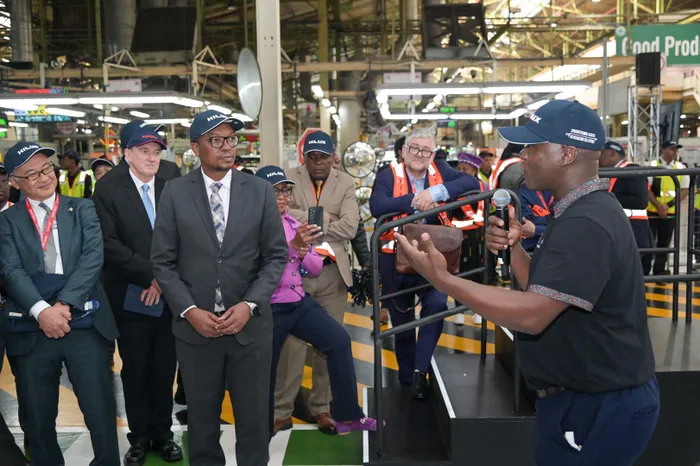
South Africa has a limited window to secure the future of its automotive industry.
Image: Supplied
Toyota South Africa Motors (TSAM) says South Africa has a limited window to secure the future of its automotive industry, warning that decisions taken today will determine whether local vehicle manufacturing remains globally competitive beyond 2028.
The comments came after Toyota marked the start of production of the ninth-generation Hilux at its Prospecton plant in Durban, backed by a R10 billion investment.
While the investment itself is an important development, Toyota executives stressed that the real significance lies in preparing the plant and its workforce for the next generation of vehicles.
"It's beyond the numbers and it's about the generations to come," said Nigel Ward, executive vice-president of Manufacturing and Support Group.
"If you go back over the generations we've built, that investment was in excess of R20 billion. It's been stepping stones to take us along."
Ward said the latest investment builds on more than 6 decades of local manufacturing and focuses as much on developing people and skills as it does on new equipment and facilities.
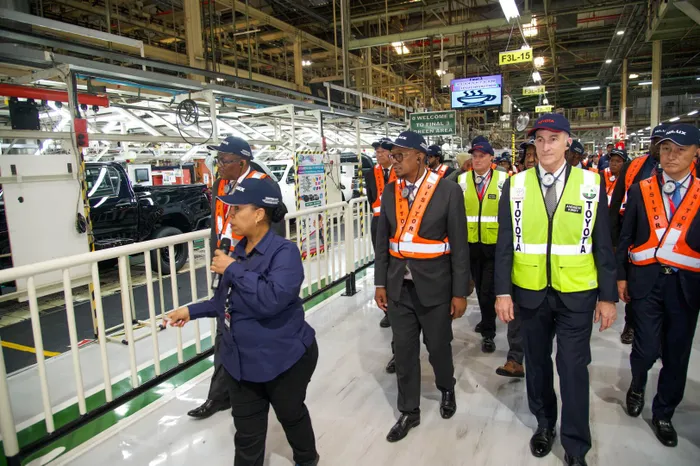
The latest investment builds on more than six decades of local manufacturing and focuses as much on developing people and skills as it does on new equipment and facilities.
Image: Supplied
Toyota South Africa President and CEO Andrew Kirby said decades of consistent government policy through programmes such as the Motor Industry Development Programme (MIDP) and Automotive Production and Development Programme (APDP) had helped build one of the country's strongest manufacturing sectors. However, he warned that the industry is now facing three major disruptions that require urgent action.
The first is the global shift towards low and zero emission vehicles, particularly in export markets. The second is the rapid growth of imported vehicle brands entering South Africa, while the third is the country's declining competitiveness.
"We used to be very reliant on low energy costs, affordable labour, logistics and taxes," Kirby said. "All of these have gone up significantly over the last 10 years."
He said Toyota recently spent more than three hours in discussions with the Minister of Trade, Industry and Competition, Parks Tau to present proposals aimed at strengthening South Africa's automotive policy.
"If we really want to become a manufacturing hub for mobility in the future, we need to also address that level of competitiveness," Kirby said.
"Right now, the figures look okay. But if we think about the years of 2028 to 2032, we are at risk as an industry. We need to be making decisions now for that period."
Kirby also renewed Toyota's call for changes to the country's industrial policy surrounding semi-knocked-down (SKD) vehicle assembly.
"Our strong request is that we phase out SKD in South Africa and strengthen the competitiveness of CKD so that we can have a better balance between locally produced vehicles and imported vehicles," he said.
Electrification also remains one of Toyota's biggest concerns.
Kirby said the current policy only supports battery electric and hydrogen fuel-cell vehicles while excluding hybrids, plug-in hybrids and other electrified powertrains.
"We don't have an electrification policy," Kirby said.
"We know that we need to be technology agnostic and we need to accelerate the transition to manufacturing new energy vehicles because that's where the future will be."
He added that South Africa remains heavily dependent on exports to Europe and the UK, which account for around 81% of the country's vehicle exports. As emissions regulations tighten in those markets, local manufacturers must be ready to build electrified vehicles.
Toyota Motor Corporation global chief engineer for Hilux Satoki Oya confirmed that Hilux electrification has already started in Thailand, where battery-electric versions are already being introduced ahead of hybrid derivatives.
He said Toyota is continuing to study how customers use electrified bakkies before deciding how quickly different technologies should be rolled out globally.
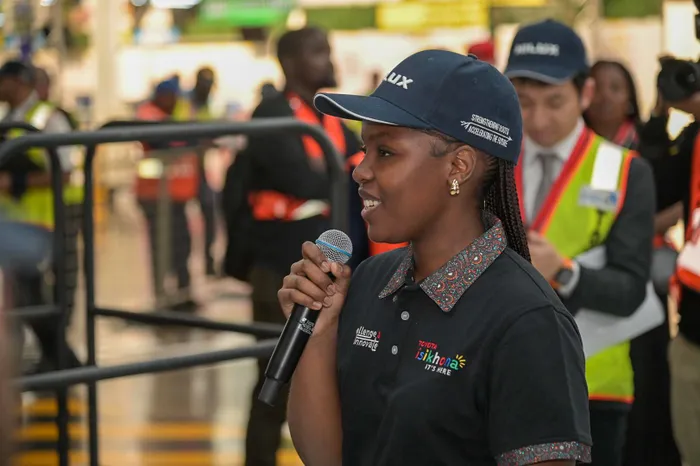
Almost 300 South Africans who have completed training assignments in Japan are now back on the Prospecton shop floor.
Image: Supplied
Asked about the rapid expansion of Chinese manufacturers across Africa, Oya acknowledged that they have become serious competitors.
"Chinese manufacturers' cars are much better than before," he said. "They are now a good competitor in the market to Toyota."
However, he said Toyota's philosophy remains unchanged, with a strong focus on vehicle quality, after-sales support, parts availability and customer satisfaction throughout the ownership cycle rather than simply selling vehicles at competitive prices.
Toyota also highlighted its continued investment in South African skills.
Kirby acknowledged concerns around education levels nationally but said Toyota's own development programmes continue to produce world-class employees.
"When we recruit people into our company and take them through our own development programmes, we are seeing them perform at a very high level," Kirby said.
"It's not holding us back because we have very well thought through, detailed programmes that help create those skills on the job."
According to Ward almost 300 South Africans who have completed training assignments in Japan are now back on the Prospecton shop floor.
"I can walk into the assembly plant and see who has worked and trained in Japan," Ward said.
Toyota currently has about 230 South Africans training in Japan, where they work on production lines running almost twice as fast as those in Durban.
He said the South Africans are matching the pace of their Japanese counterparts, proving they can compete at the highest international manufacturing standards.
Kirby also dismissed suggestions that Hilux's long-standing dominance is simply down to the product itself.
"If we put our customers first and make sure the technical support, the service, the parts supply and the resale value are right, we have a very strong ability to retain our loyal customers," he said.
Toyota was surprised by the popularity of the Corolla Cross Hybrid, with Kirby admitting demand had exceeded expectations.
"Most customers that drive a hybrid don't want to drive anything else," he said.
Toyota's Prospecton plant currently has the capacity to build around 140,000 Hilux bakkies a year, but Kirby made it clear that maintaining those production volumes into the next decade will depend on South Africa creating the right policy environment to remain competitive in an increasingly electrified global automotive industry.