

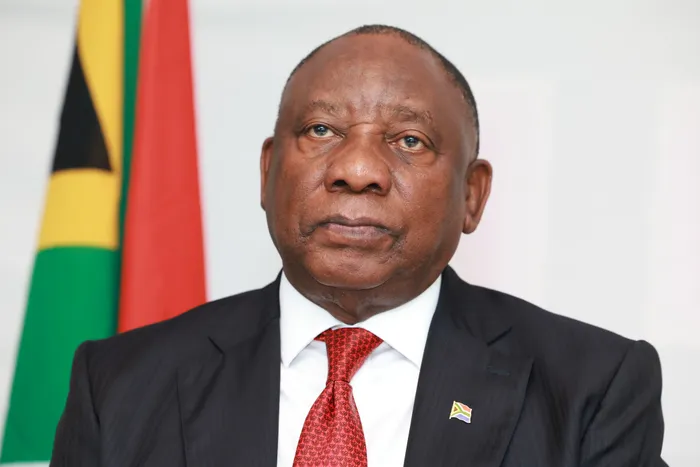
President Cyril Ramaphosa says Toyota’s latest Hilux investment demonstrates South Africa’s ability to attract capital, expand manufacturing capacity, create jobs and strengthen automotive exports.
Image: GCIS
President Cyril Ramaphosa has welcomed Toyota South Africa Motors’ R10.4 billion investment in its ninth-generation Hilux programme, stating that the project demonstrates confidence in South Africa’s manufacturing sector, workers and economic potential.
Speaking at the official line-off launch of the new Toyota Hilux at the company’s Prospecton plant in eThekwini on Thursday, Ramaphosa said the investment represented more than the launch of a new vehicle.
“It is about confidence in South Africa. It is about the enduring value of long-term investment. It is about the strength of South African workers, engineers, technicians and entrepreneurs,” Ramaphosa said.
He said the Hilux had become part of the South African story, having been produced locally for more than half a century and exported from the country.
Although the vehicle carries one of the world’s most recognised automotive brands, Ramaphosa said South Africans viewed it as a local product because it was “designed for our conditions, built by South African hands and exported from South African shores”.
Ramaphosa said Toyota’s latest investment reflected the type of long-term commitment South Africa sought to attract.
“The R10.4 billion investment in the new-generation Hilux programme demonstrates precisely the type of investment that South Africa seeks to attract,” he said.
He said the value of the investment went beyond the manufacturing facility, creating opportunities for workers, suppliers and young people entering the economy.
“Its true value lies in the opportunities it creates. It lies in the thousands of South Africans whose livelihoods depend on this plant. It lies in the workers whose skills continue to grow,” Ramaphosa said.
“It lies in the supplier companies that have expanded their production. It lies in the young people who will find employment because businesses such as Toyota continue to invest in our economy.”
The president said the project showed how investment commitments could be translated into economic outcomes.
“At the sixth South Africa Investment Conference earlier this year, I said that investors reward execution, not merely commitment,” he said.
“Investment announcements matter. But completed projects matter even more. Factories that are expanded. Machines that are installed. Workers who are employed. Exports that leave our ports. Communities whose prospects are transformed.”
Ramaphosa said Toyota’s investment had also strengthened local supplier capacity, with about a third of the investment directed towards supplier development and tooling, while suppliers had invested a further R2 billion to expand localisation.
“That is how resilient industrial ecosystems are built. That is how domestic manufacturing capabilities deepen. That is how small and medium enterprises grow,” he said.
He added that the automotive sector remained a key contributor to South Africa’s industrial economy, accounting for around 5% of gross domestic product, supporting more than 115 000 direct manufacturing jobs and more than half a million jobs across the value chain.
Ramaphosa said South Africa’s position as the world’s 21st largest vehicle producer had been built through partnerships between government, manufacturers, organised labour and suppliers.
He said the automotive industry was undergoing major changes globally, driven by cleaner mobility, new technologies and changing consumer preferences.
“South Africa must not merely respond to these changes. We must lead where we have competitive advantages,” Ramaphosa said.
He said government was strengthening support for the sector through incentives for component manufacturing, battery value-chain development, research, innovation and skills development linked to new-energy vehicles.
Ramaphosa said South Africa’s reserves of critical minerals provided an opportunity for the country to become a global hub for future mobility if combined with advanced manufacturing and technological innovation.
He also highlighted the importance of improving logistics infrastructure, including ports and rail, saying these were essential to the country’s competitiveness.
Ramaphosa welcomed improvements in Transnet's vehicle terminals in Durban, Gqeberha and East London, which handled more than 792,000 fully built vehicles in the ten months to February.
He said deeper partnerships between government and business would help strengthen South Africa’s position as an export platform.
“The world remains uncertain. Competition for investment has become more intense,” Ramaphosa said.
“South Africa will compete by building a stable macroeconomic environment, implementing structural reforms, improving infrastructure, strengthening institutions and expanding partnerships with investors who share our long-term vision.”
Ramaphosa thanked Toyota South Africa Motors, government departments, organised labour, suppliers, contractors and workers at the Prospecton plant for contributing to the milestone.
“Every Hilux that leaves this production line carries with it your skill, your discipline, your craftsmanship and your pride,” he added.
He said the launch demonstrated that South Africa remained capable of competing globally.
“That South Africa is open for business. That South Africans can compete with the very best in the world. And that when government, business and labour work together, there is no limit to what our nation can achieve,” Ramaphosa said.
IOL Business