

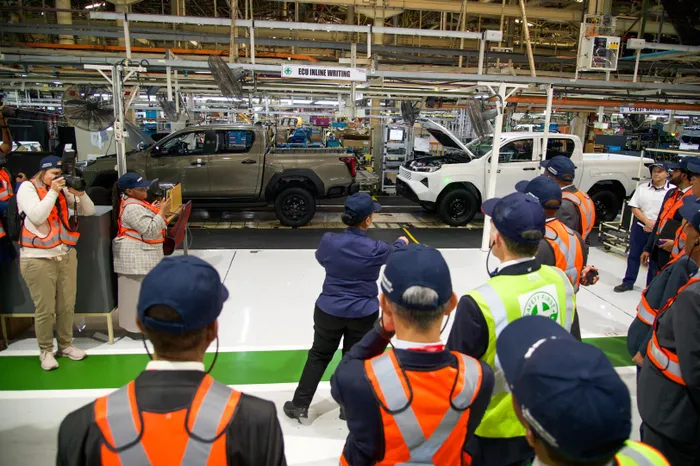
Toyota South Africa Motors (TSAM) has officially started production of the ninth-generation Hilux at its Prospecton manufacturing plant in Durban, following a R10.4 billion investment in the programme.
Image: Supplied
Toyota South Africa Motors (TSAM) has officially started production of the ninth-generation Hilux at its Prospecton manufacturing plant in Durban, following a R10.4 billion investment in the programme.
The ceremonial line-off was attended by Minister of Trade, Industry and Competition Parks Tau, Japanese Ambassador to South Africa Fumio Shimizu, executives from Toyota Motor Corporation and Toyota Tsusho, as well as representatives from government and the automotive industry.
President Cyril Ramaphosa missed the event as a result of technical issues on his airplane but addressed the gathering via video.
According to Toyota, the investment is the largest single product investment in the company's history in South Africa and is aimed at strengthening local manufacturing while expanding the country's role in Toyota's global production network.
Hilux production began at Prospecton 56 years ago, and more than 2.9 million bakkies have been built. Vehicles produced at the Durban plant are exported to 74 markets across Africa and Europe.
The programme supports 101 Tier One suppliers, generates annual supplier spending of more than R15 billion, sustains nearly 27 000 jobs across the supplier network and employs more than 4 300 people directly at the Prospecton facility.
Andrew Kirby, president and CEO of Toyota South Africa Motors, said the investment extends well beyond the production line.
“The ninth-generation Hilux is not simply the next Hilux. It is the next chapter in South African manufacturing. Every new generation presents an opportunity to elevate our technology, strengthen our supplier base, deepen localisation, develop our people and improve the competitiveness of our operations.
“The R10.4 billion investment reflects Toyota's enduring confidence in South Africa, its people and its manufacturing future.
"When Toyota invests, the impact extends far beyond the vehicles we build. It boosts local suppliers, creates employment, develops skills and contributes to the growth of an entire industrial ecosystem. Every Hilux that leaves our production line carries the contribution and pride of thousands of South Africans," he said.
The investment includes the construction of a new 29,300 square metre Toyota Logistics Centre, a new Chassis Frame Coating Facility and a Chassis Frame Welding Facility, which is expected to be completed in June 2027.
Toyota said R3.2 billion of the investment has been allocated to local supplier development, while a further R7.2 billion has been spent on production preparation, including manufacturing technology, production equipment and supplier tooling.
Supplier partners have also invested a further R2 billion in facilities, tooling and production capability.
Shinichiro Otsuka, Chief Operating Officer of Toyota Tsusho's Africa Division and Regional CEO of Toyota Africa, confirmed that South Africa remains an important manufacturing base for the company.
“Toyota South Africa continues to demonstrate the quality, resilience and manufacturing excellence that define Toyota operations around the world.
“The ninth-generation Hilux programme reflects Toyota Motor Corporation's confidence in South Africa and our belief in the capability of its people. Through continued investment in technology, skills development and localisation, South Africa remains an important strategic production base for Toyota globally."
President Ramaphosa said the investment highlighted confidence in South Africa's manufacturing sector.
“Today's milestone celebrates not simply another model rolling off an assembly line. It celebrates Toyota South Africa's continued confidence in our country and in its people. The R10.4 billion investment in the new-generation Hilux programme demonstrates precisely the type of investment that South Africa seeks to attract.
The true measure of this investment is not found in machinery or buildings. Its true value lies in the opportunities it creates."
Closing the event, Kirby said the future competitiveness of South Africa's automotive industry depended on continued collaboration between industry and government.
“The generation before us built one of Africa's greatest automotive manufacturing success stories. Our responsibility is to ensure that the generation after us inherits one that is even stronger. Today's investment is an important step towards that future."