

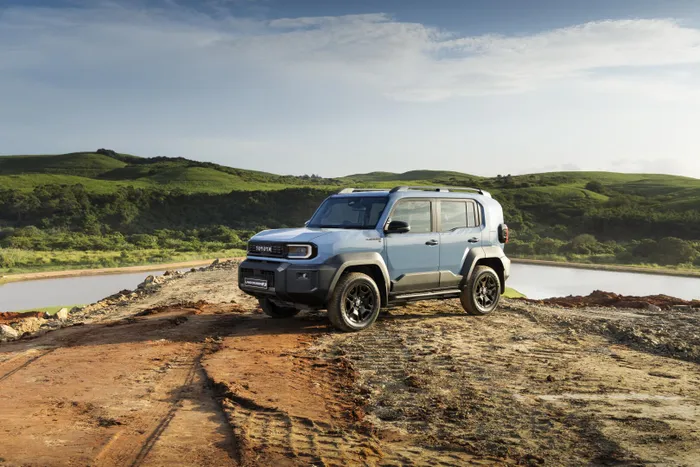
The Toyota Land Cruiser FJ is built on the company’s IMV architecture on which the Hilux and Fortuner are also built.
Image: Supplied
For as long as South Africans can remember, the Toyota Land Cruiser range has been synonymous with rugged capability and a go-anywhere attitude.
With cumulative global sales exceeding 12.4 million units across more than 190 countries and regions, the Land Cruiser has earned its reputation by enabling people to travel into some of the world’s harshest environments.
The 70-Series has been the mainstay of the naming convention and while it’s immensely capable let’s face it, they’re not the most comfortable and the interior won’t win any design awards soon.
The Prado and 300-Series raise the bar significantly, slotting it into the premium bracket in terms of features and pricing which puts it out of the average person’s reach.
We know the FJ as the V6-powered, curvy offroader with suicide doors which has been discontinued.
Toyota were at pains to explain that the FJ Cruiser was a stand-alone model and not part of the Land Cruiser stable.
This new Land Cruiser FJ is a Cruiser, designed and built with the Land Cruiser ethos and DNA front and centre.
The FJ is built on the company’s IMV architecture on which the Hilux and the Fortuner are also built.
It’s been refined and adjusted for the FJ to provide a more compact footprint and shorter wheelbase measuring 4 575mm in length, 1 855mm in width and has a wheelbase of 2 580mm.
Compared to the Land Cruiser Prado, the FJ is 350mm shorter, 125mm narrower and has a wheelbase that is 270mm shorter.
Toyota have used traditional Land Cruiser styling as a basis with a compact execution prioritising visibility, practicality and luggage space providing a lighthearted appeal.
It gets a prominent heritage-style Toyota grille, square LED headlamps and chunky split front bumpers. The wide stance, flared wheel arches and horizontal body lines as well as skid plates and black cladding provide an offroad bias appearance
The front and rear bumpers are designed so damaged sections can be replaced individually after off-road use, rather than replacing the entire bumper assembly.
A lower belt line improves outward visibility on technical trails, while roof rails, removable side steps and protective cladding add to its adventure-focused brief.
From the back the square design makes it look like something that could be placed on a moon buggy. There’s a side-opening tailgate and rear-mounted spare wheel that frees up additional cargo space inside the load area.
Colours include Platinum White Pearl, Attitude Black, Ash, Calcite Blue and Oxide Bronze.
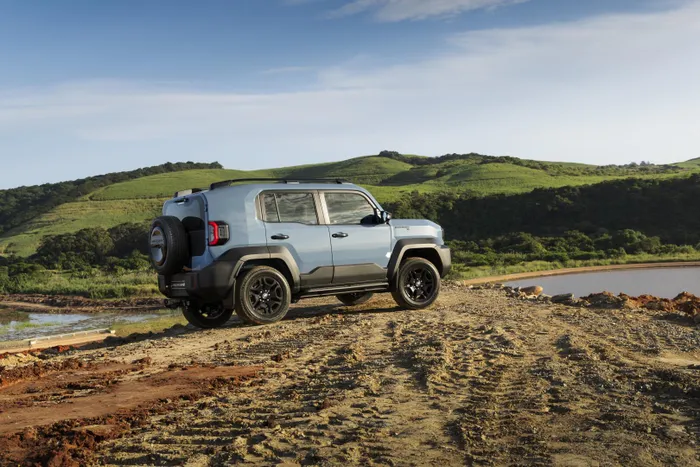
Toyota have used traditional Land Cruiser styling as a basis with a compact execution prioritising visibility, practicality and luggage space providing a lighthearted appeal.
Image: Supplied
Inside, the Land Cruiser FJ adopts a practical, user-focused cabin layout that Toyota calls “Functional Fun”.
A horizontal dashboard design helps drivers judge the vehicle’s positioning when tackling rough terrain, while physical temperature control buttons make the cabin easier to use in demanding conditions.
Unfortunately there isn’t a separate volume control dial so you have to adjust it on the steering wheel or on the touchscreen, something that not ideal when you’re bouncing around on a trail.
The eight-inch infotainment system still needs a wire to connect to Android Auto and Apple CarPlay and behind the steering wheel is a seven-inch TFT multi-information display.
It has a wide centre console and multiple storage areas throughout the cabin.
Cleverly, Toyota has added knee pads for improved comfort during off-road driving, along with a low-set instrument panel and logically positioned controls and gear lever.
The five-seat interior features split-folding rear seats that slide and recline, allowing owners to prioritise either passenger comfort or luggage space. Toyota says the load area has been designed with camping gear, outdoor equipment and active lifestyles in mind.
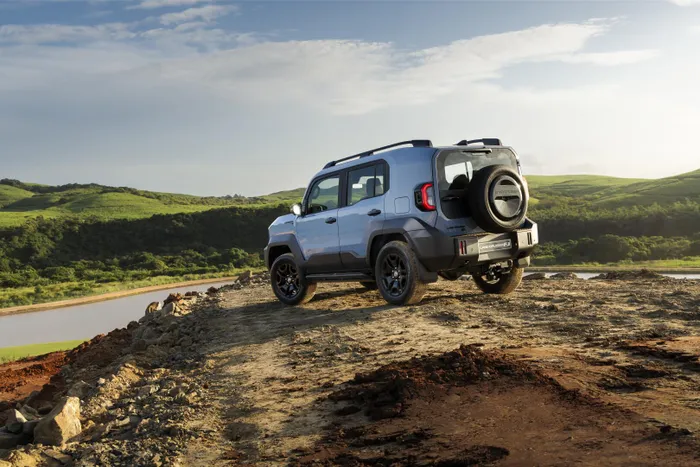
The Land Cruiser FJ is powered by a naturally aspirated 2.7-litre petrol engine, producing 122kW and 245Nm paired to a six-speed automatic transmission.
Image: Supplied
Powering the Land Cruiser FJ is Toyota’s naturally aspirated 2.7-litre petrol engine, producing 122kW and 245Nm paired to a six-speed automatic transmission featuring Toyota’s Super ECT technology.
According to Toyota, the drivetrain has been specifically calibrated to deliver smooth low-speed drivability, improved downhill control, enhanced throttle response, strong off-road traction and relaxed highway cruising.
A lower first gear improves climbing and traction performance, while a taller sixth gear supports fuel efficiency and reduced engine strain during long-distance travel.
The suspension setup consists of high-mount double wishbone front suspension and a four-link rigid rear suspension with a lateral rod.
It has a part-time four-wheel-drive system with selectable H4 and L4 modes, a rear differential lock, Downhill Assist Control (DAC), Hill-start Assist Control (HAC), ECT 2nd mode and Vehicle Stability Control.
Fuel consumption is rated at 10.7l/100 km which in real world use is highly unlikely.
During our launch drive we averaged 13.8l/100km which increased to 15l/100km on a short offroad drive that included low range.
The car had less than 300 kilometres on it when we drove it so there will be a slight improvement once everything is run and in and seated but fully loaded and towing it’s never going to be frugal.
One advantage of the engine is that it’s bullet proof and won’t have a hissy fit when petrol quality isn’t as it is supposed to be.
That’s good news once you cross our borders and enter remote areas.
The question on everyone’s lips is whether there is a diesel mill in the FJ’s future.
For now, the answer is no but Toyota South Africa are working furiously behind the scenes to make that happen.
There are two FJ variants: GX and VX.
Standard equipment across the range includes seven airbags, Vehicle Stability Control, Downhill Assist Control, a full-size spare wheel and an eight-inch infotainment system with six speakers.
The GX focuses on durability and practicality. Exterior details include black bumper mouldings, a matte black lower front guard and 17-inch dark grey alloy wheels. LED headlights have manual levelling.
Inside, the GX is fitted with black fabric seats, resin trim finishes and a urethane steering wheel. The VX adds a more premium and lifestyle-focused feel with larger 18-inch black alloy wheels and gains silver exterior detailing, along with LED headlights featuring auto levelling and Adaptive High Beam technology.
The cabin receives black synthetic leather upholstery, synthetic leather trim inserts and a leather steering wheel.
The biggest difference between the two are in the safety and driver assistance technology.
The VX is fitted with Toyota Safety Sense 3.0, adding features such as a Pre-Collision System, Adaptive Cruise Control, Lane Departure Alert and Adaptive High Beam System.
It also gains a Blind Spot Monitor, Panoramic View Monitor and additional parking assistance functions.
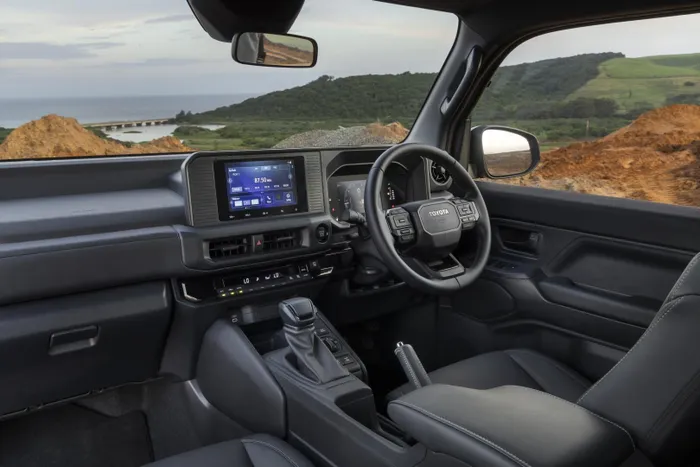
Inside, the Land Cruiser FJ adopts a practical, user-focused cabin layout that Toyota calls “Functional Fun”.
Image: Supplied
We drove the VX on launch in the Western Cape that included mostly highway driving and an offroad section on the Kloovenburg Wine & Olive Estate in Riebeek Kasteel.
Despite its shorter wheelbase, the FJ doesn’t feel in the least bit cramped and my driving partner and I, both taller than six foot, had ample space for our long legs which included the rear seats.
Driving a 4x4 Toyota with a petrol engine isn’t something we get to do often but I found the four cylinder 2.7 willing and responsive.
There’s no waiting for any turbo spooling and it quickly picks up speed.
The seating position is comfortable with decent lumbar support and the steering wheel is both rake and reach adjustable.
The gearbox is slick and changes cogs effortlessly although there was some hunting between fifth and six gears while using adaptive cruise control. We suspect though that once the car has a few thousand kilometres on it, it won’t be as pronounced.
There’s some engine noise in the cabin when accelerating hard but once it’s up to speed, it’s really quiet inside with virtually no wind or road noise testimony to the attention to its NVH levels, even with large side mirrors.
It’s a Cruiser, albeit a more compact version, so don’t expect zippy performance or sharp handling dynamics. Instead it’s made for long leisurely drives and because of its size, it will be just as adept with a family in the suburbs.
On the off-road course we were suitably impressed with its ability to take on some of the rougher stuff.
It wasn’t a grade four or five track but it gave enough of an indication of how capable it is.
In 4H up a slippery incline the traction control activates quickly meaning you’re unlikely to have any excessive wheel spin before it kicks in.
Using the Downhill Assist Control, feature we noticed how effective and quiet it was unlike some 4x4’s that sound as though there’s a bunch of small people running around with hammers.
Toyota is fully aware that owners like to customise and personalise their Land Cruisers and have developed a range of accessory options in collaboration with ARB and Toyota Genuine Accessories.
These include a snorkel, roof rack, skid plates, spare wheel garnish, mud flaps, side moulding garnish, luggage tray and a 12.3-inch Display Audio upgrade.
The Toyota Land Cruiser FJ comes with a nine-services/90,000km service plan (intervals at 10 000 km) and a three-year/100 000km warranty.
Service and warranty plan extensions are available through Toyota’s national dealer network.
Land Cruiser FJ 2.7 4x4 6AT GX : R714,000
Land Cruiser FJ 2.7 4x4 6AT VX: R761 400