

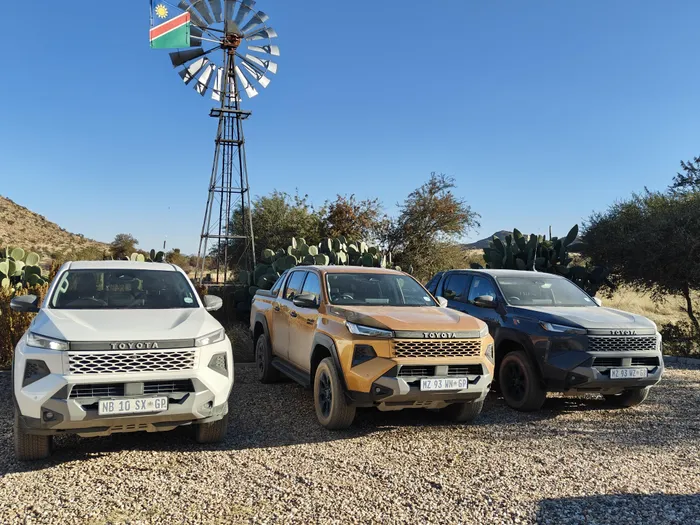
The most noticeable changes to the Toyota Hilux are found at the front, where the Hilux receives slimmer LED headlamps, a wider grille and revised bumper styling.
Image: Willem van de Putte
It’s been a long time coming but the ninth generation Toyota Hilux, that has been a fixture on our roads for 60 years, has rolled into showrooms and what better way to test the heavily revised South African icon than on the gravel roads in Namibia.
It’s a revelation to be sure and worth the wait, but before we get to that let’s see what changes have been incorporated including updated styling, a redesigned cabin, expanded safety technology and a 48-volt mild-hybrid option.
It may not be to everyone’s liking and keyboard warriors have been having a field day, but Toyota’s “Cyber Sumo” philosophy grows on you the more time you spend with it.
The most noticeable changes are found at the front, where the Hilux receives slimmer LED headlamps, a wider grille and revised bumper styling.
Toyota has also introduced new wheel designs, updated badging and revised lighting signatures, while the rear gains integrated access steps to make loading and unloading easier.
Redesigned tailgate detailing and LED rear lighting complete the visual updates.
Also, you know there are accessory outlets that are already designing bullbars that will change the front significantly.
The colours include Chromium Silver, Arizona Red, Oxide Bronze, Glacier Silver, White Pearl, Attitude Black, Desert Gold Metallic and Ash Grey.
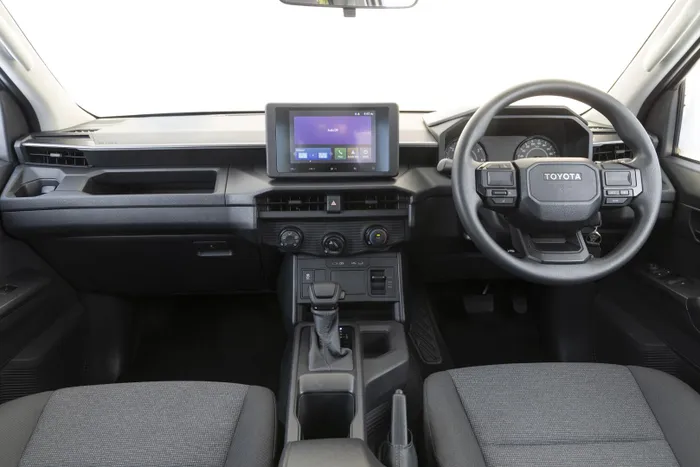
The redesigned dashboard features a stronger horizontal layout aimed at improving visibility and usability.
Image: Supplied
The biggest gripe of the outgoing model was the dated interior which has now been completely revamped.
The redesigned dashboard features a stronger horizontal layout aimed at improving visibility and usability.
Toyota has retained physical controls for key functions while introducing a more digital environment on higher-specification models.
The volume control however is adjusted by a button underneath the touchscreen and on bumpy roads this isn’t ideal although it can also be adjusted on the steering wheel.
Material quality has been upgraded, while storage areas have been reworked to better suit modern lifestyles. There are multiple USB-C charging points throughout the cabin.
Higher-grade derivatives feature a 12.3-inch digital instrument cluster paired with a 12.3-inch infotainment touchscreen. Wireless smartphone integration and wireless charging are also available.
There were one or two hitches to connect Apple CarPlay but once it had hooked up, it worked seamlessly.
I understand that users want modern digital interiors but personally, I preferred the analogue dials of the previous generation.
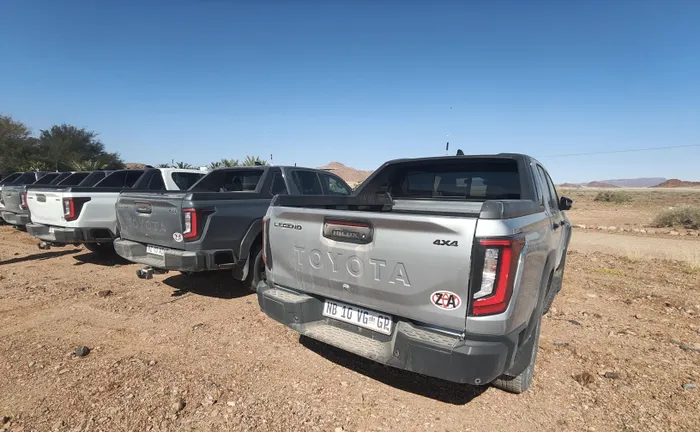
Toyota has also introduced new wheel designs, updated badging and revised lighting signatures, while the rear gains integrated access steps to make loading and unloading easier.
Image: Willem van de Putte
Connectivity has now become a major focus for the new Hilux.
Through Toyota Remote and the MyToyota application, owners can monitor vehicle status, lock and unlock the vehicle remotely, locate it, schedule services and receive maintenance reminders.
The system also incorporates roadside assistance access, geo-fencing, driver scoring and vehicle health monitoring.
Selected derivatives are equipped with Toyota Safety Sense 3, which includes adaptive cruise control, lane tracing assist, automatic high beam and an upgraded pre-collision system capable of detecting vehicles, pedestrians and cyclists.
For the first time on a Hilux, buyers can also specify Blind Spot Monitoring, Rear Cross Traffic Alert and Safe Exit Assist.
Toyota has further strengthened security by introducing Ultra Wide Band technology on Smart Entry-equipped models, designed to help prevent relay theft attacks.
Unchanged is Toyota's 2.8-litre four-cylinder GD-6 turbodiesel engine paired with a six-speed automatic transmission.
The engine produces 150kW and 500Nm in both rear-wheel-drive and four-wheel-drive configurations.
The flagship Legend derivatives introduce Toyota's 48-volt mild-hybrid system, which combines the diesel engine with an electric motor-generator and lithium-ion battery.
Power and torque outputs remain unchanged, but the system is designed to improve stop-start operation, low-speed responsiveness and overall refinement.
The mild-hybrid system incorporates an 8.5kW/65Nm motor generator together with a lithium-ion battery and DC/DC converter.
Toyota has also tweaked the calibration between engine, gearbox and the throttle, and while it still delivers the same power, it does feel a lot more responsive especially when accelerating.
Let’s face it, the Hilux was never known for its great handling characteristics which became more highlighted with the influx of new generation bakkies.
To address this, Toyota engineers implemented extensive changes to the suspension, steering and mounting systems.
Particular attention was paid to improving vehicle behaviour on gravel roads, a critical requirement for many South African and Southern African customers.
New suspension tuning, revised damping characteristics, updated bushings and structural enhancements including strengthening the chassis have contributed to improved ride quality, particularly on uneven surfaces.
New electric power steering delivers lighter low-speed manoeuvrability, improved steering precision and reduced driver fatigue.
Additional work on cabin and engine mounting systems helps reduce vibration and noise which created a noticeably more refined driving experience on almost 900 kilometers of mostly gravel roads.
The revised line-up consists of SRX, Raider X and Legend derivatives.
The SRX returns as a value-focused offering, while Raider X introduces additional technology and convenience features.
The Legend remains the flagship model and is the only derivative available with the mild-hybrid powertrain.
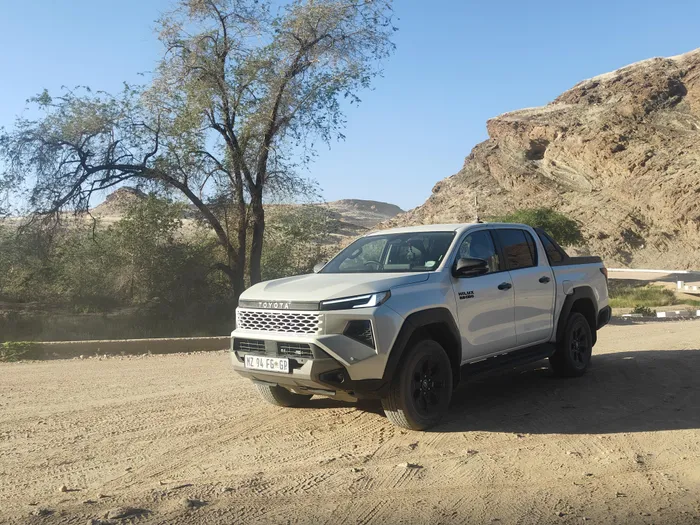
Unchanged is Toyota's 2.8-litre four-cylinder GD-6 turbodiesel engine paired with a six-speed automatic transmission.
Image: Willem van de Putte
Our route took us from Windhoek towards the desolate Solitaire and Sossusvlei area for two nights before heading to Walvis Bay for our flight back.0
The majority of the route was on gravel and in 4H and while most of those roads are in better condition than our secondary roads, corrugations and occasional washouts are inevitable.
I don’t think I’m exaggerating when I say that the changes that have been made are remarkable and have transformed the Hilux into a completely different class over its predecessor.
The steering is light and direct and provides decent feedback over various surfaces and the attention to noise, vibration and harshness is equally impressive.
Whereas the outgoing model would be a bouncing tail-happy affair over dirt and corrugations, the new one is solidly planted with no counter-steering to keep it going in the same direction needed.
Even at triple figure speeds it stayed the course and I think that was exactly what people wanted following the research Toyota had done before heading to the design tables.
The interior changes also add to the overall driving experience and after a few hours of driving there were no uncomfortable body maneuvers to keep the blood flowing.
There were one or two unexpected bumps along the way that resulted in some brief unplanned airtime but it landed smoothly and continued on its merry way.
The ninth generation Toyota Hilux is much more refined both in terms of interior, technology, safety and handling dynamics.
It’s everything that people have been asking for which Toyota has delivered in bucket loads.
Toyota’s best-selling position in the bakkie sales war was never really threatened and with this ninth generation Hilux, expect more of the same.
It is sold with a three-year/100,000km warranty and a nine-service/90,000km service plan, with service intervals set at 10,000km.
The mild-hybrid battery fitted to the Legend derivatives is covered by an eight-year/195,000km warranty.
Xtra Cab
2.8 GD-6 RB Raider X 6AT: R751,800
2.8 GD-6 4x4 Raider X 6AT: R842,200
Double cab
2.8 GD-6 RB SRX 6AT: R658,500
2.8 GD-6 4x4 SRX 6AT: R746,100
2.8 GD-6 4x4 Raider X 6AT: R892,900
2.8 GD-6 RB Legend 6AT MHEV: R945,500
2.8 GD-6 4x4 Legend 6AT MHEV: R999,900
Pricing for the ninth-generation Hilux Single Cab range will be announced during the third quarter of 2026.
It is sold with a three-year/100,000km warranty and a nine-service/90,000km service plan, with service intervals set at 10,000km.
The mild-hybrid battery fitted to the Legend derivatives is covered by an eight-year/195,000km warranty.