

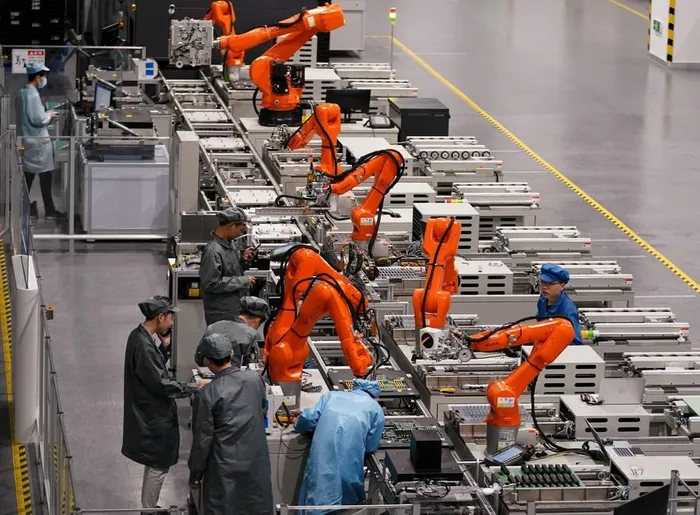
Manufacturing businesses are embracing AI, but industry experts say funding models must evolve to support digital transformation and improve competitiveness.
Image: Xinhua
South Africa's manufacturing small and medium enterprises are being encouraged to adopt artificial intelligence and smart manufacturing technologies at a pace that suits their businesses, but industry experts say access to the right type of funding will determine how quickly that transition happens.
The call comes as manufacturers face mounting pressure to modernise production while navigating weaker output, rising costs and growing customer expectations around digital compliance and traceability.
South Africa's manufacturing sector contributes close to 11% of the country's gross domestic product and was one of only three industries to create jobs during the first quarter of 2026.
However, the sector has also recorded two consecutive quarters of contracting output, placing additional pressure on businesses to improve efficiency and competitiveness.
Speaking during the Industry 4.0 panel on artificial intelligence, digitalisation, automation and smart manufacturing at the 2026 Manufacturing Indaba, Lula Product Manager Koreshini Pillay said many manufacturers focused first on the technology rather than the financing required to make digital transformation possible.
"Manufacturing SMEs start conversations about smart manufacturing by focusing on the technology. Every system upgrade, sensor and traceability platform, however, comes with an upfront cost, with a return that follows months down the line," Pillay said.

Lula Product Manager Koreshini Pillay
Image: Supplied.
She said the bigger challenge was finding funding that reflected the realities of manufacturing cash flow rather than traditional lending models.
"The question facing the market is what it costs to modernise, and who funds this transition. Most manufacturers are told to approach IDC for expansion or SEFA for guarantees, but neither solves it. Materials and technology costs land now, while the revenue they unlock only arrives months later. Underwriting has to draw on real time transaction data and the pattern of the SME's inflows so that working capital can be structured around the reality of the production floor."
Research also suggests AI adoption is already well underway among South African businesses.
The News24 x Lula Small Business Survey, based on responses from 1,088 SME owners in January this year, found that more than two thirds of South African businesses either use AI daily or are actively experimenting with the technology.
Manufacturers are increasingly using AI to modernise production lines, reduce waste and improve operational efficiency while meeting growing customer requirements for digital traceability and compliance.
However, timing remains one of the biggest obstacles.
Manufacturers typically begin preparing inventory during the second half of the year for peak retail, wholesale and logistics demand in September, October and November. This means businesses must invest in equipment, software, cybersecurity systems, machinery upgrades and employee training months before revenue is generated.
According to Pillay, delays in accessing funding can ultimately affect a manufacturer's ability to secure future contracts and remain competitive.
"There are multiple cost categories sitting within this modernisation gap," she said, adding that sensors, monitoring systems, software licences, machinery retrofits, cybersecurity, traceability platforms and skills development all compete for limited capital.
Lula Chief Credit and Capital Officer Garth Rossiter said traditional lending models often failed to recognise the unique cash flow cycle of manufacturing businesses.
"Traditional banks love to look at last year's spreadsheets and historical financials, but that's just not how a factory actually runs," Rossiter said.
"If a business owner is spending cash on raw materials in July but won't see any revenue until November, they need funding that understands that gap. Modernising your operations isn't optional anymore. It's survival. The manufacturers who win are the ones finding finance partners that match the real world rhythm of their trade."
Rossiter said funding products built around predictable cash flow could help manufacturers invest in technology without placing unnecessary pressure on working capital.
Lula said it has funded more than 3,300 manufacturing businesses, providing more than R3 billion in advances to date. Manufacturers receive an average advance of R203,000, making the sector the company's second largest by value of funding disbursed.
Rossiter said rapid access to finance could determine whether manufacturers successfully modernise or lose opportunities to competitors.
"When a manufacturer can get funding the exact moment an opportunity strikes, they don't have to put their plans on ice," he said.
"You stop just talking about upgrading and actually do it. That quick access is the difference between having a growth plan on paper and actually scaling in the real world."
Industry stakeholders believe that financing solutions tailored to manufacturing cycles could play a key role in helping SMEs embrace AI, improve productivity and strengthen South Africa's industrial competitiveness.
Follow Business Report on Facebook, X and on LinkedIn for the latest Business and tech news.