

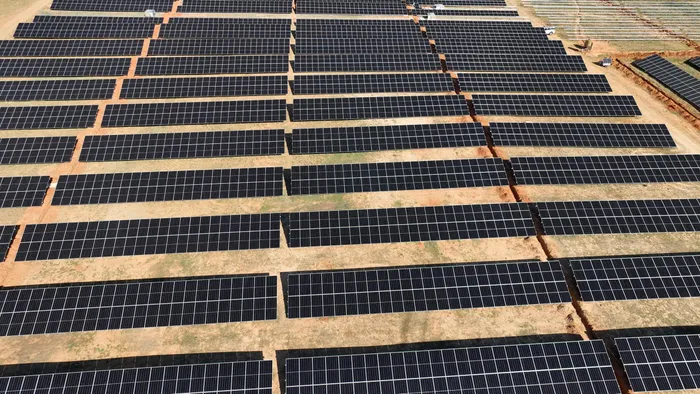
Belle Rive Farm is building South Africa's largest off grid agricultural solar and battery system, aiming to secure uninterrupted power for more than 2,000 hectares of farming operations.
Image: Supplied.
A major commercial farming operation in the Free State is investing in what is expected to become South Africa's largest off grid agricultural solar and battery energy storage installation, as rising electricity costs and the need for uninterrupted power continue to reshape the country's farming sector.
RenEnergy has been appointed as the engineering, procurement and construction contractor for the project at Belle Rive Farm, where a 4.89 megawatt peak solar photovoltaic array will be paired with a 20 megawatt hour battery energy storage system.
The installation, currently under construction, will provide electricity across more than 2,000 hectares of farmland through approximately 17 kilometres of medium voltage reticulation, allowing the farm to operate independently of the national electricity grid.
Based on available market data and supplier intelligence, the 20 megawatt hour battery system is believed to be the largest privately contracted, purpose built battery energy storage installation supporting an off grid agricultural operation in South Africa.
According to GreenCape's 2025 Market Intelligence Report, South Africa's commercial, industrial and agricultural behind the meter energy storage market is expected to stabilise at around 400 megawatt hours of new installations annually. Belle Rive Farm's project alone represents about 5% of that annual deployment.
The investment comes as commercial farmers face sustained increases in electricity tariffs. Eskom tariffs for direct customers increased by 12.74% in April 2025 after increases of 18.65% in 2023 and 12.72% in 2024. A further increase of 8.76% took effect on 1 April 2026.
Electricity accounts for about 6% of national agricultural production input costs, although the figure is significantly higher for farms that rely heavily on irrigation, cold storage and processing facilities.
Belle Rive Farm owner Stanley de Beer said the decision to move off grid was driven by the need for greater certainty and operational resilience.
"We had reached a point where the question wasn't whether to invest in energy independence, but how quickly we could make it happen. Our operations run across a large area of farmland. There's no room for power interruptions when you're managing cold storage and irrigation at this scale. This installation gives us the certainty to plan and operate without that exposure."
Belle Rive Farm produces seed potatoes, ware potatoes, pecan nuts, onions and maize, all of which depend on continuous electricity to support irrigation systems, cold rooms, packhouses and processing infrastructure during critical production periods.
RenEnergy said the project required a highly customised engineering approach rather than a standard commercial design.
The company analysed half hourly electricity consumption across multiple supply points, assessed seasonal energy demand and evaluated major farming equipment before determining the optimal system size.
Juandré Pitout, Head of Business Development at RenEnergy, said the complexity of powering a farming operation of this size required a fundamentally different approach.
"Delivering a 20 megawatt hour off grid system across more than 2,000 hectares of active farmland is not a standard brief. Commercial agriculture has a fundamentally different demand profile to logistics or manufacturing. It is seasonal, operationally critical, and unforgiving of interruptions."
He said the battery system was designed to maintain essential farm operations throughout the night and during extended periods of cloudy weather without relying on diesel generators or Eskom.
"What makes Belle Rive significant is not just the scale of the battery energy storage system, but what that scale has to do. Keep cold chain, irrigation, and processing running continuously across a farm of its size. This is what genuine energy independence looks like for South African agriculture."
The project reflects a broader shift across South Africa's commercial farming sector as businesses increasingly view renewable energy infrastructure as a long term strategic investment rather than simply an operating expense.
GreenCape projects that the commercial, industrial and agricultural behind the meter storage market will reach a cumulative installed capacity of two gigawatt hours by 2030, driven by falling battery costs, continued electricity tariff increases and the growing need for reliable power.
For large farming operations such as Belle Rive, the economics are becoming increasingly compelling as solar power combined with battery storage becomes cost competitive with grid electricity while also reducing dependence on expensive diesel generation during power disruptions.
The project also highlights how energy security is becoming a key competitive advantage for South Africa's agricultural sector, enabling farms to protect production schedules, safeguard cold chain operations and improve long term business sustainability.
Follow Business Report on Facebook, X and on LinkedIn for the latest Business and tech news.