

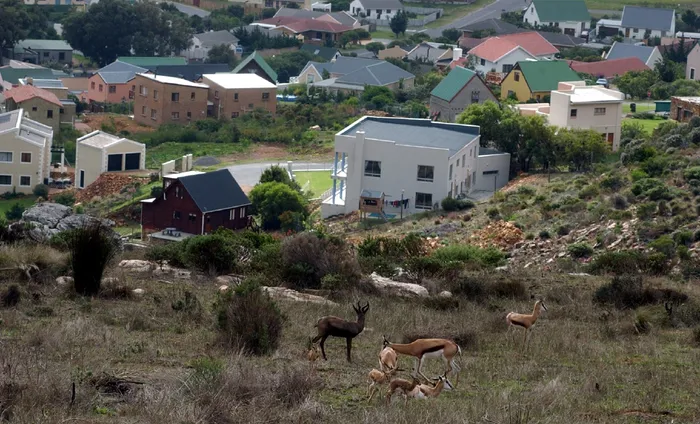
SPRINGBOKS AT THE SOLOLE GAME RESERVE. PIC ELON LESTRADE. 17-06-2004. STORY HELE Township and rural economies continue to face challenges driven by apartheid spatial planning, poor infrastructure, limited investment, weak coordination and persistent inequality.
Image: Leon Lestrade
South Africa's economic geography remains deeply shaped by apartheid spatial planning, with economic opportunities still concentrated in metropolitan areas decades into democracy.
The National Youth Development Agency (NYDA) says that many township and rural communities continue to struggle with inadequate infrastructure, poor transport links, fragmented land-use planning, and limited productive investment.
The agency says that these inequalities continue to affect almost every aspect of young people's economic participation.
Young people living in townships and rural areas often pay higher transport costs to reach jobs, experience weaker digital connectivity, face greater barriers to accessing finance, and operate in smaller consumer markets.
These challenges reduce business competitiveness and make it harder for enterprises to grow.
According to the NYDA, the Draft Township and Rural Economy Development and Revitalisation Policy represents an important step towards building inclusive local economies that promote entrepreneurship, industrial development, investment and job creation in historically disadvantaged communities.
The agency says that township and rural economies continue to face structural challenges caused by apartheid spatial planning, poor infrastructure, weak institutional coordination, limited investment and persistent inequality.
"These challenges continue to undermine the competitiveness and sustainability of township and rural enterprises, particularly small, medium and micro enterprises."
The NYDA has submitted comments and recommendations on the draft policy, calling for a stronger focus on youth development.
It wants practical measures that expand youth entrepreneurship, improve access to finance, create more procurement opportunities, strengthen digital innovation and position young people as drivers of local economic transformation.
The NYDA agrees that infrastructure is one of the biggest drivers of local economic development, but says that it should be viewed more broadly than roads, water and electricity.
"A modern township and rural economy requires integrated economic infrastructure comprising reliable electricity, quality transport networks, broadband connectivity, digital infrastructure, serviced industrial and commercial land, business incubation facilities, logistics and warehousing infrastructure, innovation hubs and shared production facilities for small enterprises."
The agency says that investment in economic infrastructure should be treated as an economic development strategy that improves productivity, lowers business costs and attracts private investment.
It also argues that spatial transformation must extend beyond physical infrastructure by aligning housing, transport, enterprise support, skills development, industrial growth and municipal services.
"Only through coordinated planning across all spheres of government can township and rural economies realise their full productive potential."
The NYDA says that it broadly supports the Draft Township and Rural Economy Development and Revitalisation Policy and commends the Department of Small Business Development for developing a framework to strengthen local economic development and support small businesses.
It welcomes the policy's recognition of barriers including inadequate infrastructure, weak institutional coordination, limited access to finance, poor market linkages and low investment.
The agency also supports the policy's focus on:
According to the NYDA, if implemented effectively, the policy could become a transformative tool for expanding economic opportunities for millions of young South Africans.
The agency says that township and rural economies have significant untapped potential. They are home to millions of people, support extensive informal economic activity and present opportunities in manufacturing, agriculture, tourism, creative industries, digital services and innovation.
It believes that coordinated public policy, better infrastructure, improved access to finance, stronger market opportunities and skills development could turn these local economies into major drivers of inclusive growth and employment.
In June, Vukile Property Fund said that its R19.5 billion South African portfolio of township, rural, urban and commuter malls serves some of the country's strongest consumer markets.
In Commercial Real Estate Trends for South Africa in 2026, released in December last year, John Jack said that township and rural shopping centres owned by Vukile and Exemplar continue to record strong trading density growth and lower vacancy rates, supported by resilient consumer demand.
Meanwhile, Izak Odendaal says that the cost and availability of housing in Cape Town remain a growing concern.
In a LinkedIn post, he said that the debate mirrors those taking place in major cities around the world, where affordability, gentrification, tourism and development often collide.
"The solution is simple but not easy: build more housing."
Odendaal said that demand remains high because Cape Town is a city where many people want to live.
Referring to Deutsche Bank's Mapping the World's Prices report, he noted that Cape Town rents are now comparable with cities such as Bangkok, Mumbai and Istanbul, and are higher than Johannesburg.
However, he said the city remains relatively affordable compared with places such as Dubai, Melbourne and Vancouver, leaving room for what he described as "lifestyle arbitrage."
Independent Media Property