

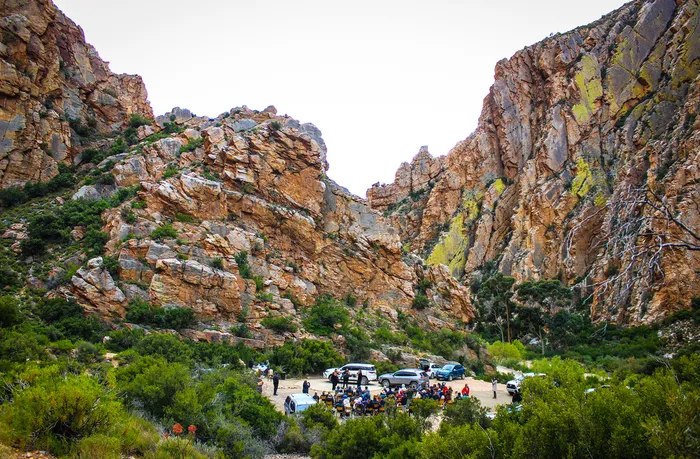
Agricultural Business Chamber of South Africa (Agbiz) said that Karoo farmers are experiencing a welcome boost due to favourable rainfall.
Image: File
Karoo farmers are poised for a strong year after exceptional rainfall across large parts of the region replenished grazing lands, boosted livestock production and reduced feed costs, according to the Agricultural Business Chamber of South Africa (Agbiz).
Agbiz chief economist Wandile Sihlobo on Thursday said the favourable rainfall received across the Karoo and Kalahari this year has created some of the best farming conditions seen in decades, offering significant financial relief to livestock producers who have endured repeated drought cycles.
“Commercial agriculture typically takes place on freehold land in South Africa. Freehold (private title deeds) farmland makes up 77.5 million hectares of South Africa’s surface area – or roughly 63%.”
South Africa’s agricultural sector spans a wide range of activities, including grain production, horticulture and livestock farming. However, extensive sheep and cattle farming dominates much of the country’s semi-arid interior.
According to Sihlobo, freehold farmland accounts for about 77.5 million hectares, or 63% of South Africa’s total surface area. Of that, 44.5 million hectares, representing 57% of the country’s farmland, are located in the Karoo and Kalahari regions.
“It is here that extensive livestock production takes place (mutton, lamb, wool, mohair, and cattle – largely in the Kalahari). For this reason, rainfall, the timing of rainfall, and the quality of natural grazing are critical to the financial well-being of farmers in this vast part of South Africa,” he said.
This year’s rainfall has been particularly beneficial because of both the volume and timing of precipitation.
Sihlobo said areas across the Karoo, including Beaufort West, Laingsburg, Graaff-Reinet, Middelburg, Britstown, Carnarvon, Victoria West, Williston, Brandvlei and Sutherland, had received exceptional rainfall.
The Kalahari has also benefited significantly, with the Kuruman River flowing again after years of drought. He said that there is something special about this year’s rainfall in the Karoo beyond the record totals that most farmers have highlighted.
“It was the timing and frequency. Regular (weekly) rainfall between 10 and 25 mm in March, April, May, and June is fantastic and has a much bigger impact on grazing quality than 100 mm in January or February.”
The improved grazing conditions have already translated into better livestock performance.
Sihlobo said sheep farmers are reporting strong lambing rates, healthier ewes and faster-growing lambs as a result of abundant natural grazing.
“The ewes are producing many lambs, the udders of the ewes are full, and the lambs gain weight very quickly. The only other year in recent history with similar fantastic conditions was 1974/75, which remains the wettest on record,” he said.
“On some farms, we see fountains, springs, and rivers running for the first time in the lifetime of these farmers.”
The rainfall has also replenished groundwater reserves and soil moisture levels, strengthening the sector’s resilience against potential dry conditions in the future.
Sihlobo said that if an El Niño weather pattern develops next year, many Karoo farmers would be better positioned to withstand its effects because of the current abundance of water and vegetation.
One of the biggest financial benefits for farmers is the sharp reduction in feed costs.
“The biggest benefit brought by the rains and the subsequent improvement in vegetation is that farmers do not have to buy any feed. Considering the current higher wool and lamb prices, we expect farm profits in the Karoo to get a well-needed boost.”
Higher wool and lamb prices have been supported by drought-related production challenges in Australia, one of the world’s largest sheep-producing countries, as well as sustained demand from China.
“What is more important is to note that all lambs produced and slaughtered in the Karoo will have access only to natural Karoo veld vegetation this year,” Sihlobo said.
“So, every lamb produced in 2026 should automatically have complied with the requirements for the Karoo Lamb Geographical Indication, provided the farm is in the Karoo region and registered with the Department of Agriculture.”
Bennie van Zyl, general manager of TLU SA, welcomed the development, saying improved grazing conditions are critical for livestock farmers.
“The main factor for them is feed for livestock to be productive and so this is good news that there is favourable rainfall and more grazing area for livestock,” he said.
BUSINESS REPORT