

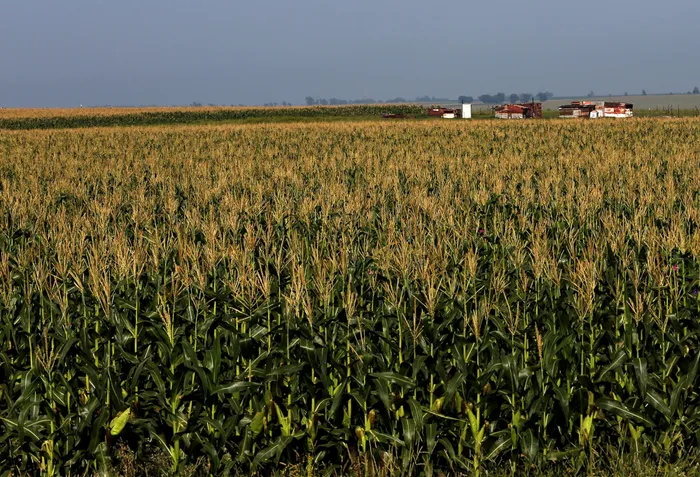
Agricultural Business Chamber of South Africa (Agbiz) has raised concern that despite South Africa expecting a record maize harvest in the 2025/2026 season, late summer has led to the maize crop being 17% behind last year’s pace.
Image: File
South Africa is on track to produce a record maize harvest of 17.1 million tons in the 2025/26 season, but agricultural experts have warned that persistent late-summer rains have significantly delayed harvesting, creating challenges for farmers and raising concerns about the upcoming planting season.
According to the Agricultural Business Chamber of South Africa (Agbiz), maize deliveries to commercial silos remain well behind last year's pace, even as crop prospects remain exceptionally strong.
Agbiz chief economist Wandile Sihlobo said South Africa's agricultural sector is set to benefit from one of its most productive seasons in recent years, driven by favourable La Niña weather conditions and increased planting activity by farmers.
“Maize is prominent in agricultural discussions not only as a staple grain but also as an indicator of field-crop conditions. If we have an ample maize crop, it is usually fair to assume that other crops are also in good condition,” Sihlobo said.
He noted that the maize crop planted in October 2025 and currently being harvested is expected to reach a record 17.1 million tons. Larger harvests are also anticipated for other grains, oilseeds, fruits and vegetables.
“We see larger harvests of other grains, vegetable oils, fruits, and vegetables. The primary catalysts are the favourable La Niña rains and farmers’ determination to plant on a slightly larger area.”
However, harvesting has progressed more slowly than normal due to unusually prolonged rainfall that continued through May.
“In the week of 5 June 2026, farmers had delivered to commercial silos about 2.1 million tons of maize (white and yellow maize). This is 17% behind last year’s pace,” Sihlobo said.
“The main reason for the delayed harvest is the prolonged summer rains, which continued through to May 2026.”
The delays have been particularly evident in areas where planting was postponed by more than a month because excessive soil moisture prevented farmers from entering fields earlier in the season.
Despite the setbacks, Sihlobo said recent assessments indicate that crop conditions remain favourable across key producing regions.
“In my recent drive across the Free State and North West provinces, I also observed, from a distance, that in much of these provinces, the maize crop is looking favourable, and that aligns with what we had already heard from farmers and the Crop Estimates Committee, which provides the crop forecast for the country,” he said.
Encouragingly, crop quality has so far exceeded expectations despite concerns that excessive moisture could damage grain quality.
“In wet years, maize or crop quality is a challenge. But this year, we are not hearing much of that. In fact, of the 2.1 million tons of the expected 17.1 million tons that farmers have delivered to commercial silos, about 94% are first grade or excellent quality.”
If quality levels remain high throughout the harvest, farmers could avoid some of the financial pressures experienced during the previous season, when excessive moisture resulted in quality downgrades and lower prices for producers.
“The slightly poor quality, although it generally has minimal impact on the ultimate maize availability and food prices in the country, does weigh on farmers’ incomes, as they receive a slightly lower price for their products,” Sihlobo said.
While the bumper harvest is expected to support domestic food security and keep maize supplies ample, Agbiz is already looking ahead to risks facing the 2026/27 production season.
“The one major challenge is higher input costs and the anticipated El Niño drought,” he said.
The delayed harvest is also creating practical difficulties for farmers attempting to bring crops out of the fields and transport them to storage facilities.
Bennie van Zyl, general manager of TLU SA, said excessive rainfall has left some maize fields waterlogged, making harvesting operations extremely difficult.
“Last year, we had approximately 5 million tons of maize that stood over this year. We're going to have a crop of 17 million tons again. It's very complicated at this stage to foresee what will be in the future,” he said.
“But we for sure have this year a very challenging year for the farmers to get their crop harvested and then to get it at the silos. Because in certain areas, the roads are also washed away.”
BUSINESS REPORT