

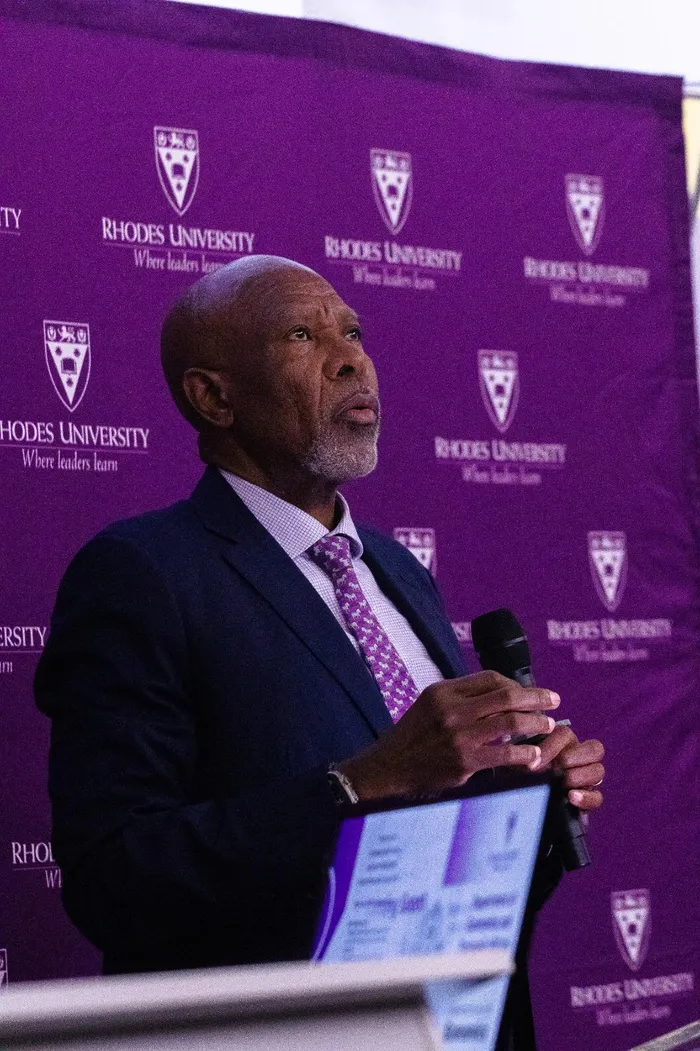
South African Reserve Bank (Sarb) Governor Lesetja Kganyago speaking at a public lecture at Rhodes University on Monday night.
Image: Supplied
South African Reserve Bank (Sarb) Governor Lesetja Kganyago has cautioned that interest rate decisions remain finely balanced as policymakers confront rising inflation risks triggered by global supply shocks, while striving to protect the country’s new 3% inflation target.
Speaking at a public lecture at Rhodes University on Monday night, Kganyago made it clear that while South Africa entered the current crisis from a position of relative strength, the path for monetary policy has become increasingly uncertain.
The Sarb last month opted for caution, keeping interest rates unchanged at 6.75% as escalating tensions in the Middle East inject fresh uncertainty into the inflation and growth outlook.
“We came into this shock with inflation at our new 3% target. The policy stance was reasonably well-calibrated, so we did not need to make urgent changes,” he said.
However, the global environment has since deteriorated, with the Middle East conflict and disruptions to oil supply routes—particularly the Strait of Hormuz—driving a sharp rise in fuel prices and heightening broader inflation risks.
As a small, open economy and a net oil importer, South Africa remains vulnerable to global shocks beyond its control.
But Kganyago emphasised that credible and disciplined monetary policy remains the country’s best defence. He stressed that monetary policy cannot directly counter such supply-side shocks in the short term.
“Our interest rate tool does not change global oil prices – and it also operates with a lag,” he noted, explaining that rate decisions mainly influence inflation over a longer horizon rather than immediate price spikes.
Instead, the central bank’s focus is on preventing so-called second-round effects, where initial price increases spread more broadly through the economy via wages, expectations and general pricing behaviour.
“The problem is that inflation does not always fall when the shock passes. Instead, inflation can be persistently higher,” Kganyago warned. “Second-round effects mark the process through which a one-off shock mutates into consistently higher inflation, which becomes entrenched as the new normal.”
This risk has placed the Sarb in a delicate position. While inflation expectations have improved, they are not yet firmly anchored at the new 3% target, which was only introduced within the past year.
At the same time, financial conditions have already tightened without formal rate hikes. Kganyago pointed out that market expectations for rate cuts have reversed in recent months, effectively raising borrowing costs.
“Markets were pricing in rate cuts this year but have now dropped those expectations,” he said. “This is some implicit tightening, even without the Sarb raising rates.”
Despite this, Kganyago stopped short of signalling a clear rate path, emphasising instead the importance of flexibility in an unpredictable environment.
“Given the risks to inflation and the uncertainty, it makes sense for us to keep our options open,” he said. “We are not going to pre-commit to a path and give up optionality.”
Kganyago acknowledged that the central bank may still need to act if inflation pressures broaden, particularly if multiple shocks begin to overlap.
Fuel price increases are already significant, and potential risks to food prices—linked to higher fertiliser and diesel costs, as well as possible drought conditions—could intensify the situation.
“We are experiencing the biggest jump in fuel price inflation in the history of inflation targeting,” Kganyago noted, underscoring the scale of the current shock.
In navigating these challenges, the Sarb is relying on a scenario-based approach, assessing a range of possible outcomes and adjusting policy accordingly. Previous projections included scenarios where rates remain unchanged, rise moderately, or increase more sharply depending on how inflation evolves.
Kganyago reiterated the Sarb’s unwavering commitment to price stability, even if that requires difficult decisions on interest rates.
“Although we cannot do much about higher inflation right now, we are very committed to getting inflation back to 3%, just where we had it before the shock hit,” he said.
He also acknowledged that any future rate hikes would be aimed at preserving long-term economic stability rather than reacting to short-term volatility.
“If we do have to raise rates, it will be to sustain low and stable inflation, and all the benefits that brings,” Kganyago said.
BUSINESS REPORT