

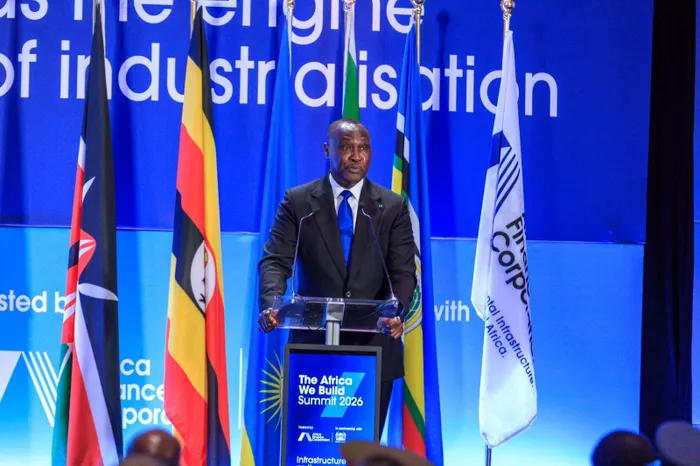
President and CEO of the Africa Finance Corporation, Samaila Zubairu, speaking at the "Africa We Build Summit" in Nairobi, Kenya, last week.
Image: Supplied
The ongoing tensions in the Middle East are expected to influence investment decisions across Africa’s energy sector, but leaders at the Africa Finance Corporation (AFC) have said the impact will vary widely depending on countries’ energy profiles and existing projects.
Responding to concerns about how the crisis could shape AFC’s strategy, Sameh Shenouda, executive director and chief investment officer, last week stressed that projects already underway remain largely insulated from immediate disruption.
However, Shenouda said rising global shipping and insurance costs are beginning to affect the economics of projects still under construction.
“There is a potential impact from increased shipping rates and higher insurance costs,” Shenouda noted, adding that these risks had been anticipated and are being actively managed.
The broader implications of the crisis, however, extend far beyond project-level challenges.
According to AFC’s chief economist, Rita Babihuga-Nsanze, Africa is experiencing the fallout through three primary transmission channels: energy dependence, trade disruptions, and fertilizer supply constraints.
Babihuga-Nsanze said the most immediate and widespread effect is being felt in energy markets.
A large portion of African countries rely heavily on imported fuel, with many sourcing supplies routed through the Strait of Hormuz—a critical global shipping lane now under heightened geopolitical risk. Countries in eastern and southern Africa are particularly exposed to disruptions along this route.
“This is fundamentally an energy shock,” Babihuga-Nsanze explained. “Even where fuel remains available, higher prices will feed into inflation, raising transport costs and the broader cost of living.”
The situation is further complicated by the limited strategic petroleum reserves held by many African nations. Babihuga-Nsanze said countries with low reserves face a higher risk of supply shortages, while those with more substantial buffers may be better positioned to weather short-term volatility.
At the same time, the crisis is reshaping global trade flows. Shipping disruptions around the Suez Canal have forced many vessels to reroute via the Cape of Good Hope, significantly increasing transit times and costs. This has led to delays in imports and exports, particularly affecting countries on Africa’s eastern seaboard.
While some African ports could benefit from diverted shipping traffic, the continent’s infrastructure is not yet fully equipped to handle such shifts. For example, Kenya’s Port of Lamu has seen anecdotal increases in activity, but also faces congestion challenges due to limited capacity.
A third, less visible but equally critical channel is fertilizer supply. The Middle East plays a key role in global fertilizer production and distribution, and disruptions along key shipping routes are constraining access for African importers. This is particularly concerning for eastern Africa, where local production is limited and agricultural systems depend heavily on imports.
“These supply constraints could have knock-on effects on food security,” Babihuga-Nsanze warned, noting that reduced fertilizer availability may impact crop yields and exacerbate existing vulnerabilities.
Despite these near-term risks, AFC leadership emphasized that the الأزمة also presents a strategic opportunity for Africa. In the medium to long term, the current disruptions could accelerate investment in domestic energy infrastructure, including refineries, storage facilities, and fertilizer production plants.
“The way we see it, this is a wake-up call,” Babihuga-Nsanze said. “It highlights the urgency for African countries to build resilience by adding value to their natural resources and reducing dependence on imports.”
For resource-rich nations, particularly those that export oil, gas, or minerals, the crisis may even provide a temporary windfall through higher global commodity prices. However, for net importers, the immediate outlook remains challenging, with inflationary pressures and potential supply constraints likely to persist.
Ultimately, AFC maintained that its investment approach will remain adaptive, balancing short-term risk management with long-term development goals. By focusing on projects that enhance energy security, industrial capacity, and regional integration, the foundation aims to turn a global crisis into a catalyst for sustainable growth across the continent.
BUSINESS REPORT