

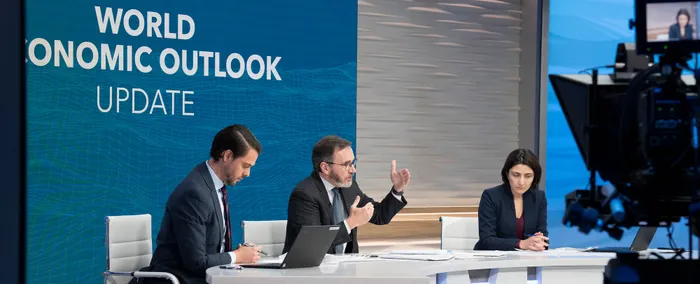
IMF chief economist, Pierre Olivier Gourinchas (middle) and Deniz Igan, division chief of the IMF Research Department (right) with moderator, Jose Luis de Haro (left) from the IMF Communications Department. Gourinchas said the conflict had abruptly altered the global trajectory.
Image: IMF Photo/Kim Haughton
The International Monetary Fund (IMF) has downgraded its global growth outlook for 2026 to 3.1%, down from 3.3% projected in January, as escalating conflict in the Middle East disrupts energy markets and threatens to derail economic momentum.
In its latest World Economic Outlook update released on Tuesday, the IMF warned that what had been a resilient global recovery is now facing a significant setback, with risks tilted firmly to the downside.
The downgrade comes after the outbreak of war in the Middle East in late February, which has led to the closure of the Strait of Hormuz—a critical artery for global oil supplies—and damage to key energy infrastructure.
These developments have raised the prospect of a major supply shock with far-reaching consequences for inflation, trade, and financial stability.
IMF chief economist Pierre-Olivier Gourinchas said the conflict had abruptly altered the global trajectory.
“The global outlook has abruptly darkened following the outbreak of war in the Middle East,” he noted, adding that the disruption could trigger “an energy crisis on an unprecedented scale.”
Prior to the conflict, the IMF had been preparing to revise its growth forecasts upward, supported by strong investment in technology, easing trade tensions, and supportive financial conditions. However, the war has overwhelmed these positive trends, forcing a reassessment of the global outlook.
According to the IMF’s reference scenario, which assumes the conflict remains relatively short-lived, global growth will slow to 3.1% in 2026, while inflation is expected to rise to 4.4%, reversing part of the recent disinflation trend.
The Fund warned that the impact of the shock will be transmitted through three main channels: higher commodity prices, rising inflation expectations, and tightening financial conditions.
Together, these forces are expected to weigh on demand, disrupt supply chains, and erode purchasing power globally.
Gourinchas emphasised that higher energy prices represent a classic negative supply shock, increasing costs across sectors ranging from transportation to food production.
“Higher commodity prices are a textbook negative supply shock… disrupting supply chains, lifting headline inflation, and eroding purchasing power,” he wrote in an accompanying blog.
The IMF also outlined more severe downside scenarios. In an adverse case—where the conflict persists longer and energy prices rise further—global growth could fall to 2.5%, with inflation climbing to 5.4%.
In a worst-case scenario involving prolonged supply disruptions and unanchored inflation expectations, growth could slow to around 2%, bringing the global economy close to recession territory.
The economic fallout is expected to be uneven across regions. Energy-importing countries, particularly low-income and developing economies with limited fiscal buffers, are likely to be hardest hit.
Meanwhile, even energy exporters in the Gulf region face losses from damaged infrastructure, reduced production, and weaker tourism activity.
Beyond the immediate shock, the IMF cautioned that the conflict is unfolding in an already fragile global environment marked by rising geopolitical tensions and a shift toward a more fragmented, multipolar world.
Gourinchas highlighted the broader implications, noting that war imposes “extremely high and persistent economic costs” and creates difficult policy trade-offs for governments.
He urged policymakers to prioritise a swift resolution to the conflict, describing it as the most effective way to limit economic damage.
In the meantime, central banks should remain vigilant to prevent inflation expectations from becoming unanchored, while governments should avoid costly and poorly targeted fiscal interventions such as broad energy subsidies.
Instead, the IMF recommends targeted and temporary support measures for vulnerable households, alongside policies that preserve price signals and maintain fiscal discipline.
Despite the downgrade, the Fund stressed that the global economy retains some resilience, supported by technological innovation and potential productivity gains from advances in artificial intelligence.
However, these longer-term positives are unlikely to offset the near-term risks posed by the conflict.
“The world economy faces yet another difficult challenge,” Gourinchas said, warning that while global fragmentation may increase, international cooperation remains essential to safeguarding growth and stability.
With uncertainty surrounding the duration and intensity of the conflict, the IMF concluded that risks to the outlook remain “tremendous,” underscoring the fragile state of the global economy as it navigates yet another major shock.
BUSINESS REPORT