

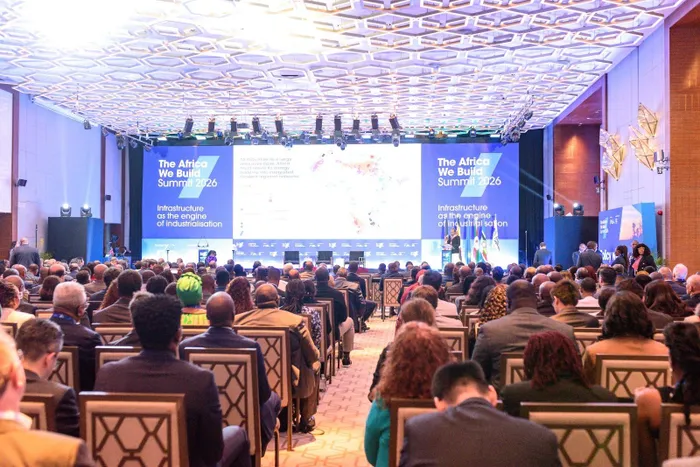
The Africa We build Summit underscored a growing consensus: Africa’s future growth will depend less on raising new capital and more on deploying existing resources efficiently.
Image: Supplied
Africa is entering a pivotal phase in its development journey, with domestic capital now outpacing external financing flows and reshaping how the continent funds its infrastructure and industrial ambitions.
This is according to the Africa Finance Corporation’s (AFC) "State of Africa’s Infrastructure Report 2026" (SAIR 2026), released on Thursday.
The report reveals that Africa’s non-bank domestic capital pools have surpassed $2 trillion—exceeding the roughly $1.7trln in cumulative external financing flows recorded between 2014 and 2024.
This marks a structural turning point, signalling that the continent is no longer primarily dependent on foreign capital to drive growth. Instead, the challenge has shifted.
“The constraint is no longer capital—it is intermediation,” said Samaila Zubairu, President and CEO of AFC, at the launch during The Africa We Build Summit.
“We have the savings, but not yet the systems to channel them into infrastructure and industry at scale. Closing that gap is now Africa’s most important economic task. The next phase of Africa’s infrastructure story must move beyond standalone assets towards integrated systems.”
The summit underscored a growing consensus: Africa’s future growth will depend less on raising new capital and more on deploying existing resources efficiently.
The report argues that building robust financial systems, investment pipelines and risk-sharing mechanisms is now the continent’s most urgent economic priority.
Domestic institutional capital has been a major driver of this shift. Pension and insurance assets alone have crossed the $1trln mark for the first time.
Public development banks hold $276 billion in assets, while sovereign wealth funds account for $164bn. Central bank reserves have also grown, rising from $480bn in 2024 to $530bn in 2025.
A notable trend is the increasing role of gold in reserves. Gold now represents approximately 17% of total reserves, up from less than 10% just a few years ago, reflecting both global uncertainty and strategic diversification.
Despite this growth, much of Africa’s capital remains locked in low-risk, short-term investments such as government securities.
The report identifies this as a critical bottleneck, with limited bankable projects and regulatory constraints preventing funds from flowing into long-term infrastructure and industrial development.
At the same time, external financing sources are becoming less reliable. Official development assistance declined from $83.8bn in 2020 to $73.5bn in 2023 and is expected to fall further.
Sovereign bond issuance has also dropped sharply—from over $29bn in 2018 to just $4–6bn annually in recent years—while foreign direct investment has stagnated at around $45–55bn per year.
This evolving landscape means external capital is increasingly playing a complementary role rather than serving as the foundation of Africa’s development model.
Lerato Mataboge, Commissioner for infrastructure, energy and digitisation at the African union, said
"Infrastructure systems should move beyond fragmentation and begin to operate as coherent, connected platforms that support production, trade and resilience," she said.
"We don't have joint infrastructure planning between countries. We need to address this gap by making it mandatory for countries planning infrastructure to consider the regional impact."
SAIR 2026 highlights that the greatest opportunity now lies in integrated infrastructure systems. Rather than isolated projects, the report advocates for interconnected ecosystems linking energy, transport, digital networks and industrial demand.
In East Africa, this approach is already taking shape. The Port of Mombasa handles over 45 million tons of cargo annually, supported by expanding rail corridors such as the Naivasha–Kisumu line.
Aviation is also emerging as a key growth driver, contributing an estimated $5.5bn to GDP across Kenya, Rwanda and Ethiopia, while supporting around one million jobs.
Energy integration is another priority area. Projects like the Ethiopia–Kenya power interconnector demonstrate how cross-border systems can enhance efficiency and reliability, enabling power to flow where it is needed most.
However, the report warns that Africa remains vulnerable to external shocks due to fragmented systems.
The continent still imports over 70% of its refined fuel and faces an annual import bill of around $230bn for essential goods, including food, fertiliser and industrial inputs.
In digital infrastructure, while connectivity has improved significantly, gaps remain in backbone networks, data centres and enterprise platforms—elements critical for translating access into economic productivity.
Kenyan President William Ruto emphasised the importance of aligning Africa’s financial strength with its development ambitions.
“Africa has the resources and the potential to finance its own transformation,” he said at the summit. “What we must now do is build the systems that ensure this capital works for our people and our economies.”
The report concludes that Africa’s development challenge is no longer about scarcity of capital, but about coordination, execution and institutional capacity. Unlocking the continent’s full potential will depend on its ability to connect finance with real-economy investments at scale.
As Zubairu put it, “Africa is not capital-poor—it is capital-rich but system-poor.”
BUSINESS REPORT