

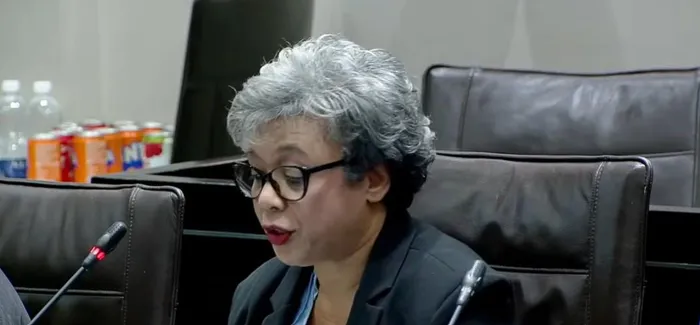
Transnet Group CEO Michelle Phillips and other executives appeared before the Standing Committee on Public Accounts on Tuesday.
Image: Parliament YouTibe screengrab
Transnet Group CEO Michelle Phillips has painted a stark picture of the State-owned logistics company’s challenges, telling Parliament that years of infrastructure decline, rising debt, and governance failures have combined to undermine both operational performance and South Africa’s broader economic growth.
This comes after a report on the audit outcomes of Transnet tabled before Parliament last month revealed that the group was facing mounting financial and operational pressures, with rising debt, missed volume targets and a growing maintenance backlog casting doubt over the sustainability of its turnaround efforts.
Appearing before the Standing Committee on Public Accounts on Tuesday, Phillips said Transnet’s difficulties were the result of “a convergence of factors” that have created a self-reinforcing cycle of operational and financial decline across rail and port operations.
“We’ve seen a convergence of infrastructure deterioration, equipment shortages, governance failures and financial constraints, which has impacted not only the sustainability of the organisation but also its performance and the growth of the South African economy,” Phillips said.
She noted that these challenges do not operate in isolation but instead compound one another, reducing network capacity, limiting investment and weakening Transnet’s ability to fulfil its national mandate.
Among the key issues highlighted were deteriorating rail infrastructure, a shortage of operational locomotives and escalating security threats.
Phillips revealed that at one point, 377 locomotives were out of service, severely constraining volumes and revenue generation.
“We do not make money if the track is not working and if locomotives are not available,” she said.
Security challenges have also intensified, with cable theft and vandalism surging dramatically.
“Over the past five years, we’ve seen a 179% increase in security incidents and more than a 1,000% increase in cable theft,” Phillips told MPs.
Financial strain has further compounded the crisis. Transnet’s debt ballooned from R73.1 billion in 2012/13 to R134.5bn by 2015/16, while finance costs rose from R6.1bn to R9.1bn over the same period. The entity has since struggled to bring debt below the R130bn mark.
This debt burden, combined with declining volumes, has weakened cash generation and limited the company’s ability to invest in critical infrastructure and equipment.
Phillips also pointed to the fallout from the controversial 1,064 locomotive procurement programme, linked to R42.9bn in irregular expenditure, with many of the locomotives still not operational due to spare parts constraints.
Operational performance has similarly declined over time. Freight volumes dropped from a peak of 226.3 million tons in 2017/18 to 149.5 million tons in 2022/23, before showing modest recovery to 167.8 million tons in the latest financial year.
Phillips said government intervention has been critical in stabilising the entity, including the provision of a R46bn guarantee facility and additional support through the Budget Facility for Infrastructure, which has allocated about R14bn in grant funding for key projects.
However, she emphasised that these measures are not sufficient on their own, with structural reform now central to Transnet’s recovery strategy.
“The scale of the impact underscores the necessity for coordinated operational, financial and structural interventions,” she said, adding that Transnet has aligned its strategy with government’s freight logistics roadmap as a condition for continued support.
Dr Andrew Shaw, Transnet's chief strategy and planning officer, outlined the policy framework underpinning these reforms, highlighting the shift toward greater private sector participation and increased competition in the rail sector.
“The National Rail Policy created the opportunity for competition on the rail network by allowing private operators to access and operate on the network in a structured way,” Shaw said.
He explained that Transnet has begun separating rail infrastructure from operations, establishing a Rail Infrastructure Manager to oversee network access while enabling third-party operators to apply for slots.
The reforms are further supported by the Freight Logistics Roadmap, adopted by Cabinet in 2023, which aims to boost economic growth, expand network capacity and shift freight from road to rail.
“The roadmap provides a clear direction for expanding capacity, improving infrastructure and enabling private sector participation in a very managed way,” Shaw said.
He added that early progress has already been made, with 11 private train operating companies identified as potential participants in the network.
Meanwhile, Phillips acknowledged that Transnet’s recovery will take time but insisted that the combination of policy reform, infrastructure investment and private sector involvement offers a viable path forward.
“The decline was systemic in nature, and its reversal requires a coordinated and sustained effort,” she said.
BUSINESS REPORT