

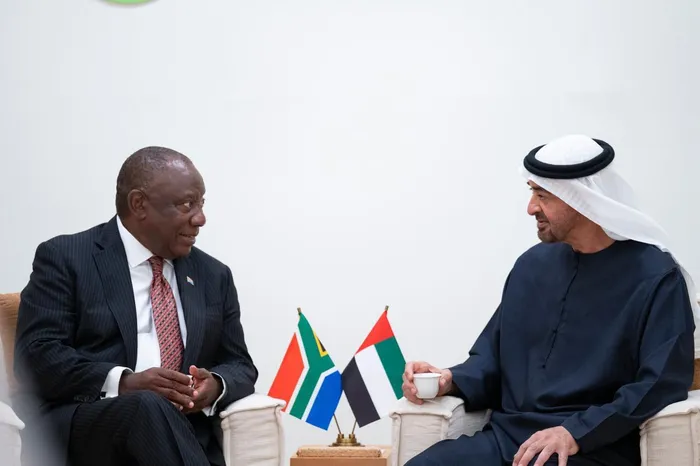
President Cyril Ramaphosa in January held a bilateral meeting with His Highness Sheikh Mohamed bin Zayed Al Nahyan, President of the United Arab Emirates on the margins of the 2026 Abu Dhabi Sustanability Week.
Image: GCIS
By Lebina Ditha
At a time of heightened geopolitical tension, much of the global focus has been on fragmentation — shifting alliances, disrupted trade routes and growing regional instability. Less attention has been paid to the steady deepening of economic ties between the Gulf and Africa.
Recent developments suggest that the relationship is gaining weight.
In January 2026, South African President Cyril Ramaphosa travelled to Abu Dhabi at the invitation of Sheikh Mohammed bin Zayed Al Nahyan to attend Abu Dhabi Sustainability Week. He was accompanied by senior ministers responsible for trade, international relations, the Presidency, and justice — a delegation that reflected clear economic priorities.
Addressing world leaders at the summit, Ramaphosa stated: “Infrastructure development in Africa is going to explode by leaps and bounds and on the back of energy generation and good financing, we will be able to see higher levels of growth. I invite you to come to the African continent and invest there. That is where the future is.”
The remarks captured a broader shift in how African governments are positioning the continent within the global economy.
For the UAE, the relationship has deeper roots. Speaking at the 39th African Union Summit in Addis Ababa in February 2026, UAE Minister of State Sheikh Shakhbout bin Nahyan Al Nahyan stated: “Our engagement with Africa is rooted in decades of trade, maritime links, and people-to-people connections across the Red Sea and Indian Ocean corridors.”
Those links are now expanding in scale.
The South Africa-UAE trade reached R8.77 billion, approximately $509.6 million, in January of this year, with South Africa retaining a positive trade balance of R1.23bn, around $71.8m. During this period, mineral products amassed 62.7% of total imports. Conversely, iron and steel products accounted for 28.5% of total imports as reported by Sars. This alone highlights SA’s import dominance in energy and supporting materials, through trade and investment with the UAE.
The UAE’s mineral and energy trade relationship with the rest of the continent is further corroborated by Masdar's focus. In 2023, it committed $10bn to renewable energy projects across Africa, targeting 10 gigawatts of capacity by 2030.
The scale of demand remains significant. As Ramaphosa noted at the 2026 Africa Energy Indaba, around 600 million people across the continent still lack reliable electricity — a constraint that continues to limit economic expansion and industrial development.
African policymakers have been clear about the type of partnerships required. At the Africa Energy Indaba, the Minister of Electricity and Energy, Dr Kgosientsho Ramokgopa, stated: “If the world is serious about tripling nuclear capacity by 2050, Africa must be central to that ambition. That requires financing structures aligned with developmental realities. It requires multilateral institutions to move decisively from policy eligibility to implementation. It requires vendor nations to integrate localisation, skills transfer and industrial participation into comprehensive partnerships. Africa’s development project requires firm, clean and sovereign power at scale.”
Elements of that approach are increasingly visible in the UAE’s engagement. Nearly 40% of its foreign assistance over the past decade — approximately $21bn — has been directed towards African countries, with a growing emphasis on technology, skills development and knowledge transfer. The latter is supported by the $1bn investment into the AI for Development initiative, announced at the G20 leadership Summit in November.
As Sultan Mohammed Al Shamsi noted: “The initiative builds structured corridors of cooperation, beginning with foundational digital and AI infrastructure in priority sectors such as health, agriculture, logistics, digital government, and financial services. These corridors are co-designed with African governments to ensure that UAE technical, financial, and operational capabilities are directly aligned with local development strategies.”
Trade policy is evolving alongside this. The UAE has concluded Comprehensive Economic Partnership Agreements with countries including Nigeria, the Democratic Republic of Congo, Sierra Leone, Angola and Kenya. These agreements extend into services, digital trade and investment protection, and sit alongside the African Continental Free Trade Area in shaping regional value chains.
There is also increasing alignment at a multilateral level. In a joint statement issued in January 2026, the African Union Commission and the UAE reaffirmed their shared commitment to Agenda 2063, recognising the link between peace, security, trade and long-term development.
At the AU Summit, Sheikh Shakhbout stated: “Africa is a continent that will not only be a new centre of growth, but a cornerstone of the economic ambitions around the world.”
That framing reflects a wider shift in how Africa is being positioned in global economic terms. This deepening relationship is unfolding against a backdrop of regional instability.
Engagement has continued across investment, infrastructure and trade, with activity on the ground remaining consistent. Africa’s demographic growth, urbanisation and resource base continue to attract long-term capital. The UAE has moved early and at scale. In a global environment defined by short-term volatility, that consistency is increasingly notable.
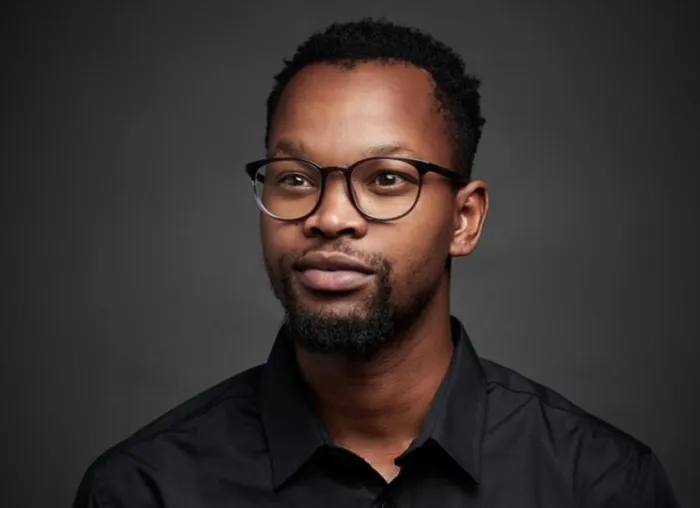
Lebina Ditha is the market lead in South Africa for Global Advisors.
Image: Supplied
* Lebina Ditha is the market lead in South Africa for Global Advisors.
** The views expressed do not necessarily reflect the views of IOL or Independent Media.
BUSINESS REPORT