

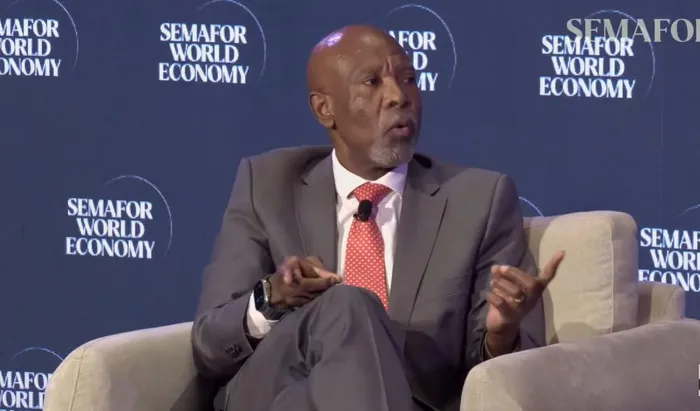
South African Reserve Bank (Sarb) Governor Lesetja Kganyago speaking at the Semafor World Economy Summit in Washington D.C. on Thursday.
Image: Semafor YouTube screengrab
South African Reserve Bank (Sarb) Governor Lesetja Kganyago has signalled that interest rate hikes remain a possibility as global shocks, particularly from rising oil and fertiliser prices linked to geopolitical tensions, threaten to spill over into broader inflation across the economy.
Speaking at the Semafor World Economy Summit in Washington D.C. on Thursday, Kganyago warned that while central banks typically “look through” temporary shocks, the current environment presents a more complex challenge, with multiple overlapping pressures that could entrench inflation if left unchecked.
“What matters when you have a shock like this is that, classically, you look through the shock and then respond only to second-round issues,” Kganyago said. “The problem with the shock is that it’s not just one shock—it’s a sub-shock.”
His remarks come against the backdrop of heightened global uncertainty, including conflict in the Middle East, which has already pushed oil prices higher and raised concerns about supply disruptions.
However, Brent crude prices plunged 10% to below $90 per barrel on Friday, hitting near five-week lows after Iran’s Foreign Minister Abbas Araghchi announced that the Strait of Hormuz is now fully open to commercial traffic during the temporary 10-day ceasefire period.
The move boosted optimism that one of the most severe global energy supply disruptions in recent history may be easing
Kganyago noted that oil prices remain a key assumption in the Sarb’s policy framework and will be closely reassessed in upcoming deliberations.
However, he emphasised that the risks go beyond fuel. Fertiliser prices, which are also sensitive to global supply chains and geopolitical developments, could have a direct and more persistent impact on food inflation.
“For fertiliser, it’s directly into food prices,” he said. “In the second half of the year, when our planting season comes back, that feeds into food prices.”
Kganyago said the combination of higher fuel and food costs could trigger second-round effects, where initial price increases begin to influence wages, transport costs and broader price-setting behaviour across the economy. It is these second-round pressures that typically prompt a central bank response.
“For us as a central bank, our function is to make sure that the impact of the shock is only transient and not persistent,” Kganyago said. “Because if it becomes persistent, we run the risk of inflation becoming entrenched.”
While the Reserve Bank has previously been on a rate-cutting path, Kganyago’s comments suggest a more cautious stance, with policymakers ready to act if inflation expectations begin to drift away from the target.
South Africa’s inflation target range remains anchored to 3%, with a tolerance band of 1 percentage points on either side over the next two years in a bid to ease the elevated cost of living on consumers.
In January, the Reserve Bank left its benchmark lending rate unchanged at 6.75%, translating to the prime lending rate also staying the same at 10.5%,
South Africa’s inflation rate eased further in February, slowing to 3% in February from 3.5% in January, offering continued relief to consumers and reinforcing expectations of a stable interest rate environment, at least in the near term.
Kganyago indicated that in an adverse scenario, inflation could move toward the upper end of the range, raising the likelihood of a policy response.
“We assess the risks to inflation to be on the upside,” he said. “For the rest of the year, we must do what is prudent.”
Although he stopped short of explicitly committing to rate hikes, Kganyago made it clear that the Sarb would not hesitate to act if there are signs that inflation pressures are broadening beyond initial shocks.
“We are constantly looking for any evidence that might start emerging that would suggest that the second round could kick in,” he said.
The governor also highlighted the importance of inflation expectations in shaping monetary policy decisions, noting that once businesses and consumers begin adjusting prices and wages in anticipation of higher inflation, it becomes significantly harder to contain.
“That tells us that pricing has moved beyond the shock,” he explained.
Kganyago’s comments underscore the delicate balancing act facing the Reserve Bank: supporting economic recovery while guarding against a resurgence in inflation driven by external shocks.
BUSINESS REPORT