

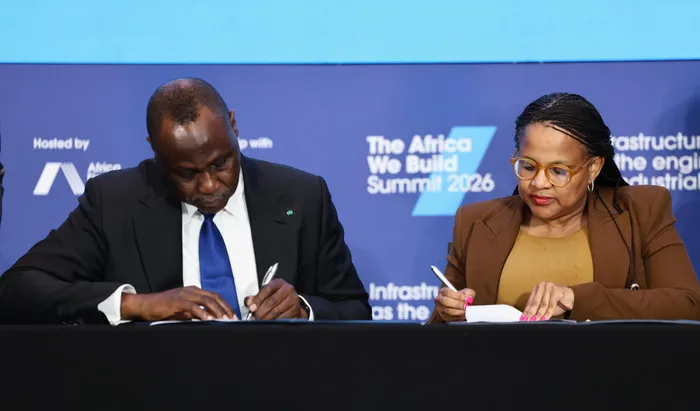
Samaila Zubairu, President and CEO of Africa Finance Corporation (AFC) and Boitumelo Mosako, CEO of the Development Bank of Southern Africa (DBSA) during the signing ceremony at The Africa We Build Summit in Nairobi on Thursday.
Image: Supplied
The Development Bank of Southern Africa (DBSA) has committed to join Africa Finance Corporation (AFC) in financing the $750 million (around R12 billion) Infrastructure Climate Resilient Fund (ICRF) in a bid to accelerate climate adaptation and sustainable infrastructure across Africa.
As part of this commitment, the DBSA on Thursday confirmed it will invest R300 million in the Fund, which is managed by AFC Capital Partners (ACP), the asset management arm of AFC.
The fund is designed to embed climate resilience into infrastructure projects from conception through to operation—an approach increasingly seen as essential as Africa faces intensifying climate shocks.
Announced in Nairobi at the "Africa We Build Summit", the agreement marks a significant step toward scaling climate adaptation finance across the continent.
Climate-related disruptions are already costing African economies between 2% and 5% of GDP annually, while adaptation needs are estimated to reach as much as $50 billion per year.
Climate change, such as rising temperatures, infrequent precipitation patterns and flooding, is threatening existing, and crucial yet-to-be-built, infrastructure in sub-Saharan Africa – a region already challenged by infrastructure that is low in quantity, quality, and accessibility.
It is also heightening pre-existent investment barriers thereby putting at risk an entire region's opportunity of economic growth and development.
DBSA’s commitment to the fund signals growing alignment among African financial institutions to treat climate-resilient infrastructure as a viable and necessary asset class.
DBSA CEO Boitumelo Mosako noted that climate shocks are advancing faster than available financing, leaving vulnerable communities disproportionately exposed.
"Africa does not have the luxury of waiting. Climate shocks are outpacing adaptation finance, and vulnerable communities continue to bear the greatest burden," Mosako said.
"This partnership with the Africa Finance Corporation sends a clear signal that development finance institutions are pooling their mandates, capital, and risk appetite to achieve what neither institution can accomplish alone."
The fund has already attracted strong backing from global and regional investors, including a $253m commitment from the Green Climate Fund—its largest equity investment in Africa to date—alongside participation from the European Investment Bank, the Nigeria Sovereign Investment Authority, and several African pension funds.
The ICRF aims to bridge a long-standing financing gap by mobilising both public and private capital into projects that can withstand extreme weather and shifting environmental conditions.
Structured as a blended finance vehicle, the ICRF combines concessional funding with commercial investment to reduce risk and unlock private capital. This approach addresses one of the key barriers to climate adaptation projects in Africa: the difficulty of financing resilience measures that may not deliver immediate financial returns but are critical for long-term sustainability.
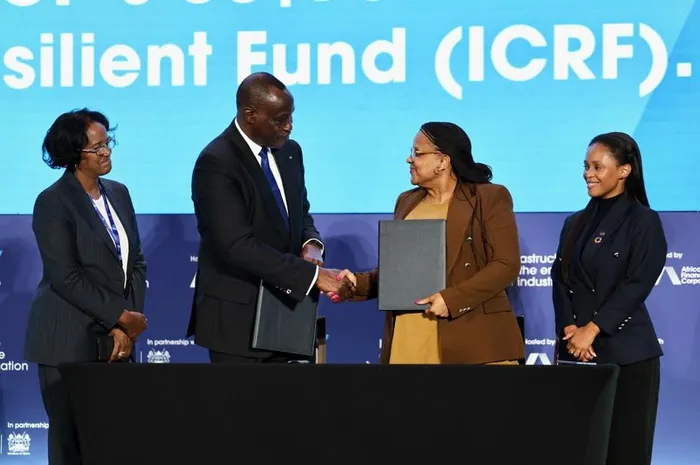
Samaila Zubairu, President and CEO of Africa Finance Corporation (AFC) and Boitumelo Mosako, CEO of the Development Bank of Southern Africa (DBSA) during the signing ceremony at The Africa We Build Summit in Nairobi on Thursday.
Image: Supplied
AFC President and CEO Samaila Zubairu described the fund as a direct response to the continent’s pressing infrastructure challenges. He emphasised that building resilience into infrastructure systems is no longer optional but essential for economic stability and growth.
"ICRF is our response to a defining challenge—ensuring Africa’s infrastructure is built to withstand the growing impacts of climate change," Zubairu said.
"We are therefore pleased to welcome DBSA as a key partner for the Fund. Their participation reflects strong African institutional alignment and marks a significant milestone in a partnership we look forward to deepening in the years ahead."
The fund will target key sectors central to Africa’s development trajectory, including renewable energy, transport and logistics, digital infrastructure, and industrial development. These sectors are not only vital for economic expansion but also for enabling a transition to low-carbon growth while strengthening resilience across national economies.
A distinctive feature of the ICRF is its rigorous investment framework. Each project will undergo comprehensive climate risk screening, factoring in both physical risks—such as extreme weather events—and transition risks linked to emissions and regulatory changes. This lifecycle approach ensures that resilience is not an afterthought but a core design principle.
The Green Climate Fund is expected to play a catalytic role by providing first-loss capital and technical support for climate risk assessments. This de-risking mechanism is intended to crowd in additional institutional investors, amplifying the fund’s overall impact.
In total, the ICRF is expected to mobilise up to $3.7bn in financing and support a portfolio of 10 to 12 infrastructure projects across Africa. Beyond individual projects, the initiative aims to set a new benchmark for how infrastructure is planned and delivered on the continent—prioritising durability, sustainability, and adaptability in the face of climate uncertainty.
BUSINESS REPORT