

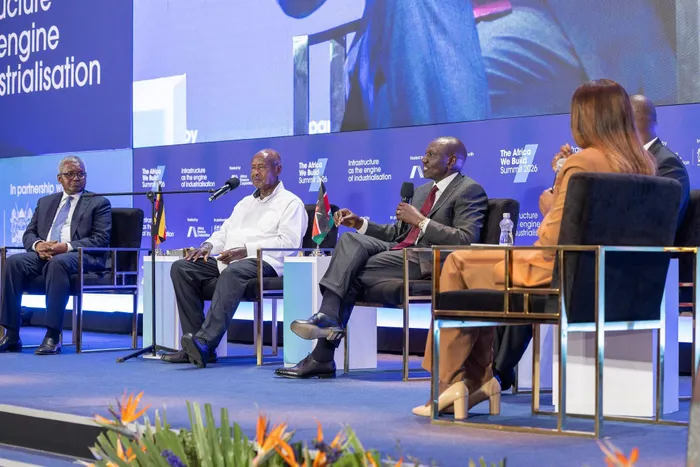
Dangote Group chairman and CEO Aliko Dangote (left), Uganda President Yoweri Museveni (centre) and Kenya President William Ruto, during a presidential panel discussion at the Africa We Build Summit in Nairobi on Thursday.
Image: Supplied
East African leaders have thrown their weight behind a proposed mega crude oil refinery in Tanzania, as governments across the region move to back billionaire industrialist Aliko Dangote in a project aimed at transforming Africa’s energy landscape.
Speaking at the "Africa We Build Summit" in Nairobi on Thursday, Kenya President William Ruto and President of Uganda Yoweri Museveni signaled strong political support for the refinery, which is expected to be built in the City of Tanga, Tanzania, within the next four to five years.
The project, spearheaded by the Dangote Group, is part of a broader push to reduce Africa’s dependence on imported refined fuel and instead process its own crude oil within the continent.
Dangote confirmed his commitment to the plan, telling the summit that he is ready to replicate the scale of his Nigerian refinery project in East Africa if governments align behind the initiative.
“My commitment here today is that if we agree with the three or four governments here about the refinery, we will lead and make sure that that refinery is built within the next four or five years,” he said.
The proposed facility is expected to mirror the scale of the Dangote refinery in Nigeria, which is undergoing expansion to reach 1.4 million barrels per day by 2028. Such capacity would position the East African refinery among the largest in the world and significantly deepen regional fuel supply.
The Iran war has exposed Africa's vulnerability to fuel chokepoints and is heading for a 86 million tonne fuel shortfall by 2040. Africa imports over 70% of its refined fuel and some $230 billion (R3.8 trillion) worth of essential goods, including fuel, food, plastics, steel, and fertiliser each year.
Ruto emphasized that the refinery represents a shift in thinking among African leaders, who are increasingly prioritizing regional cooperation and long-term industrialization over short-term national interests.
“The solution to the challenges we have is not out there—it is with us,” Ruto said. “We must take the lead ourselves. Others can only come to support us.”
Ruto highlighted ongoing discussions among regional governments to jointly develop the refinery, noting that it would integrate oil resources from multiple countries, including Kenya, Uganda, South Sudan and the Democratic Republic of Congo.
“We are discussing that we are going to have a joint refinery. It will benefit all of us,” he said, adding that existing pipeline infrastructure linking Kenya and Uganda could be leveraged to distribute refined products across the region.
The Kenyan leader also pointed to the importance of difficult policy decisions in driving industrial growth, citing Uganda’s ban on the export of raw minerals as an example of leadership aimed at promoting value addition.
The proposed refinery project comes at a critical time for Africa, where many countries continue to face fuel shortages, high import costs and limited refining capacity. Despite abundant oil reserves, the continent still exports crude and imports refined products at a premium—a model Dangote has repeatedly criticized.
Museveni reinforced this approach, outlining Uganda’s strategy to process its natural resources domestically and contribute crude supply to the regional refinery.
“Our strategy is very clear,” Museveni said. “We shall build a small refinery, which we have planned. This was for the internal market of Uganda and for the parts of Tanzania and parts of Kenya, which are near Uganda because of the transport costs. But the surplus oil shall contribute to the East Africa.”
Uganda is currently developing a $4bn, 60,000-barrel-per-day oil refinery in Kabaale, aimed at starting operations by 2029/2030. A new deal with UAE-based Alpha MBM Investments, with a 60% stake, is targeting a Final Investment Decision in July 2026, while the Uganda National Oil Company holds 40%.
Museveni stressed that ownership of the refinery should reflect the region’s shared resources, arguing that it must not be limited to coastal states alone but include oil-producing countries as stakeholders.
He also made a broader case for industrialization, criticizing the export of unprocessed raw materials. Using gold as an example, he said value addition can more than double revenues while creating jobs locally.
“It is really a criminal to export unprocessed raw materials,” he said, underscoring the need for vertical integration across African economies. I cannot allow the export of unprocessed raw material from Uganda.”
Support for the refinery was echoed by Samaila Zubairu, president and CEO of the Africa Finance Corporation, who emphasized the role of African capital in financing such large-scale projects.
Zubairu noted that the continent has significant untapped financial resources, including pension and insurance funds, which could be mobilized for infrastructure development if supported by the right regulatory frameworks.
“We should be looking at $20bn, $30bn, $40bn for development,” he said. “We need to focus on our needs and mobilize our own capital.”
BUSINESS REPORT