


Inflation is expected to rise towards 4% in the coming months as the impact of higher fuel costs and global price pressures begins to filter through into consumer prices.
Image: Sora
Inflation is expected to rise towards 4% in the coming months as the impact of higher fuel costs and global price pressures begins to filter through into consumer prices.
South Africa’s annual consumer inflation rate increased to 3.1% in March from 3.0% in February, according to Statistics South Africa. The main contributors to annual inflation were housing and utilities, food and non-alcoholic beverages, and insurance and financial services, Statistics South Africa said.
Investec chief economist Annabel Bishop said March’s inflation data did not yet reflect the effects of the Middle East conflict, with the oil price shock only expected to show in upcoming figures.
“March avoided the war’s effect, with a lag in the impact too on oil feedstocks,” she said.
Bishop said inflation is forecast to rise to around 4% year-on-year in the second quarter of 2026 as these lagged effects feed through. “For the year as a whole, inflation is forecast around 3.8% year-on-year, near the 4.0% tolerance band, but the risk remains to the upside,” she said.
South African Reserve Bank Governor Lesetja Kganyago has anchored the inflation target at a point-target of 3%, with a 1 percentage point tolerance band, departing from the previous 3% to 6% range.
“Headline inflation is projected to rise this year but remain within the plus or minus 1 percentage point tolerance band and return to target by late 2027,” the governor said.
This new target aims to lower inflation expectations and align South Africa with international best practice.
Kganyago said in the April Monetary Policy Review that prices for oil, gas, fertilisers and aluminium have risen sharply amid emerging supply shortages amid high uncertainty as to the conflict’s duration and intensity.
Bishop noted that global food prices and currency movements are likely to add further pressure, with agricultural prices rising and the rand weakening during March. A lengthy war is not expected, but the Middle East war is taking a month longer to unwind than initially signalled, she added.
Standard Bank Group head of South Africa macroeconomic research, Dr Elna Moolman, also expects the impact of higher fuel prices to become evident in the April data.
“This data doesn't yet reflect the full inflationary impact after the Iran war, which will have a more significant impact on April's inflation rate, given the spike in fuel prices at the beginning of April” she said.
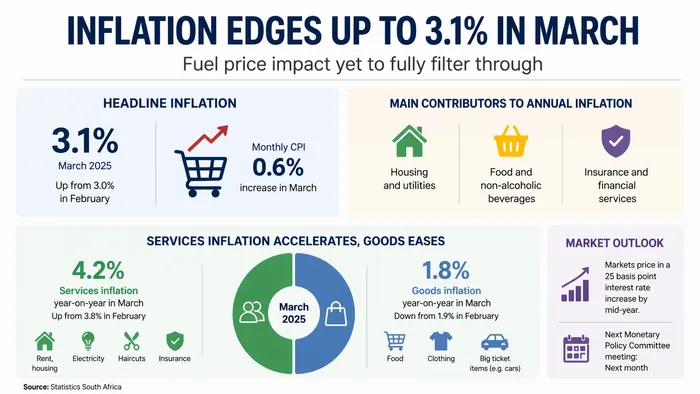
Inflation drivers for the March number.
Image: ChatGPT
PSG senior economist Johann Els said April’s inflation rate is likely to increase to between 3.7% and 3.8% as fuel costs feed through.
“April's CPI inflation will likely shift from the 3.1% in March to around 3.7% or 3.8%,” he said. Els said the outlook beyond April will depend on fuel price developments, including whether fuel levy relief is extended.
If “there’s no petrol price increase in May, then the May number will likely shift downwards slightly to 3.6% or thereabouts. It all depends about the extent of the diesel price increases as well,” said Els.
On interest rates, Bishop said markets are currently pricing in one 25 basis point increase in the repo rate around mid-year. Els similarly expects a once-off 25 basis point increase, assuming oil prices ease and the conflict does not persist.
Moolman said the South African Reserve Bank’s policy decisions will depend on how oil prices and the exchange rate evolve, as well as the duration of the conflict. “If the war ends relatively soon, the bank may not have to hike interest rates,” she added.
IOL BUSINESS