

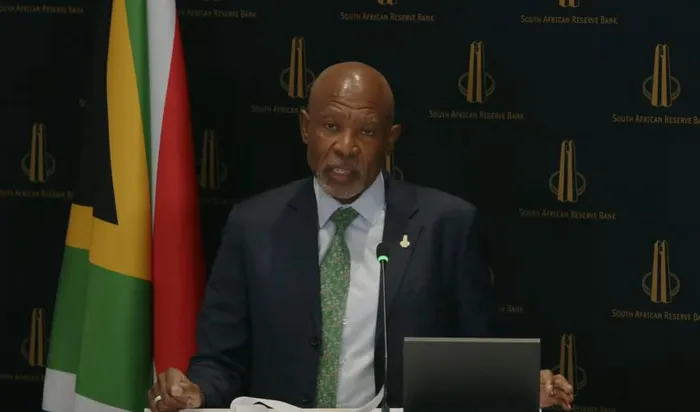
Sarb Governor Lesetja Kganyago addressing the Sarb's 106th Ordinary Annual General Meeting in Pretoria on Friday.
Image: YouTube screengrab
South African Reserve Bank (Sarb) Governor Lesetja Kganyago has defended the central bank's commitment to its new 3% inflation target, saying the recent surge in inflation caused by higher oil prices will not derail efforts to restore price stability.
Addressing the Sarb's 106th Ordinary Annual General Meeting in Pretoria on Friday, Kganyago said the central bank remained focused on protecting the purchasing power of the rand despite a global oil price shock that had temporarily pushed inflation above target.
He noted that South Africa had taken a significant step in 2025 by replacing its longstanding 3% to 6% inflation target range with a 3% target, plus or minus one percentage point.
"Our constitutional mandate is to protect the value of the currency in the interest of balanced and sustainable economic growth," Kganyago said.
He said the new target aligned South Africa with major economies and peer countries and would deliver an environment much closer to price stability.
"We used to target a range of 3–6%. From 2017, we explicitly aimed at the 4.5% midpoint of that band. In 2025, South Africa formally adopted a 3% target, plus or minus one percentage point."
The governor acknowledged that rising oil prices had pushed headline inflation to 4.5% in May and 5% in June, placing pressure on households and businesses.
"We have just been hit by a big oil shock, which pushed headline inflation to 4.5% in May and 5% in June. Everyone feels the pain of rising prices, and everyone is worried about inflation being too high, including us," he said.
However, he stressed that the increase was driven by external factors rather than domestic monetary policy.
"Last year we made a choice to have lower inflation. Yes, we have now been hit by a shock that was completely exogenous and has nothing to do with our choices. But shocks will happen."
Kganyago said the central bank's responsibility was to ensure inflation returned to target over time.
"For the Sarb, our job is to ensure inflation reverts to target. Monetary policy does not control the prices of individual goods and services. But we do have a lot of influence over the longer-run buying power of the rand, across a broad purchase basket, and we intend to protect that."
He said this commitment had informed the Monetary Policy Committee's decision to raise the repo rate to 7% in May.
"That is why we raised rates to 7% in May – to ensure that inflation gets back to target. This created the space for us to hold rates at our MPC meeting in July."
Looking ahead, Kganyago said lower inflation would ultimately pave the way for lower interest rates.
"As a Monetary Policy Committee, we do not make any promises about the path for interest rates... But I can say with confidence that lower inflation produces lower rates."
Beyond monetary policy, Kganyago reflected on developments in the financial sector and the Sarb's broader role in safeguarding financial stability.
He welcomed South Africa's removal from the Financial Action Task Force greylist, saying authorities had invested heavily in strengthening anti-money laundering controls.
"Since our greylisting in 2022, there have been major investments by the South African authorities, including the Sarb, to get our house in order. We were happy to come off the greylist late last year."
Kganyago also highlighted the opportunities and risks presented by artificial intelligence and digital assets, saying regulators needed to encourage innovation while protecting the integrity of the financial system.
"If they can make cross-border payments faster and cheaper, that would be welcome progress. But if they mainly make it easier to transact anonymously, helping their users get around prudential controls or escape with the proceeds of crime, that is dangerous," he said of stablecoins.
He added that South Africa's payments modernisation programme was aimed at making digital payments faster and cheaper, even without relying on blockchain technology.
Kganyago said the Sarb had strengthened its own financial position, with foreign exchange reserves rising from $68 billion a year ago to $74bn.
"The Sarb is in a strong position. We have taken a big step forward with our new 3% inflation target. Our financial system continues to demonstrate resilience in an uncertain and difficult world. We are driving payment innovation to close the gap with the leading countries," he said.
"If the South African experience of the past two decades teaches anything, it is the importance of having well-governed institutions. The Sarb's institutional strength is clear, but it comes from a lot of hard work."
BUSINESS REPORT