

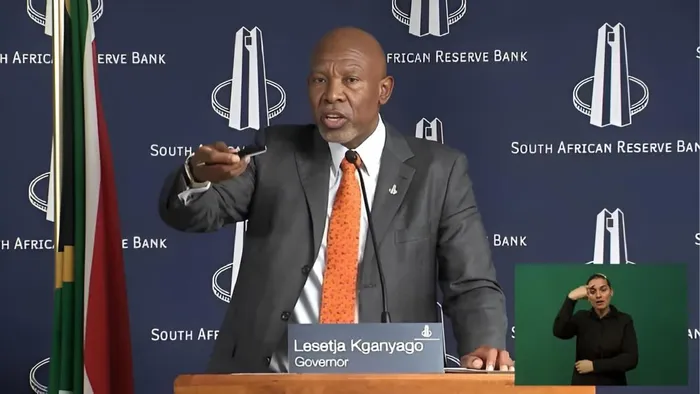
South African Reserve Bank Governor, Lesetja Kganyago.
Image: IOL
Even though the South African Reserve Bank (SARB) kept the prime lending rate unchanged at 10.5% on Thursday, the Monetary Policy Committee (MPC) indicated that the direction of interest rates from here remains finely balanced.
While the central bank's baseline forecast still points to interest rates remaining broadly stable before easing as inflation returns to its 3% target, it also outlined scenarios under which borrowing costs could either rise again later this year or begin falling sooner than expected.
The MPC voted four to two in favour of keeping rates unchanged, with two members preferring a 25-basis-point increase.
Governor Lesetja Kganyago said the committee considered the current policy stance, following May's 0.25 percentage point rate hike, to be "appropriate for now", adding that future decisions would continue to be taken "meeting by meeting" as economic conditions evolve.
The Reserve Bank said the inflation outlook had "improved slightly" since its May meeting but warned that inflation remained above target and that risks were still tilted to the upside.
Headline inflation is expected to remain above 4% until early next year, driven largely by higher fuel costs, while services inflation was described as "problematic". The Bank also noted that inflation expectations had risen across all groups surveyed by the Bureau for Economic Research.
Johann Els, senior economist at PSG, said the statement was noticeably less hawkish than he had expected, despite renewed risks from higher oil prices and conflict in the Middle East.
"I think that is probably the biggest takeaway from today's meeting," he said.
Els said the South African Reserve Bank treated higher oil prices and the conflict in the Middle East as risk scenarios rather than incorporating them into its central forecast. It also lowered its oil price assumption and reduced its inflation forecast to 4% from 4.4% at its previous meeting.
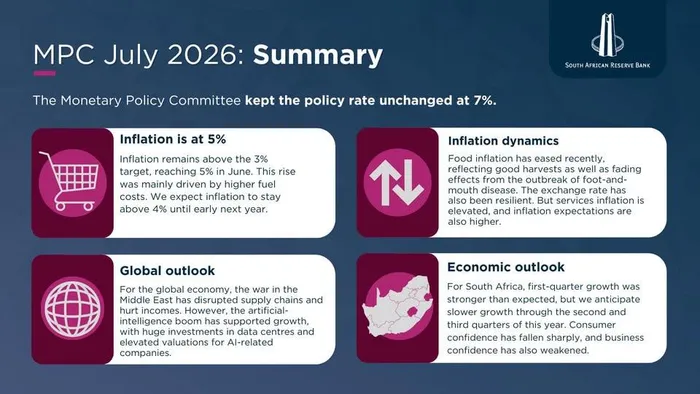
The Reserve Bank has hit pause on interest rates, but says the path ahead will depend on whether inflation pressures ease or intensify in the months ahead.
Image: Facebook/SARB
However, Els said June's higher-than-expected inflation reading meant he now expected inflation to average closer to 4.2% this year.
The MPC also acknowledged that the economy had lost momentum since its previous meeting, with weaker consumer and business confidence, higher fuel prices and uncertainty weighing on growth.
It said households had suffered from higher fuel costs, while municipal dysfunction had become a binding constraint on economic activity.
Kristof Kruger, head of fixed income trading at Prescient Securities, said those growth concerns appeared to have played a significant role in the decision to leave rates unchanged.
"Today's hold is the SARB choosing growth over orthodoxy," Kruger said.
Kruger added: "With inflation at 5%, the textbook says hike. But the SARB looked at slowing growth in quarters two and three, weak consumer confidence and a supply shock it cannot control with interest rates, and decided the risk of overtightening outweighed the risk of waiting."
Despite opting to hold rates, the Reserve Bank made it clear that further tightening remains a possibility.
It modelled a scenario in which inflation expectations continue rising, feeding into higher wage settlements and core inflation, requiring one additional interest rate hike this year and a longer period of restrictive monetary policy.
A second scenario showed that persistently higher oil prices could produce a similar outcome. Conversely, a more favourable oil price outlook would allow inflation to return to target more quickly and create scope for interest rate cuts before the end of the year.
Standard Bank Group head of South Africa macroeconomic research Dr Elna Moolman said the central bank's message was that both outcomes remained possible.
"It is therefore not impossible that we could see interest rate hikes later this year, depending on how these inflation risks unfold," Moolman said.
Moolman added: "For now, however, the Reserve Bank describes interest rates as appropriate, and its model implies that there could be scope for interest rate cuts from later this year."
IOL BUSINESS