

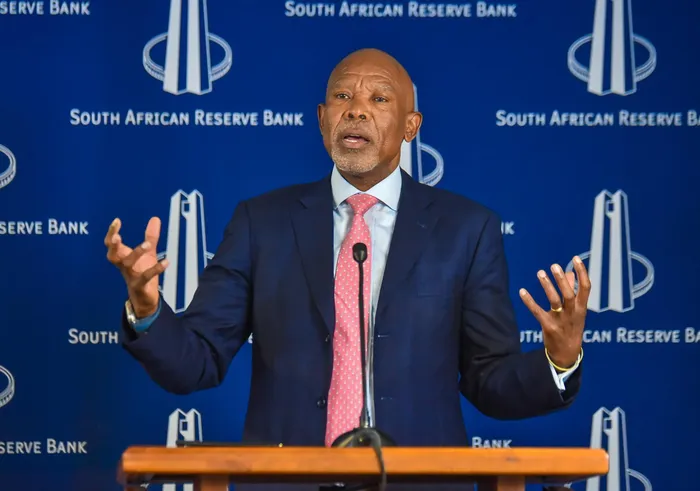
Announcing the decision, Sarb Governor Lesetja Kganyago said the conflict in the Middle East had entered "a new and volatile phase", driving renewed uncertainty over global energy markets.
Image: SARB | Facebook
The South African Reserve Bank (Sarb) surprised markets on Thursday by leaving the repo rate unchanged at 7%, opting for caution amid heightened geopolitical uncertainty and persistent inflation risks, despite widespread expectations of another interest rate increase.
The decision by the Monetary Policy Committee (MPC) means the prime lending rate remains at 10.5% per annum.
The decision was split, with four MPC members voting to keep rates unchanged while two supported a 25-basis-point increase, underlining continued concern about inflation, which rose to 5% in June, even as economic growth weakens.
Announcing the decision, Sarb Governor Lesetja Kganyago said the conflict in the Middle East had entered "a new and volatile phase", driving renewed uncertainty over global energy markets.
"Oil prices, which had declined to about $70 a barrel earlier this month, have now rebounded to roughly $90," Kganyago said.
He said the global economy had been disrupted by the conflict, although investment linked to artificial intelligence had helped offset some of the negative impact.
Domestically, South Africa's economy expanded by close to 2% year-on-year in the first quarter, but this was largely driven by stronger exports rather than underlying domestic demand.
"We anticipate slower growth through the second and third quarters of this year. Consumer confidence has fallen sharply, and business confidence has also weakened," Kganyago said.
PPS Investments portfolio manager Reza Hendickse described the decision as "a pause rather than a pivot away from a hawkish bias".
"The bank has held rates while flagging that inflation is still too high, that risks remain skewed higher, and that its own forecast keeps the rate broadly stable through year-end, with cuts only arriving once inflation is convincingly back near 3%," Hendickse said.
Recent inflation outcomes have been driven largely by fuel costs, with headline inflation expected to remain above 4% until early next year despite some temporary relief at the pumps this month.
"Aside from fuel, goods prices have been relatively contained. The exchange rate has been resilient, with the rand close to where it started the year against the dollar, and stronger against the euro. This has helped with import prices," Kganyago said.
However, he warned that services inflation remained problematic, with higher price increases across insurance, transport and housing, while inflation expectations had also risen.
The Sarb's Quarterly Projection Model indicates interest rates are likely to remain broadly unchanged for the rest of the year, with rate cuts only expected later in the forecast period once inflation returns sustainably towards the Bank's 3% objective.
Following the announcement, the rand weakened to around R16.70 against the US dollar, its lowest level since mid-May, as investors reacted to the unexpected decision.
Wichard Cilliers, head of market risk at TreasuryONE, said the decision caught markets off guard.
"The rand is under pressure at the moment on the back of this as the market expected the Sarb to hike," Cilliers said.
"The Sarb has slightly improved its 2026 economic growth forecast to 1.4% while lowering its inflation forecast to 4.0%, reflecting a more positive outlook."
North-West University Business School economist Prof. Raymond Parsons said the decision would provide some relief for financially stretched consumers and businesses.
"The MPC unexpectedly decided by a 4-2 vote (two members wanted a 25-bps rise) not to raise interest rates again for now. Most economists and the markets were anticipating another 25-bps rise."
Parsons said the central bank's decision reflected its updated assessment of the risks posed by the Middle East conflict and the delayed impact of previous monetary tightening.
"The latest monetary policy stance will come as some relief to business and consumers struggling with mounting cost and financial pressures," Parsons said.
He said the Reserve Bank still believed inflation could return to its 3% target by early 2027, provided global pressures eased and domestic reforms accelerated.
Standard Bank Group head of South Africa macroeconomic research Dr Elna Moolman said the door remained open for further tightening should inflation risks intensify.
"It is therefore not impossible that we could see interest rate hikes later this year, depending on how these inflation risks unfold," Moolman said.
"For now, however, the Reserve Bank describes interest rates as appropriate, and its model implies that there could be scope for interest rate cuts from later this year."
BUSINESS REPORT