


DebtBusters found that the proportion of respondents who said they would consider debt counselling increased from 36% last year to 40% this year.
Image: Vitaly Gariev | Unsplash
South Africans may be watching this week's Monetary Policy Committee (MPC) meeting closely, but for many households, interest rates are no longer the biggest financial worry. Instead, it is the cost of simply getting through the month.
That shift is the central finding of DebtBusters' fifth annual Money Stress Tracker, which found that the cost of living has overtaken interest rates as South Africans' biggest source of financial stress. Concerns about inflation rose by 28% over the past year, while worries about electricity costs almost doubled, increasing by 99%.
The MPC announces its decision on Thursday, with economists divided over whether the South African Reserve Bank (SARB) will hold or raise interest rates.
For consumers, an even bigger issue lands a day earlier when Statistics South Africa releases the latest inflation figures. Economists expect annual inflation to edge up from 4.5% in May to between 4.6% and 4.7%, largely because of higher fuel prices.
Citadel Global MD Bianca Botes believes the resilience of the rand, improving fiscal metrics and continued structural reforms support leaving rates unchanged.
"South African Reserve Bank Governor Lesetja Kganyago's hawkish stance keeps further tightening possible if inflationary pressure persists," she said.
CAM Asset Management portfolio manager Mike van der Westhuizen said lower oil prices and the stronger rand had eased some inflationary pressure, although geopolitical tensions remained a risk. He currently saw an almost two-thirds chance of a rate increase or, at the very least, a more hawkish tone from Kganyago.
Investec chief economist Annabel Bishop said renewed inflation risks could still justify another increase.
"The SARB may decide that another pre-emptive hike is necessary in July, given the jump in inflation expectations," she said.
Harry Scherzer, chief executive of Future Forex, said the MPC faced a finely balanced decision, with economists split between another increase and leaving rates unchanged. The prime lending rate is currently 10.5%.
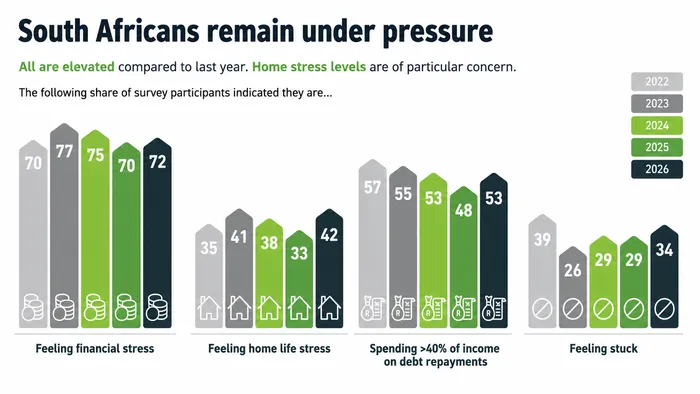
South Africans remain under extreme financial pressure.
Image: DebtBusters
Whatever the MPC decides, the DebtBusters data suggests consumers are worried about more than interest rates.
"Interest rates are no longer consumers' primary concern. The rising cost of living has taken over," said DebtBusters executive head Benay Sager.
"The dominant source of anxiety has shifted each year: inflation in 2022, interest rates in 2023, debt levels in 2024, a brief stabilisation in 2025, and the cost of living in 2026. What has remained constant is that short-term financial survival crowds out longer-term planning for a large majority of South Africans," DebtBusters said.
Overall, 72% of respondents said they were experiencing financial stress, while 42% said financial pressures were affecting life at home — the highest level recorded since the survey began five years ago.
Sager said that while borrowing costs remained elevated, consumers were increasingly grappling with a combination of rising food prices, electricity tariffs, transport costs and municipal charges that continued to squeeze already stretched household budgets.
Electricity, in particular, has emerged as one of the fastest-growing sources of financial anxiety. The near doubling in concern over electricity costs reflects not only tariff increases but also the broader impact that higher energy costs have on municipal bills and the price of goods and services across the economy.
For many households, these are unavoidable monthly expenses that cannot easily be reduced.
More than half of the 18,000 respondents said they spend more than 40% of their take-home pay servicing debt, up from 48% a year ago. DebtBusters notes that once debt repayments consume more than 40% of net income, households have little room to absorb unexpected expenses or rising prices without cutting back elsewhere.
The findings reinforce what debt counsellors have been warning in recent weeks. The National Debt Counselling Association said many consumers now have little or nothing left to save once debt repayments and essential household expenses have been covered, leaving them increasingly vulnerable to even modest increases in the cost of living.
That changing financial reality is reflected throughout the survey, with financial strain also taking a growing emotional toll.
Clinical psychologist Andrea du Plessis said financial stress had become more than an occasional concern.
"Financial stress is no longer an occasional challenge — it has become a constant psychological state," she said.
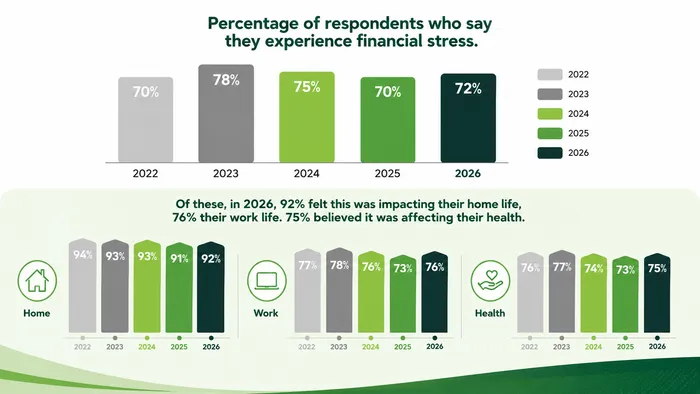
Money worries keep South Africans up at night.
Image: DebtBusters
Du Plessis said the impact extended well beyond household finances.
"When we bring it into the home that is supposed to be our sanctuary, our safe space, then we don't have any space anywhere that we feel safe."
The findings among consumers who are not in debt review suggest they are becoming more willing to seek help before their financial situation deteriorates further. DebtBusters found that the proportion of respondents who said they would consider debt counselling increased from 36% last year to 40% this year.
The increase aligns with what debt counsellors have been reporting, as more consumers seek assistance not because of a single financial shock, but because years of rising living costs have steadily eroded their disposable income.
IOL BUSINESS