

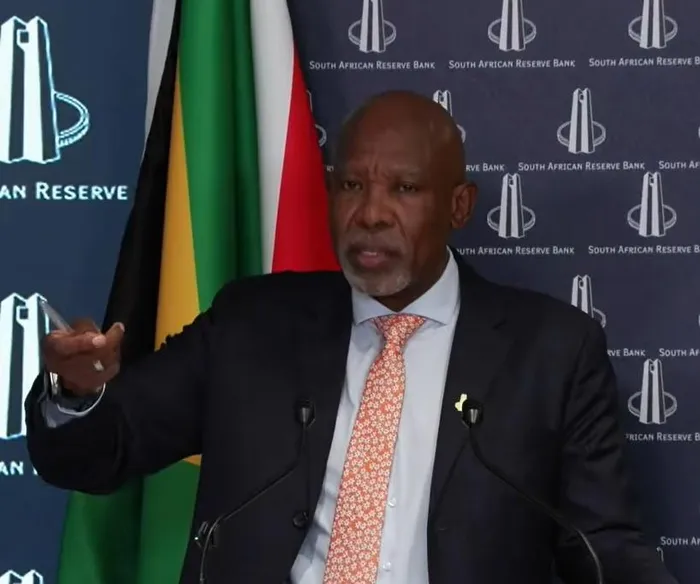
Announcing the decision, Sarb Governor Lesetja Kganyago said the MPC voted by a margin of four to two to keep rates on hold. Two members preferred a 25 basis point increase, reflecting concerns about persistent inflationary pressures.
Image: SARB YouTube screengrab
The South African Reserve Bank (Sarb) left the repo rate unchanged at 7% on Thursday, with the Monetary Policy Committee (MPC) opting for caution as higher global oil prices and rising inflation expectations continue to pose risks to the inflation outlook despite weak economic growth.
Announcing the decision, Sarb Governor Lesetja Kganyago said the MPC voted by a margin of four to two to keep rates on hold. Two members preferred a 25 basis point increase, reflecting concerns about persistent inflationary pressures.
"The committee decided to keep the policy rate unchanged, at 7%. Four members preferred a hold, while two favoured an increase of 25 basis points," Kganyago said.
"The committee agreed that the outlook is uncertain, and with the rate increase at our previous meeting, the policy stance is appropriate for now, with rates somewhat restrictive."
The decision comes against the backdrop of renewed geopolitical tensions in the Middle East, which have driven Brent crude oil prices from around $70 a barrel earlier this month to about $99 a barrel, raising concerns over fuel costs and inflation.
Kganyago said recent inflation readings had remained above the bank's target largely because of higher fuel prices, although food inflation had moderated due to good harvests and the fading impact of foot-and-mouth disease.
"We expect headline inflation to stay above 4% until early next year," he said.
The MPC also warned that inflation expectations have risen, with the latest Bureau for Economic Research survey showing all respondent groups anticipating higher inflation, particularly trade unions.
The central bank noted that services inflation remained elevated, while its preferred measures of underlying inflation continued to point to persistent price pressures.
On the growth front, the Sarb acknowledged that the economy had performed better than expected in the first quarter, expanding at close to 2% year-on-year, largely because of stronger net exports.
However, Kganyago cautioned that momentum had weakened since then as consumer and business confidence deteriorated following the escalation of the Middle East conflict.
"We started this year with good momentum, but households have suffered from higher fuel prices, while uncertainty has weighed on investment. It is also increasingly clear that municipal dysfunction has become a binding constraint on growth," Kganyago said.
Looking ahead, the Reserve Bank's Quarterly Projection Model indicates that interest rates are likely to remain broadly stable for the rest of the year, with the possibility of rate cuts only once inflation moves sustainably towards the Bank's 3% objective.
Kganyago reiterated that future decisions would remain data dependent.
"Our decisions will continue to be taken on a meeting-by-meeting basis, with careful attention to the outlook, data outcomes, and the balance of risks to the forecast," he said.
BUSINESS REPORT