

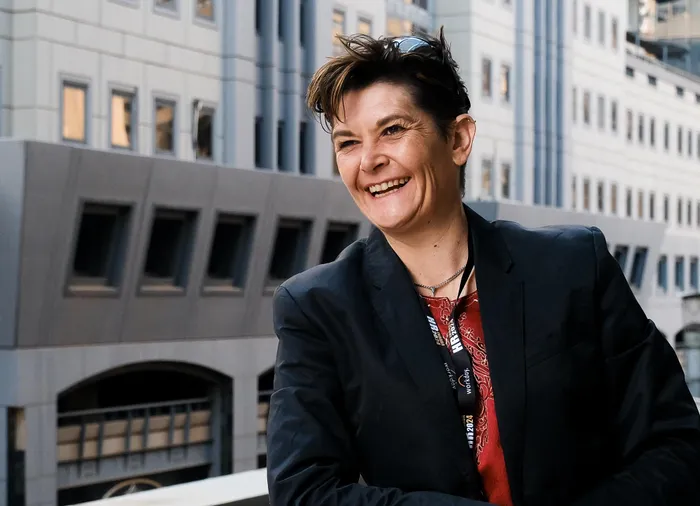
Nicola Mawson somehow had R5 left before payday - here are her views on inflation, interest rates, and some life hacks.
Image: Supplied
Yesterday morning, when asked which way I thought the South African Reserve Bank (SARB) would go with interest rates, I was leaning firmly towards hold. In fact, I was happy to bet the R5 I could afford on them taking a 'wait and see' stance.
(Don't judge me, there's always too much month left at the end of the money and South Africans are all really battling. I'm chuffed I can even afford to bet R5.)
At 10am, that view changed. Inflation accelerated to 5% in June, above market expectations of between 4.7% and 4.8% and the highest level since June 2024 when the print came in at 5.1%. For me, this shifts the needle towards a 0.25 percentage point hike, which would take the prime lending rate to 10.75%.
Most South Africans, however, are less concerned about interest rates than they are about the cost of living, a view that translates into "debt can wait, we need to eat first". Recent figures from DebtBusters bear this out — because consumers' main source of anxiety is the cost of living.
The dominant source of anxiety has shifted each year: inflation in 2022, interest rates in 2023, debt levels in 2024, a brief stabilisation in 2025, and the cost of living in 2026. The survey – based on the responses of 18,000 South Africans who aren't in debt counselling – found that 72% of respondents are stressed about money.
South Africans aren't managing to pay their bills, can't save, and those earning R50,000 or more – assuming they were paying down debt – would need 101% of their net income to just cover debt.
Currently, the ratio of South Africans who spend more than 40% of their take-home pay servicing debt is 5.3 out of every 10 – a level that is unsustainable. TransUnion's latest Consumer Pulse Study found that 39% of South Africans expect to miss at least one bill or loan repayment every month.
And salaries are going backwards when you take inflation into account, with the latest PayInc data showing that real take-home pay has fallen to its lowest level in around two years. According to the latest PayInc Net Salary Index, the average South African net salary was R21,598 in June.
That's the middle class. That's a sixth of employed South Africans according to the University of Cape Town and, arguably, the backbone of mass-market consumer spending. Not trips overseas, not golf clubs, not new cars every three years — mass-market-at-the-till-point spending such as groceries, electricity, fuel, and other essentials.
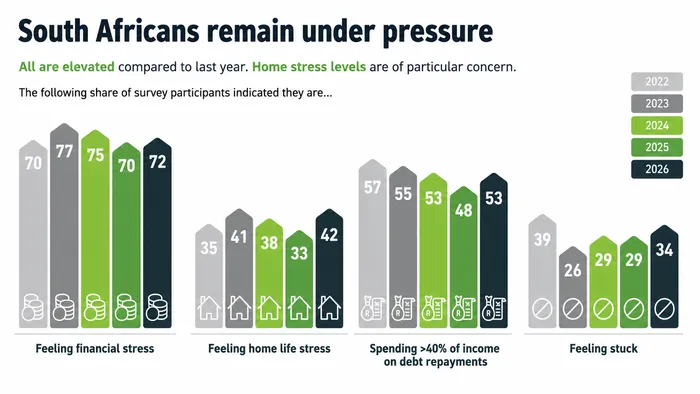
How tough financial decisions are affecting people.
Image: DebtBusters
Among South Africans taking home more than R20,000 a month, almost six in 10 spend 40% or more of their take-home pay servicing debt, while four in 10 say they need to devote half of their after-tax income to debt repayments.
The food bill, based on the average cost of a household food basket as determined by the Pietermaritzburg Economic Justice & Dignity Group, is a quarter of the average net salary.
And that's three-quarters of your income gone if you are eating and paying debt before school fees, transportation — the biggest driver of inflation last month — toiletries, electricity, communications, medical costs, and everything else.
Beyond the damage this does to mental health, it has a massive spillover effect on the economy. Independent economist Elize Kruger warns that shrinking disposable incomes are likely to place increasing pressure on household budgets, consumer spending and broader economic activity.
Consumer spending is the primary engine of our economy, accounting for close to 70% of gross domestic product. Not key push-side drivers such as manufacturing, construction, and mining — you and I. Which is why this afternoon worries me.
Looking at the broader macro-economic picture, it's more likely now that SARB's Monetary Policy Committee will have no choice but to put interest rates up because it's part of their mandate to keep inflation in check and protect the rand.
The economic simplistic way of viewing what the central bank needs to do is put rates up to dampen consumer spending. At its core: if I am paying more on debt, I don't have money for more shoes.
If I don't have money for more shoes, the supply and demand equation shifts and prices drop. If my shoes aren't selling, I discount them. That doesn't, however, mean that I will sell more because people have no money anyway. (That they won't sell at all because they are ugly is currently neither here nor there.) When prices drop, inflation comes down.
The other side of the seesaw is SARB's mandate to protect the rand. When interest rates go up, investors are keener to put money where they will earn more – and so say all of us except we have no money to save.
A solid argument against putting interest rates up this afternoon is that the ZAR has been merrily sitting range bound around R16.40 or so for quite some time. Yes, it's gotten stronger or weaker but it's pretty much hanging around there.
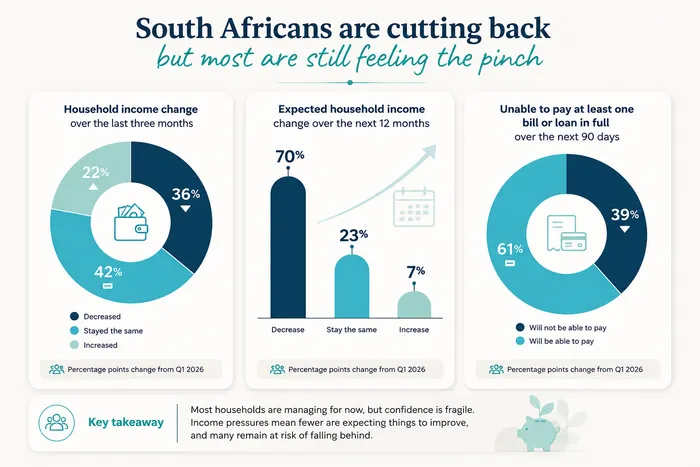
There is a persistent gap between income and inflation.
Image: TransUnion
But SARB still needs to do a balancing act, because it needs to act in the best interests of the economy. And inflation is now well beyond its target range of 3% — even if we were still in the 3% to 6% range, there would be cause for concern.
Anchor Capital economist Lerato Ntuli, Investec chief economist Annabel Bishop and TreasuryONE's head of market risk Wichard Cilliers see what economists call “an upside” risk to rate hikes.
PSG senior economist Johann Els says there's a case for a hike but it will be a close call, while Dr Elna Moolman, Standard Bank Group head of South Africa Macroeconomic Research, says if there is a hike, it's likely to be the last in this cycle.
If we reverse engineer my bet on a hike, that means more debt for South Africans who aren't able to pay their bills. And it doesn't necessarily mean that lettuce, for example, will become cheaper because oil is still high having gone above $85 again thanks to more turmoil in the Middle East.
This isn't a case of what goes up must come down. Nope. It's a case of the rate at which prices increase slows. And the economy will slow, too. My dire concern is that we won't meet the more or less 1.2% economic growth forecast for the full year. And that means jobs won't be created.
However, that doesn't solve the immediate problem of all of us hanging on by what fingernails we have left. They say , not everyone but quite a few financial people, that the way to cope is earn more or cut expenses. Very funny.
Unemployment is 32.7% so where am I going to get a second (or third) job from? Ok, not me, I work for myself, which is a whole other dynamic, although I'm certainly not in a position to create jobs. Or even one job.
It seems to be an American thing where older people – Baby Boomers mostly – tell the young'uns that they need to stop life's little pleasures like a Starbucks a day. At, say R40 a day or R1,200 a month, will be a massive help, but isn't enough to fill the void.
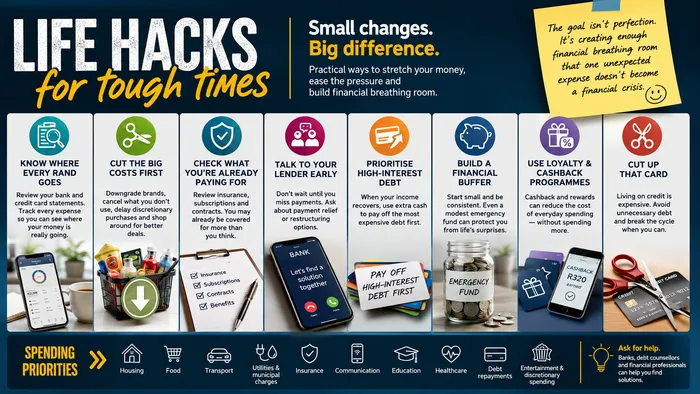
Some hacks for making each month just a little easier.
Image: ChatGPT
(Just a note: I'm not a financial advisor; I'm just sharing my life hacks.)
***Nicola Mawson is an IOL Contributor. The views expressed here do not necessarily represent those of IOL.
IOL Business