

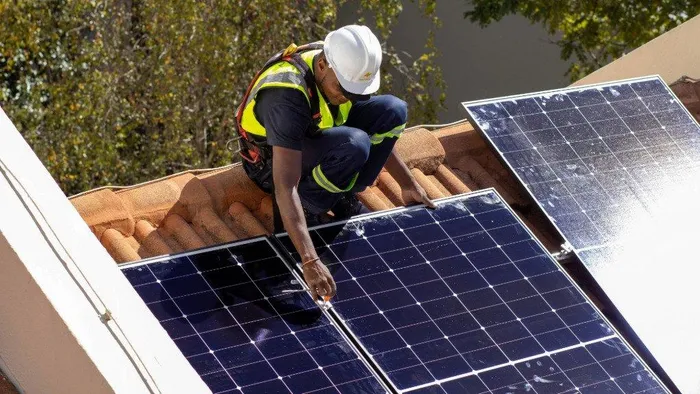
Wetility was conceived as a utility, that would evolve beyond its pioneering solar subscription model which offers no upfront costs to the customer, removing the initial capital barrier and serving as an entryway into the market.
Image: Supplied
Vincent Maposa
In South Africa, electricity has become one of the least certain things in daily life. For close on two decades, the country has lived with energy uncertainty, a consequence of an ageing coal fleet built largely between the 1960s and 1990s that can no longer keep pace with demand. Over the past year, the grid has steadied with availability climbing back above 65%, but this has come with an ongoing and growing pressure point – price. Direct tariffs rose by 12.74% in April 2025, with a further increase of 8.97% planned for 2026. The typical customer’s bill has risen by almost 180% over the past 10 years.
Eskom’s recovery is visible with more than 350 days without loadshedding and generation that has stabilised - key performance indicators have improved. However, in 2025, more than 91,000 distribution-level unique power outages were recorded across South Africa during the year. These were, and continue to be, primarily unplanned interruptions that shut down shops, spoil stock, and leave households without warning or recourse.
Today, the challenge is broader than keeping the lights on, it is affordability, predictability, reliability and access. It is about giving people the confidence in the services they depend on everyday; and this is how utilities of the future will be defined.
Consumers today can no longer accept the simple model that utilities have relied on for decades –provide a service, send a bill and leave it to customers to navigate the uncertainty. They need some solutions that help them understand, manage and optimse both their energy usage and financial wellbeing.
We believe that a utility of the future should do far more than just deliver electricity. It is one that will combine technology, financing intelligence and customer-centric services into a seamless experience that allows customers to have peace of mind and control over their lives. More importantly, it will deliver on certainty, not as an abstract concept but with tangible outcomes.
It will be the reason a learner is able to study with no interruption, households and businesses have predictable costs to plan ahead, with financing that make essential services like water and electricity more affordable and, knowing that when support is needed, it is available to customers. These are the outcomes that make certainty an enabler of opportunity.
A study on the Ruimsig settlement from the University of the Free State found that, with sufficient energy supply, 99% of children could study longer into the night, 80% of residents could work longer hours, 94% reported less coughing from paraffin/candles, 85% felt safer, and 78% gained new income opportunities that were previously unavailable.
The difference between having certainty and living without it determines whether people are able to fully participate in the economy and realise their full potential. This is the belief that has informed Wetility’s growth and evolution.
At inception, Wetility was conceived as a utility, that would evolve beyond its pioneering solar subscription model which offers no upfront costs to the customer, removing the initial capital barrier and serving as an entryway into the market. However, the vision was always much broader - the name itself connects ‘we’ to ‘utility’ because the brand has been built with the customer in mind.
Having kept the lights on at scale with our initial offerings, over time, we have had to ask ourselves some fundamental questions around the broader energy experience of South Africans and the lack of certainty that has prevailed over decades.
South Africa’s challenge is more than just access to energy, but the certainty around it, therefore the future requires a new model and Wetility is building it - a technology-enabled utility designed to deliver certainty through affordability, reliability, predictability and financial inclusion.
This vision extends beyond solar, it is also anchored on smart metering, AI-powered energy management, financing solutions, rewards programmes, credit access and innovations such as OneBill – a solution that addresses a structural problem that extends across the continent. In much of Africa, electricity payment systems are fragmented, exclusionary, and disconnected from the broader financial lives of the people who depend on them.
One Bill responds to this reality by bringing together grid and solar electricity, credit access, and financial services into a single experience with guaranteed savings for households long underserved by both the energy and banking sectors. This innovation removes the complexity from the energy experience and showcases how utilities can create value.
To date, the company has deployed more than R1.5 billion in capital over more than 10,000 systems with customers saving between 20-40% on their monthly electricity bills.
As South Africa navigates the just energy transition, we need to rethink what a utility can be, and what customers should expect from it. A utility of the future must be proactive rather than reactive, intelligent rather than transactional, and designed around the customer experience rather than infrastructure alone.

Vincent Maposa is the founder and CEO of Wetility.
Image: Supplied
* Vincent Maposa is the founder and CEO of Wetility.
** The views expressed do not necessarily reflect the views of IOL or Independent Media.
BUSINESS REPORT