

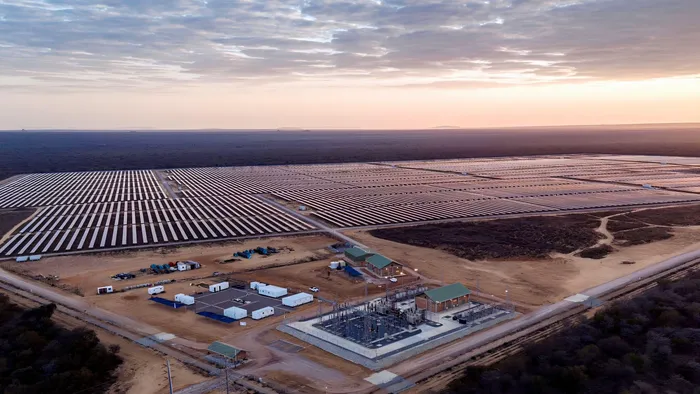
Exxaro Resources has brought its first utility-scale self-generation solar project into commercial operation.
Image: Supplied by Exxaro
Even as Eskom reports its strongest winter power system performance in years, with no load shedding projected for the remainder of winter, Exxaro Resources has brought its first utility-scale self-generation solar project into commercial operation.
Developed by Exxaro's wholly owned renewable energy business, Cennergi, the Lephalale Solar Project is a 68MW alternating current behind-the-meter solar photovoltaic facility at the company's Grootegeluk Mine in Limpopo.
The 185-hectare plant comprises 129,024 solar panels and is designed to generate approximately 176GWh of renewable energy annually, supplying power directly to the mine and reducing its reliance on grid electricity during daylight operating hours.
Based on Exxaro's stated annual generation, the project would produce enough electricity each year to power about 16,000 average South African households, illustrating the scale of demand it will remove from the national grid during daylight hours.
The R1.7 billion project is Exxaro's first utility-scale self-generation renewable energy asset to reach commercial operation and forms part of the group's decarbonisation strategy.
"The official opening of the Lephalale Solar Project is far more than the completion of a renewable energy facility; it marks another significant milestone in the delivery of our sustainable growth and impact strategy," Exxaro CEO Ben Magara said.
Magara added, “As Exxaro's first utility-scale, self-generation renewable energy asset to reach commercial operation, it demonstrates our ability to successfully develop, finance, construct and operate large-scale renewable energy infrastructure through our growing renewable energy business, Cennergi.”
The project is underpinned by a 25-year power purchase agreement with Grootegeluk Mine. It has been licensed for future battery energy storage integration, positioning it to deliver more flexible renewable energy as market opportunities evolve. Commercial operations began on 20 April after construction started in August 2023.
According to Exxaro, the facility is expected to reduce the mine's Scope 2 greenhouse gas emissions by about 17%, lower electricity costs by more than R100 million a year and strengthen energy security at the operation.
"The Lephalale Solar Project is the realisation of our decarbonisation journey where we are strengthening our energy security, creating shared value for communities and supporting the country's just energy transition," Magara said.
Magara said that, “by reducing electricity costs by over R100 million annually, while reducing Scope 2 emissions by approximately 17%, the project demonstrates that decarbonisation is not only good for the environment, but it also makes sound business sense.”
The project also generated economic benefits during construction, creating 808 jobs, of which 557 were filled by members of host communities. Exxaro said it invested R1.12 million in community bursaries and worker training, while 41.9% of procurement spend went to local suppliers and 13 local subcontractors participated in the project.
The investment comes as Eskom continues to report improvements in the national power system under its Generation Recovery Plan. The utility said its Energy Availability Factor reached 64.82% for the financial year to 9 July, while unplanned outages have fallen by more than 5,200MW compared with the same period last year.
Diesel expenditure has dropped by almost 85%, and South Africa has now gone 420 consecutive days without load shedding, and Eskom continues to project no load shedding for the remainder of winter.
Load-shedding marked a brief return last May after a period of widespread national power outages beginning at the end of 2007. The electricity grid subsequently stabilised on 16 May 2025.
In April 2024, South Africa had a full month without rotational power cuts, which was the first time since January 2022. However, load shedding and scheduled rolling blackouts returned at the end of January 2025.
IOL BUSINESS