

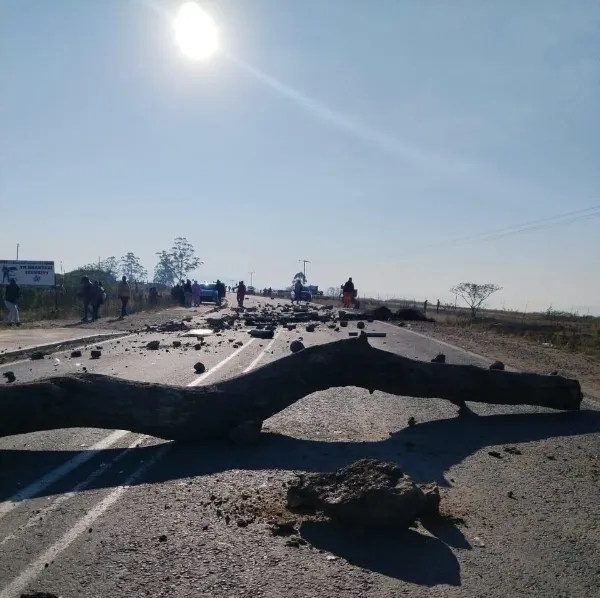
Lion Park road was closed by residents protesting against Eskom disconnecting the illegal electricity supply.
Image: Bongani Hans
Eskom was welcomed with debris, including burning tyres, broken bottles, and huge tree branches, blocking the MR477 road as it moved with the police to Lion Park outside Pietermaritzburg to disconnect illegally connected electricity on Wednesday morning.
The state-owned power utility, which received a disconnection order from the Pietermaritzburg High Court, was accompanied by heavily armed police and private security officers in an operation to remove transformers and cables that the community used to steal electricity worth about R14 million per year.
Some residents, who woke up in the early hours of the morning to prevent the operation, claimed that police fired rubber bullets at them as they were protesting.
The operation started with a technical briefing between Eskom and the police at the utility’s offices in Mkhondeni before the convoy of vehicles, including police and Eskom trucks, proceeded to the disconnection scene.
Eskom said it disconnected electricity that had been connected to over 1,400 households over the past 12 years.
At the scene, some community members seemed to be ready to fight to protect their homes from being left in darkness, but after realising the presence of a large number of police and security officers, they backed off, and the disconnection continued.
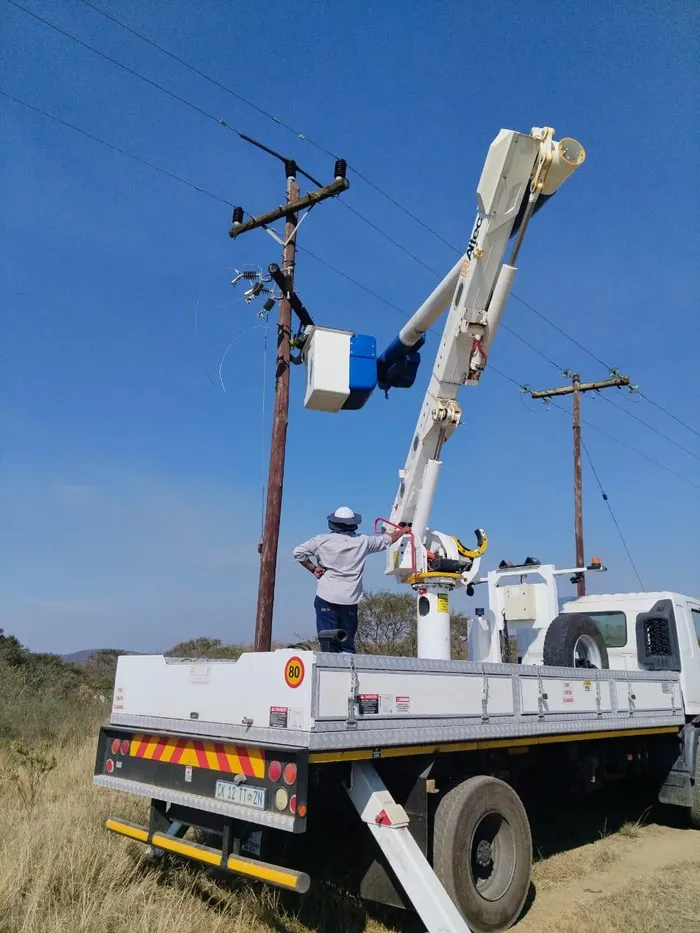
Eskom technicians removing an illegally installed transformer in Lion Park outside Pietermaritzburg on Wednesday.
Image: Bongani Hans
Eskom spokesperson Dadewabo Mbhele said: “We hope for no resistance, as I don’t think anyone who steals would want to continue stealing, and I don’t think this is the calibre of KZN residents.
“All Eskom has to do is to recover the cost, which we have incurred for generating power, because we are not profit-making, and we must recover what we spend when we generate and transport the energy.”
Eskom made it clear that no resistance would make it back off from the operation, and it became clear to the residents that, from now on, they will be without electricity for a while to cook and to connect their heaters during this cold winter weather.
Other residents were heard complaining that this would deprive them of the opportunity to watch the FIFA World Cup semi-final between England and Argentina on Wednesday evening.
The state-of-the-art houses, which depend on illegally connected electricity, are built on the land that was placed under Azibuye Emasisweni Amaqhamu Community Trust’s control after it was legally claimed from various farmers.
Residents said that since they started settling on the land around 2018, they have been applying for an electricity connection, and even collected money to pay Eskom.
However, Mbhele denied this, saying Eskom could not connect electricity to houses built on the land that had not been rezoned as a residential area.
“This land is zoned as agricultural, and it is not residential, so who would have come to us because we have been dealing with the trust?” she said.
She said Eskom had offered the trust a bulk supply connection as a viable alternative while the trust was still trying to rezone the area.
“Eskom must have a licence to reticulate in a residential area, but this is a farm,” she said.
The bulk supply, which Eskom proposed to the trust, was that it would connect all residents to one metre, and residents would collect money every month to pay for a shared bill from the trust.
“We have submitted to the court that there have been many interactions between us and the trust, and they (trust) know that we have given them a solution that we are going to quote them for a bulk supply while they are sorting out rezoning.
“While they have trouble sorting that out, we are going to give them a bulk supply,” said Mbhele.
She said the trust has not come back to Eskom to accept the proposed deal.
However, some residents said they do not want the bulk supply because they will have to pay one price irrespective of whether some of them would overconsume the power.
Eskom's Industry and Stakeholder Management Manager, Joyce Zingozi, said Eskom was served on June 4 with an urgent interdiction application by a group of individuals alleging to be Lion Park residents.
“Eskom entered its intention to oppose the order. On June 5, 2026, the Pietermaritzburg High Court struck the matter off the roll and awarded costs in favour of Eskom,” said Zingozi.
However, the trust’s chairperson, Mlungisi Khanyezi, said Eskom had given the trust short notice to approach the court to oppose the disconnection application.
“We tried to plead with Eskom to connect the residents, but it only connected about five homesteads and closed the channel last year, and gave us court orders on Monday, which was a one-day notice.
“Right now, our lawyers and I are in the High Court, busy preparing paperwork to stop this chaos,” said Khanyezi.
He said the fact that the land has not yet been rezoned has nothing to do with Eskom.
“We are the owners of the land, and Eskom must connect electricity if it is authorised by the land owners,” he said.
Khanyezi said in the court papers that the trust’s lawyers told the court that Eskom did not give the trust permission to oppose the disconnection application.
“As the trust’s chairperson, I am not opposed to Eskom removing illegal connections, but Eskom must immediately give people legal connections,” said Khanyezi.
One woman, who was seen throwing stones into the road to block the Eskom and police convoy from entering the village, said she was on her way to work as a nurse at about 5am when she heard that Eskom was coming to disconnect.
“I turned my car back home to take off my uniform and rush to join the protestors who were already closing the road,” she said.
Sinokuhle Mthembu said that after spending many years without electricity, the resident bought transformers and cables and found electricians to illegally connect them to the Eskom grid.
“How can we be without electricity if we are voters in South Africa and when we have human rights?” she said.
Mthembu said her main concern was that she would not be able to prepare bottled milk for her toddler.
“We have applied for electricity many times and even paid money. If politicians are not here to assist us, they must not need us for the local government elections,” said Mthembu.