

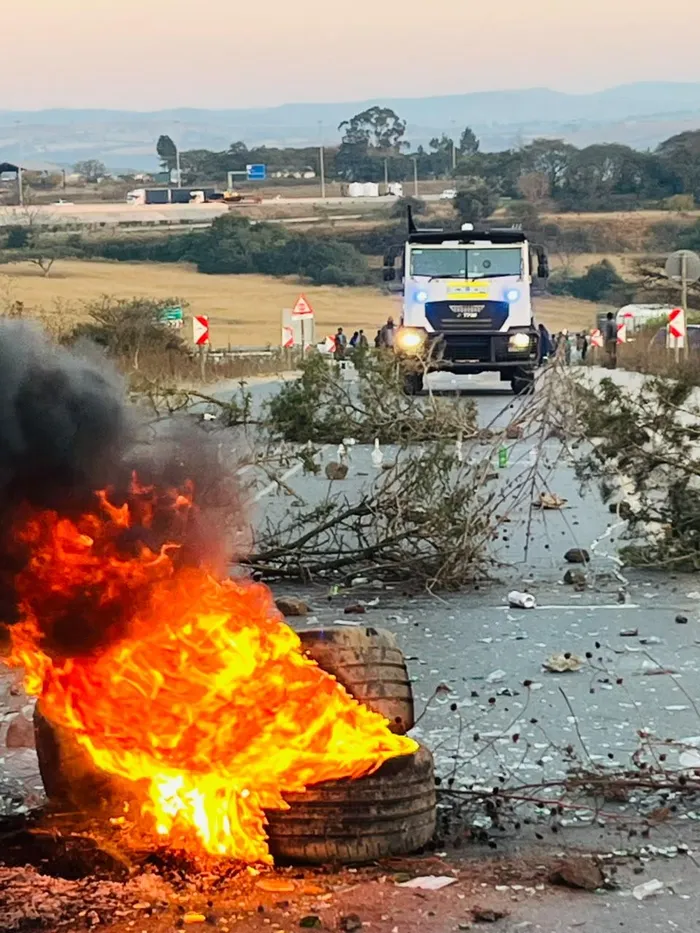
Lion Park residents tried unsuccessfully to block Eskom and the police from entering their village to disconnect the illegal electricity supply on Wednesday.
Image: Supplied
All KwaZulu-Natal residents whose households have electricity illegally connected to Eskom’s grid will soon be subjected to darkness, as there is a massive operation to disconnect.
The utility was busy on Wednesday and Thursday, disconnecting and confiscating loads of transformers and cables that the community of Lion Park in Pietermaritzburg used to steal power.
Residents tried unsuccessfully to block the road leading to Lion Park to prevent Eskom from executing its Pietermaritzburg High Court order to disconnect.
This operation followed another one, which took place at Hardingsdale Farm, which is popularly known as Claridge, in Pietermaritzburg, in March.
“Similar operations will be carried out throughout the province in areas rife with illegal connections,” warned Eskom in a statement released on Wednesday.
Since the disconnection, affording Claridge residents have installed solar panels on their rooftops to keep lights and their household electricity appliances on.
Eskom does not have a total number of villages with illegal connections in the province, but according to its Senior Manager for Customer Services, Dadewabo Mbhele, who spoke to the media in Lion Park, intelligence is on the ground identifying such villages.
“We are planning to also go to the other areas, as in other provinces, you would have seen us disconnecting, for instance, farmers who have been connecting illegally for a very long time.
“We are working with intelligence to have a look at where these areas are where we are losing energy, so that we can make a network safe for the customers that pay us,” said Mbhele.
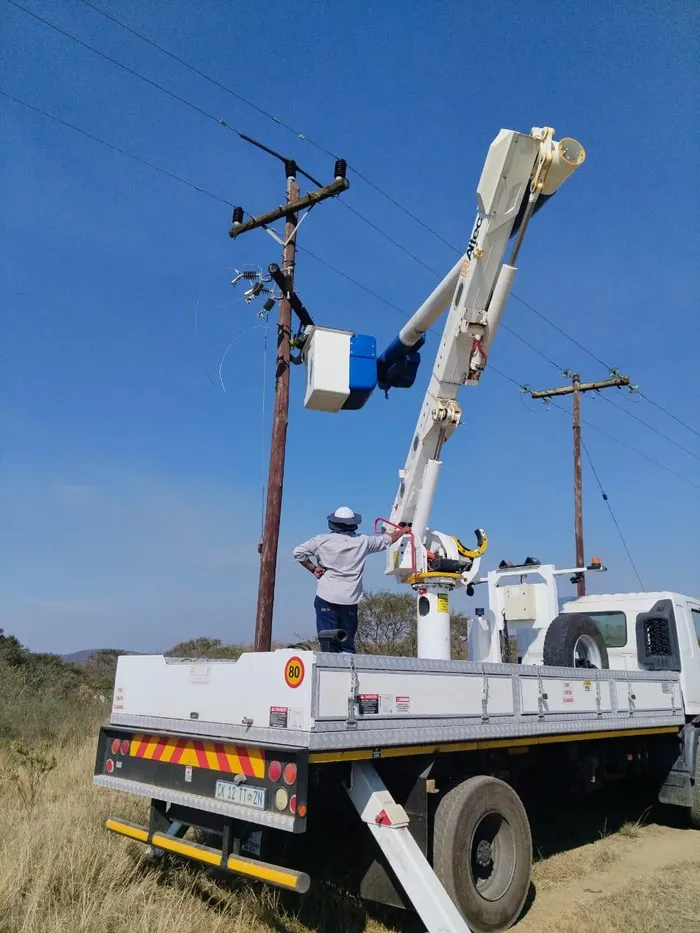
Eskom technicians removing an illegally installed transformer in Lion Park outside Pietermaritzburg on Wednesday.
Image: Bongani Hans
She said in March that the utility estimates it loses approximately R6 billion annually due to illegal connections.
During Eskom’s operation in Lion Park, some residents, who own state-of-the-art houses, told the media that they can afford to pay bills for the legally connected electricity, but they are struggling to convince Eskom to connect them.
Mbhele said households in the area cannot be connected because their land is zoned as agricultural, not residential land.
Eskom said it was committed to providing electricity services lawfully and safely to replace illegal connections that are threatening the integrity and safety of the electricity network.
Both the Lion Park and the Claridge areas have homesteads with expensive mansions.
Eskom remarked that in Lion Park, electricity was illegally connected to households that have grown to over 1,400 over the past 12 years.
“The area (Lion Park) consists largely of high Socio-Economic Measure (SEM) households with the capacity to pay for services.
“Members of the community have constructed extensive illegal electricity infrastructure, including poles, lines, and transformers, to supply power to approximately 1,400 households.
“The unauthorised connections are estimated to result in revenue losses exceeding R14 million per year to Eskom,” read the statement.
Eskom suspects that some of the infrastructure used to connect electricity illegally has been obtained illegally.
“Eskom reiterates that it has a legal obligation, in terms of its electricity distribution licence and the NRS 048 Code, to remove illegal connections and ensure the safe and reliable supply of electricity to all customers.
“Illegal connections place significant strain on the electricity network, increase the risk of outages, and pose serious safety hazards to communities,” the utility said.
Eskom’s statement quoted its chairperson, Dr Mteto Nyati, as saying the country deserved reliable electricity that can only be built on a foundation of accountability and payment for services rendered.
“Non-payment by municipalities and customers isn’t just a financial issue - it is holding back our nation’s progress, investment, and prosperity.
“We have made significant strides in stabilising the grid, but sustainable success demands collective responsibility.
“When we all pay what we owe, we power a stronger, more reliable South Africa for every citizen and business,” said Nyathi.
Eskom Group Investigations and Security General Manager, Tembela Kulu, said the group would never back down on protecting its infrastructure and networks.
“Our teams will continue to support the audit and removal of illegal connections to safeguard Eskom’s assets, protect the integrity of the electricity network, and safeguard our employees’ safety,” said Kulu.
The utility said that while it is costly to identify and remove illegal connections, it is concerned that illegal connections are a risk to human life, as they lead to electrocutions, fires, and damage to critical infrastructure.
Eskom’s Industry and Stakeholder Management Manager, Joyce Zingoni, said the combination of disconnections of illegal connections, community engagements, and smart meter installations is yielding positive results in the fight against electricity theft and the culture of non-payment.
“We will keep executing these activities for the protection of our infrastructure, as long as there are illegal connections and tampering with our network.
“We will continue to raise awareness, educate communities, change the culture, and continue removing illegal connections,” Zingoni said.
The Lion Park land fell under the Azibuye Emasisweni Amaqhamu Community Trust’s administration after it was legally claimed from various farmers.
The trust’s chairperson, Mlungisi Khanyezi, stated on Wednesday that he and the trust’s lawyers were filing an urgent application at the Pietermaritzburg High Court to interdict Eskom from carrying on with the disconnection.
On Thursday, he said the court rejected the trust's urgent application.
“The court said we were late in opposing the order that it had granted Eskom. Our lawyers argued that they were given short notice to oppose, but since the judge had made the decision, we could not argue further,” said Khanyezi.
He said the trust was now considering accepting Eskom's offer for bulk electricity, whereby residents would be combined in one bill.
Some residents had opposed the bulk supply, saying that they are against paying one bill when there was a possibility that some of them would overconsume the power.
Khanyezi said the trust would meet with the residents to convince them to accept the bulk offer.
“I believe that we should now work together because, at the end of the day, everyone needs electricity. The community should now plead with Eskom to assist us,” said Khanyezi.
The entity has appealed to members of the public to blow the whistle by reporting on illegal connections via its crime line on 0800 11 27 22, via WhatsApp on 081 333 3323, via email at [email protected], or via SMS Line on 31090. Reports can be made anonymously.