

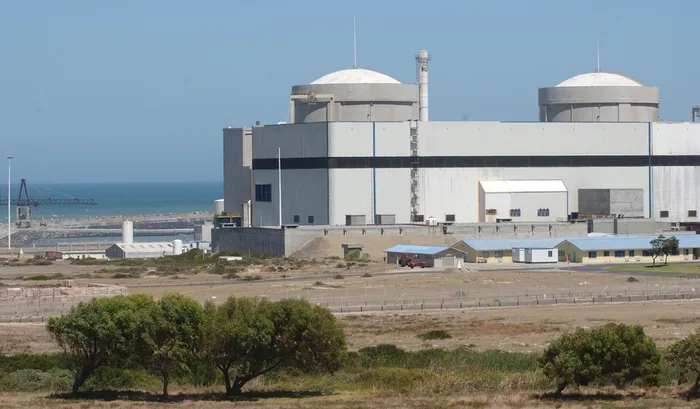
In a statement, Eskom confirmed that there has been no radiation leak during recent routine maintenance activities at Koeberg Nuclear Power Station’s Unit 2.
Image: Ian Landsberg/Independent Newspapers
Eskom has confirmed that there has been no radiation leak during recent routine maintenance activities at Koeberg Nuclear Power Station’s Unit 2, which has been on a scheduled outage since April.
In a statement, Eskom said no iodine tablets were needed to be administered to employees and there was no impact on employees, the public or the environment.
“The event has been classified as Level 0 (No Safety Significance) on the International Nuclear and Radiological Event Scale (INES), the lowest possible rating, indicating that there was no impact on nuclear safety, plant operations, employees, the public or the environment,” Eskom said.
“The National Nuclear Regulator (NNR) was informed in line with regulatory requirements. At no stage was there any release of radioactive material beyond the containment structures, and there was no risk to surrounding communities or the environment.”
Eskom said that during scheduled inspections of the steam generators that are used to produce electricity, highly sensitive radiation monitoring equipment detected two brief and localised airborne radioactivity events within a controlled work area inside the containment building on 2 and 7 July.
Eskom added that these detections were confined to the designated work zone, remained well within the plant’s protected barriers and were managed according to established radiation protection procedures.
“The event was safely managed to international standards by Koeberg’s highly trained teams, with no impact on nuclear safety, plant operations, maintenance activities or the planned scheduled outage completion date of November 2026. The outage remains on schedule and Koeberg Unit 1 remains in full operation.”
Eskom added that the Eddy Current Testing inspections are performed using operated robotic equipment probes positioned inside part of the steam generator.
“During the movement of the inspection probes through the steam generator tubes, a very small quantity of microscopic oxide particles, commonly referred to in the nuclear industry as "crud", became airborne within the enclosed work area.”
Eskom said that the purpose of ECT is to establish a baseline for tubes inside the steam generator and the thickness of the tubes to identify any signs of wall thinning long before they could affect plant performance or safety, in order to maintain the integrity of the barrier between the reactor coolant system and the secondary steam system.
“This process uses ECT, a globally applied, non-destructive inspection technique,” it said.
Eskom added that minor airborne particulate transients of this nature are a well-understood and documented phenomenon that can occur during steam generator inspection activities at pressurised water reactors worldwide.
“The industry employs robust containment, ventilation and monitoring systems specifically to detect and manage such occurrences safely.”
Eskom said that all monitoring results confirmed that the transient remained confined within the controlled work area and that there was no release of radioactive material to the environment.
“The event did not affect the safe operation of the station and maintenance activities have continued under established safety controls. The personnel were provided with a full safety debriefing following the event,” said the power utility.
“This event demonstrated the effectiveness of Koeberg's defence-in-depth approach, with monitoring, containment and radiation protection systems functioning as designed and providing early detection and control of the transient.”
Eskom added that they remain committed to maintaining the highest standards of nuclear safety, regulatory compliance and transparency in the operation of Koeberg Nuclear Power Station.
BUSINESS REPORT