

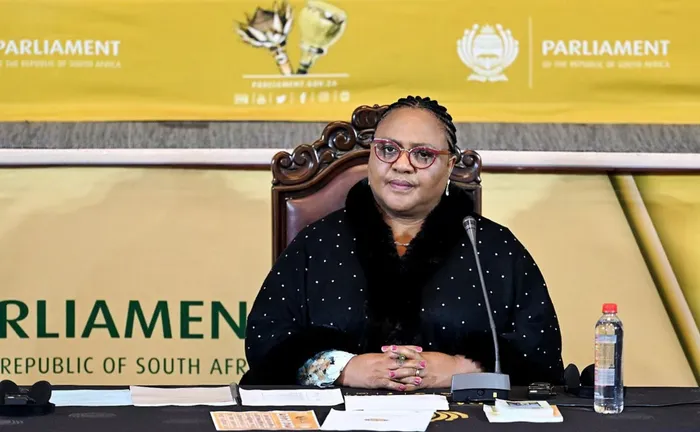
Speaker Thoko Didiza's decision to remain neutral in the impeachment inquiry against President Cyril Ramaphosa raises critical questions about the role of Parliament, institutional integrity, and constitutional democracy in South Africa.
Image: File Picture
In constitutional democracies, there are moments when restraint becomes a more profound exercise of power than intervention. National Assembly Speaker Thoko Didiza's decision not to oppose President Cyril Ramaphosa's application to interdict Parliament's impeachment committee may well represent such a moment.
Predictably, critics have characterised the Speaker's stance as passive, politically convenient, or even protective of the president. Yet a more sophisticated constitutional reading suggests that Didiza's position may be rooted not in political allegiance but in an institutional understanding of the Speaker's office and the separation of powers.
The South African Constitution assigns the Speaker a unique role. While elected through political processes, the Speaker is ultimately a constitutional custodian of parliamentary integrity. The office exists not to advance the interests of government or opposition, but to safeguard the legitimacy of parliamentary processes themselves.
The crucial question is therefore not whether President Ramaphosa's legal challenge is persuasive. That question belongs to the courts. The constitutional question is whether the Speaker should transform herself into an active litigant in a dispute where Parliament's own committee has already elected to defend its mandate. There are compelling reasons why she may have declined to do so.
First, constitutional neutrality matters. The impeachment committee was established pursuant to the Constitutional Court's judgment requiring Parliament to revisit the Section 89 process. The committee is now performing a quasi-investigative constitutional function. By remaining formally neutral, the Speaker avoids creating the impression that she has prejudged either the committee's work or the president's challenge.
Second, the doctrine of institutional differentiation within Parliament must be respected. Parliament is not a monolithic actor. The National Assembly, its committees, and the Speaker perform distinct constitutional functions.
Once the impeachment committee resolved to defend its own mandate, the Speaker could reasonably conclude that Parliament's interests were already represented before the court. Third, there is a deeper constitutional principle at stake: judicial determination of constitutional uncertainty.
President Ramaphosa argues that the committee's work should be suspended pending the review of the underlying panel report. Whether that argument succeeds is less important than ensuring that the dispute is adjudicated through lawful judicial channels rather than political confrontation.
By abiding by the court's decision, the Speaker reinforces the principle that constitutional disagreements should be resolved through institutions rather than through political escalation. This approach is consistent with an understanding of constitutional democracy in which procedural legitimacy is itself a constitutional value.
A Speaker who enters the litigation aggressively risks becoming a participant in the very controversy she is constitutionally required to manage. None of this means that Didiza's position is beyond criticism.
Opponents may argue that Parliament has a constitutional duty to defend its authority against executive encroachment. They may contend that a failure to oppose the president's application weakens legislative independence and creates the appearance that Parliament is reluctant to hold the executive accountable.
These concerns deserve serious consideration. Yet they assume that parliamentary independence can only be demonstrated through litigation. Constitutional practice suggests otherwise. Independence may also be demonstrated by allowing Parliament's duly constituted committee to defend its own mandate while the Speaker preserves the institutional impartiality of her office.
Ultimately, Didiza's decision reflects a larger constitutional tension that has existed since 1994: whether constitutional accountability is best advanced through political contestation or through procedural restraint.
Her answer appears to be that the Speaker's office should stand above the immediate conflict and permit the judiciary to determine the proper constitutional path forward. In an era increasingly defined by institutional polarisation, such restraint may not satisfy either side of the political divide.
But constitutional leadership is often measured not by how forcefully an officeholder enters a dispute, but by how carefully they preserve the legitimacy of the institutions entrusted to them. If that is indeed Didiza's reasoning, her stance is not one of avoidance.
It is a constitutional statement that the rule of law, rather than political combat, must ultimately determine the fate of South Africa's first modern presidential impeachment inquiry.
Mbikwana is a scholar writing in his personal capacity on matters of constitutional law and democratic governance.