

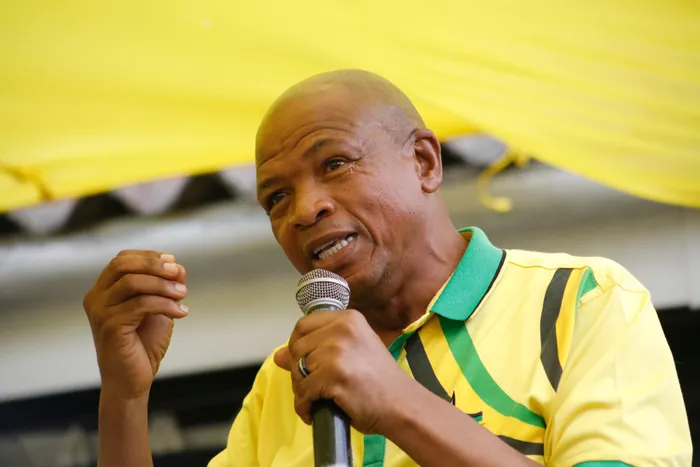
ANC MP Supra Mahumapelo
Image: Doctor Ngcobo / Independent Newspapers
Former North West Premier and Chairperson of Parliament’s Portfolio Committee on International Relations and Cooperation, Supra Mahumapelo, says the African National Congress (ANC) has developed a comprehensive recovery strategy aimed at regaining control of key municipalities lost during previous local government elections.
Mahumapelo’s remarks come as the governing party prepares for another critical electoral contest amid persistent concerns over internal divisions, declining electoral support in urban centres and the lingering political impact of the Phala Phala controversy involving President Cyril Ramaphosa.
Speaking during an interview, Mahumapelo acknowledged that the ANC had suffered significant setbacks in municipalities such as Tshwane and Johannesburg but insisted that the party had undertaken a thorough assessment of its shortcomings and was implementing measures to reverse its fortunes.
“Based on the ANC’s performance in the last local government elections, we have seen and analysed where we went wrong,” said Mahumapelo.
“And after that analysis, we have developed intervention mechanisms to overcome the obstacles that resulted in us reducing and losing some of the municipalities like here in Tshwane, Johannesburg and so on.”
The ANC’s losses in the 2021 local government elections marked one of the most significant declines in support since the advent of democracy, resulting in coalition governments taking control of several major metros. The outcome exposed growing frustration among voters over service delivery failures, corruption allegations, economic hardship and factional battles within the governing party.
Mahumapelo said the ANC’s response centres on rebuilding trust at the community level and improving direct engagement with voters.
“The plan we have in place includes, among others, speaking better, consistently and more in touch with the people on the ground,” he said.
“Firstly, on what it is that we have achieved. Secondly, what is in the pipeline? Thirdly, on how the ANC can be used by people as their own instrument to overcome the challenges that they face.”
According to Mahumapelo, one of the lessons drawn from previous campaigns is that the party often focused too heavily on electioneering and not enough on listening to communities.
“I think sometimes we are in a hurry when we campaign. We have agreed that we must reduce the pace a bit so that we listen more to the people,” he said.
“Our plan is such that we will be able to recover most of the municipalities. So let’s push and see what the results will be like.”
The comments come at a time when the ANC continues to face questions about the potential political fallout from the Phala Phala matter, which remains one of the most contentious issues confronting President Cyril Ramaphosa’s administration.
Asked whether the controversy could affect the ANC’s electoral prospects, Mahumapelo said the matter had already been discussed by the party’s National Executive Committee (NEC), which had resolved that senior leadership structures would manage its political implications.
“The National Executive Committee has discussed the Section 89 report of Parliament,” he said.
“Our agreement as the National Executive Committee is that the leadership at the high echelons of the organisation will attend to the political dynamics of the matter and the political imperatives.”
He said responsibility for managing developments in Parliament rests with the ANC’s parliamentary leadership.
“In Parliament, the Chief Whip will be at the helm of the matter, working with the Office of the Secretary-General. The rest of us must focus on our work and make sure that the ANC wins the elections.”
While expressing confidence in the party’s campaign strategy, Mahumapelo conceded that it remains unclear whether the Phala Phala issue could influence voter behaviour.
“Well, we don’t know,” he said when asked directly whether the controversy would have an impact on the ANC’s electoral performance.
“What we have developed as the ANC is that our programme, particularly from perceptions’ point of view, must be such that it helps us to manage the perceptions that it can impact on the performance of the ANC in the elections.”
His comments underscore the challenge facing the ANC as it seeks to balance governance, organisational renewal and electioneering while navigating controversies that continue to dominate the national political discourse.
With coalition politics increasingly shaping South Africa’s municipal landscape and voter support becoming more fragmented, the ANC’s ability to reconnect with communities and convince voters that it remains capable of addressing their concerns may ultimately determine whether it can reclaim the metros that have slipped from its grasp.
For Mahumapelo, however, the party’s immediate focus is clear: listen more closely, reconnect with communities and turn lessons from past defeats into electoral gains.
IOL News