

ATM Parliamentary Leader Vuyo Zungula says the party will oppose President Cyril Ramaphosa’s court bid to halt the Phala Phala impeachment inquiry, calling it an attempt to delay accountability.
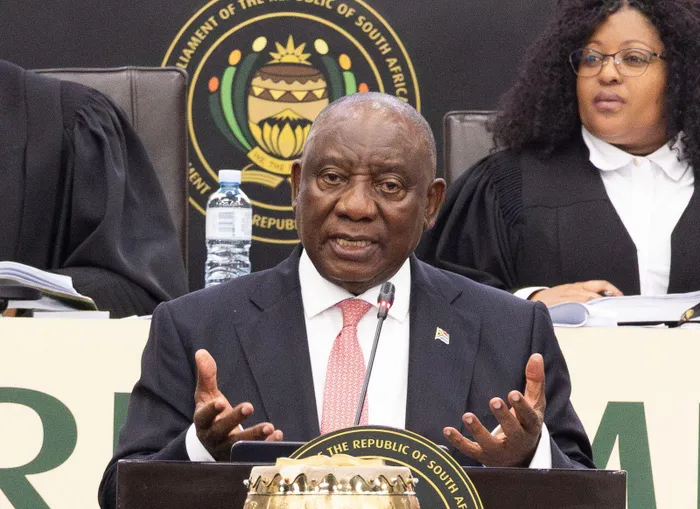
Image: GCIS
ATM’s Parliamentary Leader Vuyo Zungula says the African Transformation Movement will oppose President Cyril Ramaphosa’s urgent court application seeking to halt Parliament’s impeachment inquiry into the Phala Phala farm scandal, accusing the President of attempting to delay accountability through the courts.
This comes after Ramaphosa launched an urgent court bid to halt Parliament’s impeachment process linked to the Phala Phala scandal.
He filed papers in the Western Cape High Court on Friday seeking to review and set aside the Section 89 independent panel report, which found there was prima facie evidence that he may have violated the Constitution and committed serious misconduct in connection with the 2020 burglary at his Phala Phala farm.
Ramaphosa argued that the impeachment process should not continue while he challenges the underlying report in court.
He made the remarks during an interview on Newzroom Afrika, where he confirmed that the party’s legal team was finalising opposing papers that would be filed either on Monday or Wednesday.
Zungula said Ramaphosa’s argument that he would suffer irreparable harm if the Section 89 impeachment inquiry proceeded was not convincing, insisting that the process was necessary for transparency and public accountability.
He questioned what damage the President could suffer from a process aimed at establishing the facts.
“What harm can possibly come out of such a process?” he said, adding that South Africans deserved full answers on the allegations surrounding the Phala Phala matter.
Zungula said the timing of the President’s court application also raised serious questions, noting that it came more than a month after the impeachment process had already begun unfolding.
He pointed to earlier Constitutional Court developments and Parliament’s subsequent establishment of the Section 89 committee, arguing that the process was already well underway before the urgent application was filed on 12 June.
Zungula also referenced the committee’s leadership structure and administrative processes, including communications involving Makashule Gana as part of the parliamentary process, saying these developments showed that the inquiry was already actively underway before Ramaphosa approached the court.
Zungula said the ATM’s legal advice was that the President was “badly advised” in seeking to interdict Parliament from carrying out its constitutional mandate.
He said Parliament was acting within its rights and obligations in continuing with the inquiry.
“Parliament is doing its own processes when it comes to holding him accountable,” he said.
He argued that the impeachment process itself was not arbitrary, but followed instructions stemming from the Constitutional Court, which had previously directed Parliament to correct procedural deficiencies in its handling of the matter.
Zungula said this made it difficult for the President to now seek to halt the process through urgent court intervention.
He added that it was unprecedented for a sitting head of state to attempt to stop Parliament from executing a constitutionally mandated accountability mechanism.
On the role of the Speaker of the National Assembly Thoko Didiza, Zungula said the ATM would closely watch whether she joins the court proceedings to oppose the President’s application.
He said this would be a key test of institutional independence and Parliament’s willingness to defend its own processes.
“We are going to judge the Speaker based on this particular process,” he said, adding that the head of Parliament must act to protect the institution’s integrity.
Zungula alleged that the Speaker operated under political pressure from the ANC, claiming that past parliamentary leadership had acted on party instructions.
He said the ATM would assess her credibility based on whether she actively defends Parliament in court against the President’s challenge, warning that failure to do so would raise questions about institutional independence and political influence.
Zungula described Ramaphosa’s court application as part of what he called “Stalingrad tactics”, arguing that the President was using litigation to delay parliamentary accountability processes.
“He is definitely abusing them,” he said, referring to the use of court processes.
Zungula said the Phala Phala matter raised serious unanswered questions that required full parliamentary scrutiny, and could not be resolved through court intervention alone.
He added that a President must be beyond reproach and able to inspire public confidence, arguing that the current allegations undermined that standard.
Zungula maintained that Parliament, not the courts, was the proper forum to test the facts of the matter.
He warned that any attempt to halt the impeachment inquiry could undermine both Parliament’s authority and the Constitutional Court’s earlier rulings on the matter, which had reinforced the need for a proper inquiry process.
IOL Politics