

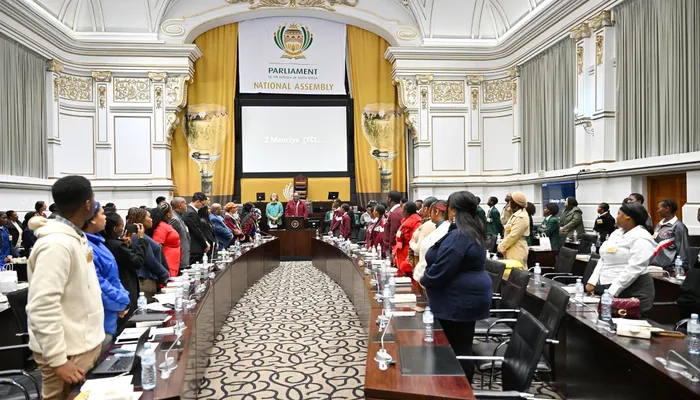
As South Africa embarks on contentious impeachment proceedings, the core issue at stake revolves not only around the presidency but also around the very integrity of Parliament itself.
Image: Phando Jikelo/ParliamentRSA
As legal papers are filed in urgent court applications, as parliamentary committees prepare for hearings that may or may not proceed, and as political parties rehearse familiar accusations in the language of principle while meaning something closer to power, South Africa may be missing the most important constitutional drama unfolding before its eyes.
The real impeachment underway is not that of President Cyril Ramaphosa. It is the impeachment of Parliament's credibility, authority, and moral standing as the central institution of accountability in a constitutional democracy.
This is not a statement about one president, nor is it a verdict on one political moment. It is an uncomfortable reflection on a pattern that has become too consistent to ignore: the gradual weakening of Parliament as a site of genuine oversight and its transformation into an arena where political loyalty too often outranks constitutional duty.
The current impeachment proceedings and the president's attempt to interdict them have simply exposed this deeper institutional fault line. What is being tested is not only the legality of a process but also the strength of Parliament's conviction that it still possesses the authority, independence, and courage to investigate the highest office in the land without fear of political consequence or procedural paralysis.
To understand why this moment matters, one must first confront a difficult historical truth. South Africa’s Parliament has, on several defining occasions, struggled to fully exercise its oversight mandate when confronted with executive power at its most politically sensitive points.
The era of Nkandla revealed an institution hesitant to confront presidential accountability decisively, even in the face of Constitutional Court criticism that Parliament had failed to fulfill its obligations.
The years of state capture exposed further fragility, as parliamentary mechanisms often appeared reactive rather than assertive, frequently trailing behind revelations that had already reached the public domain through commissions and civil society rather than originating from robust legislative scrutiny. These are not isolated episodes. They form a continuum that has shaped public perception of Parliament as an institution that often arrives late to accountability, if it arrives at all.
Against this backdrop, the current impeachment process becomes more than a legal or political contest. It becomes a referendum on whether Parliament has learned from its own institutional history or remains trapped within it.
At the centre of the present tension is a familiar constitutional balancing act. On one side stands the principle that any sitting president, like any citizen, has the right to challenge processes they believe to be unlawful or procedurally flawed.
The courts exist precisely to safeguard that right, and no serious constitutional democracy can deny an individual access to judicial review simply because they occupy high office. This principle is not in dispute. It is a cornerstone of the rule of law.
Parliament is a constitutionally empowered institution of accountability, not a ceremonial body of debate. Its mandate is investigative and supervisory; if its processes can be indefinitely delayed through litigation, oversight risks becoming theoretical rather than functional. The current tension is not merely a partisan or executive dispute, but a critical test of whether Parliament can maintain its practical role in political reality.
We must consider the institutional challenge of balancing procedural fairness with timely accountability. While supporters may view the impeachment as political maneuvering and critics may see legal challenges as obstruction, neither perspective is constitutionally sufficient. Our democratic duty requires a rigorous distinction between investigation and conviction, scrutiny and persecution, and legal process and political outcome to avoid reducing this moment to mere political theatre.
This distinction is precisely where democratic systems succeed or fail. In mature constitutional democracies, institutions are expected to operate even when the political temperature rises. Investigations do not pause because they
are uncomfortable. Legal challenges do not automatically imply guilt. Parliamentary oversight does not lose legitimacy simply because it targets powerful individuals. Yet in politically polarised environments, these distinctions begin to erode, and institutions are judged not by their constitutional function but by their political consequences.
South Africa is increasingly vulnerable to this erosion. The result is a public discourse in which Parliament is either seen as an extension of political power or as a battlefield for factional contestation, rather than as an independent constitutional actor.
This perception is not only damaging in symbolic terms. It has practical consequences. An institution that is not widely trusted to act independently struggles to command compliance, respect, or legitimacy when it eventually does act.
What makes the present impeachment proceedings particularly significant is that they force Parliament to confront this perception directly. The institution is is now required to demonstrate, in real time, whether it can proceed with a constitutionally mandated process while simultaneously respecting judicial authority and procedural fairness.
Constitutional oversight and accountability are mandatory, not matters of political convenience. While the relationship between the courts and Parliament is often seen as adversarial, these institutions must reinforce one another: the courts ensure legality, while Parliament ensures accountability.
The presidency remains subject to both. This dispute must be understood within this architecture, as any overreach or underperformance by these institutions incrementally weakens our democratic system.
Yet perhaps the most important question is not what the courts will decide or how Parliament will proceed. The most important question is what this moment reveals about the evolution of South Africa’s democratic institutions over time.
Have they matured into resilient structures capable of withstanding political pressure, or have they become increasingly fragile, dependent on judicial intervention to perform their most basic functions?
The answer will not be determined by a single case or a single president. It willbe revealed in patterns of behaviour, institutional responses, and the willingness of public representatives to place constitutional duty above partisan instinct.
This is why the phrase “impeachment of Parliament” is not merely rhetorical. It captures a deeper anxiety about whether the institution still commands the moral and constitutional authority required to hold the executive accountable in moments of genuine national significance.
A parliament that cannot effectively scrutinise power risks becoming a constitutional form without constitutional force. It may continue to debate, to convene, and to deliberate, but it will struggle to enforce the accountability that gives those activities meaning.
The irony is that this erosion does not require dramatic collapse. It occurs gradually, through delay, hesitation, procedural avoidance, and political caution disguised as institutional prudence. And so the question returns with increasing force: what exactly is being tested in this moment?
It is not only the conduct of a president. It is the capacity of Parliament to act as Parliament. It is the willingness of a constitutional democracy to treat accountability not as an event triggered by political crisis but as a continuous obligation.
It is the ability of institutions to remember that their legitimacy is not derived from political convenience but from constitutional responsibility. History will not judge this moment solely by its legal outcome. It will be judged by what it reveals about the strength or fragility of South Africa's democratic architecture.
Because, in the end, the real impeachment is not of Cyril Ramaphosa. It is of Parliament. And the verdict, for now, is still being written.
Qwesha is a trade finance consultant with expertise in global commerce and risk management and regularly contributes to a number of publications