

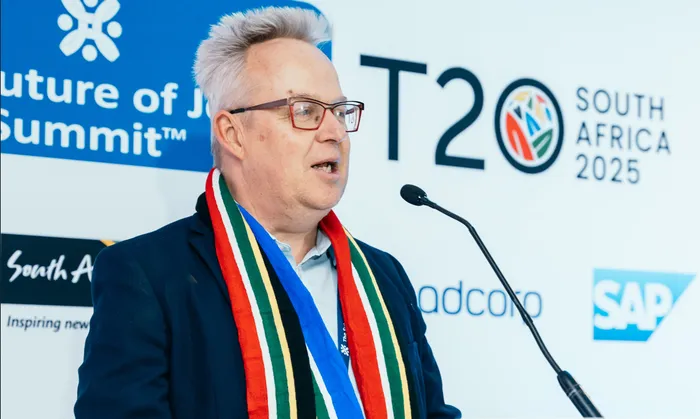
Dr Nik Eberl is the founder and executive chair: The Future of Jobs Summit™ (Official T20 Side Event). He is also the author of Nation of Champions: How South Africa won the World Cup of Destination Branding).
Image: Supplied
What is South Africa's most valuable national asset? Many would point to our mineral wealth, our entrepreneurial spirit, our strategic location, or our abundant natural resources. Others would argue it is our Constitution, our financial institutions or the resilience of our people.
All are important. But there is another asset—one that cannot be mined, taxed or measured on a balance sheet. It is the invisible force that determines whether nations rise or decline. That asset is collective belief.
The world's most successful nations are not simply those with the strongest economies or the richest natural resources. They are societies where people share a belief in a common future; where citizens trust one another enough to cooperate, entrepreneurs believe opportunity exists, investors have confidence to commit capital, and young people believe tomorrow can be better than today. Nations run on confidence long before they run on capital.
As we mark Mandela Month, it is worth asking whether South Africa's greatest challenge is not only economic or political, but psychological. Have we stopped believing? Recent public debates around immigration, crime, unemployment and economic inequality reveal a country under immense strain. These are real challenges that require serious policy responses and honest public debate.
Yet alongside these legitimate concerns, something more subtle is taking place. Our social cohesion is fraying. Public trust is declining. Confidence is weakening. And when confidence disappears, prosperity becomes increasingly difficult to build. This is not simply an opinion. It is supported by science.
Behavioural scientists have long demonstrated that beliefs shape behaviour. People who believe their efforts matter are more likely to persevere, innovate and invest in the future. Conversely, when people lose hope, they withdraw. They become more risk-averse, less entrepreneurial and less willing to collaborate.
The same principle applies to societies. Economists often speak about investor confidence. But investor confidence is simply one expression of a much broader phenomenon: collective belief. Businesses invest because they believe markets will grow. Families educate their children because they believe opportunity awaits. Entrepreneurs build companies because they believe their efforts will be rewarded. Communities cooperate because they believe others will do the same.
Belief becomes behaviour. Behaviour becomes performance. Performance reinforces belief. This creates either a virtuous cycle—or a destructive one. South Africa has experienced both. There have been moments when we collectively believed in ourselves. The transition to democracy was one. The 1995 Rugby World Cup was another.
The 2010 FIFA World Cup demonstrated what becomes possible when government, business, civil society and ordinary citizens unite behind a shared purpose. Against widespread scepticism, South Africa delivered one of the most memorable tournaments in FIFA history and introduced the world to a nation capable of achieving extraordinary things.
For a brief moment, South Africans remembered what collective belief feels like. That feeling mattered. Because belief is contagious. So is cynicism. Today, negativity often dominates our national conversation. Social media rewards outrage. Headlines amplify failure. Political discourse frequently divides rather than unites.
Criticism has an important place in any democracy. Democracies need accountability, transparency and vigorous debate. But there is an important distinction between constructive criticism and collective despair. No nation has ever talked itself into prosperity.
History tells a remarkably consistent story. Post-war Germany rebuilt confidence before it rebuilt global competitiveness. Singapore combined visionary leadership with an unwavering belief that a resource-poor island could become one of the world's leading economies. South Korea transformed itself from one of the world's poorest countries into one of its most innovative by cultivating a shared national commitment to education, excellence and long-term progress.
Their success was never built on optimism alone. It was built on shared belief translated into disciplined action. South Africa requires exactly the same formula. Belief is not a substitute for economic reform. It cannot replace competent governance, sound policy or ethical leadership. But neither can reforms succeed if a nation no longer believes improvement is possible.
Leadership therefore has a responsibility far greater than managing institutions. Leadership creates belief. The leaders who leave the deepest legacy are those who expand what people believe is possible.
That may be Nelson Mandela's greatest contribution to South Africa. His extraordinary achievement was not simply negotiating a peaceful transition to democracy. He inspired millions of South Africans—and millions around the world—to believe that reconciliation was possible when conflict seemed inevitable, that hope could triumph over fear, and that a shared future was stronger than a divided past. He understood that before people change their behaviour, they must first change what they believe.
Perhaps that is the challenge facing every South African today. Business leaders must create organisations people believe in. Political leaders must rebuild trust through integrity and delivery. Educators must help young people believe their potential exceeds their circumstances. Communities must rediscover the value of social cohesion over social division.
And each of us has a choice about the stories we tell ourselves and one another. Do we reinforce decline, or do we become builders of confidence? The future of South Africa will not be determined by GDP alone. Nor by elections alone. Nor by global markets alone. It will also be determined by whether we can rebuild the invisible asset upon which every prosperous society ultimately depends. Collective belief.
Because when a nation believes in itself, it becomes capable of achieving far more than anyone thought possible. And perhaps that is the most important investment South Africa can make—not only in its economy, but in its future.
Dr Nik Eberl is the founder and executive chair: The Future of Jobs Summit™ (Official T20 Side Event). He is also the author of Nation of Champions: How South Africa won the World Cup of Destination Branding).
Follow Business Report on Facebook, X and on LinkedIn for the latest Business and tech news.