

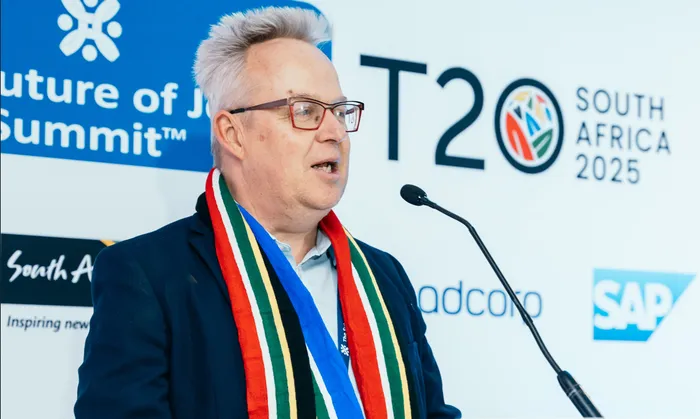
Dr Nik Eberl is the founder and executive chair: The Future of Jobs Summit™ (Official T20 Side Event). He is also the author of Nation of Champions: How South Africa won the World Cup of Destination Branding).
Image: Supplied
South Africa may be asking the wrong question. For years, our national debate has centred on one statistic: the unemployment rate.
Every quarter, the country collectively holds its breath as Statistics South Africa releases the latest figures, and the inevitable debate follows. Is unemployment improving or deteriorating?
Recently, respected business leader Gerrie Fourie, the former CEO of Capitec, joined economist and entrepreneur GG Alcock in challenging the official narrative.
Their argument is both provocative and important.
They contend that South Africa's true unemployment rate may be far lower than the official figure of around 32%.
Across townships, informal settlements and rural communities, millions of South Africans are generating income every day—renting out backyard rooms, repairing vehicles, braiding hair, running spaza shops, delivering parcels, selling food, fixing phones, offering childcare, and participating in the thriving informal economy.
They make an important point. South Africa's informal economy is significantly underestimated.
But I believe this debate is still missing the bigger issue. The real question is not whether someone earns an income.
The real question is whether they have a job.
These are not the same thing. Income is one outcome of work. A job is a far richer human experience.
If we reduce employment to income alone, we fundamentally misunderstand why work matters.
The International Labour Organization speaks about "decent work", but perhaps it is time we expand the conversation even further.
A meaningful job performs several essential functions in a person's life. It fulfils deep psychological, social and developmental needs that no income statistic can adequately measure.
From my research into motivational intelligence and future leadership, I believe every great job delivers seven forms of value.
The first is assurance. Income matters. Financial security enables people to feed their families, pay rent, educate their children and plan for tomorrow. Without economic assurance, dignity is fragile. But assurance is only the beginning.
The second is challenge. Human beings are wired to solve problems, master skills and overcome obstacles.
Good work stretches us. It builds confidence through achievement.
A life without meaningful challenge eventually becomes emotionally draining, even if it generates an income.
Third is connection. Work connects us with colleagues, customers, suppliers, mentors and communities. It creates trust, friendships and social capital.
Countless studies show that loneliness is one of the greatest threats to human wellbeing. A healthy workplace provides one of society's most important networks of belonging.
Fourth is significance. People want to know that they matter. They want to believe their work improves someone else's life.
Whether serving customers, treating patients, teaching learners or designing software, meaningful work gives individuals the feeling that they are making a contribution beyond themselves.
Fifth is growth.
Every worthwhile job should develop the individual. It expands knowledge, strengthens emotional intelligence, builds resilience and improves judgement.
The greatest organisations do not simply employ people—they grow people.
Sixth is contribution.
Work allows individuals to create value for society. Every entrepreneur creates opportunities for others. Every artisan builds infrastructure.
Every nurse heals communities. Every teacher shapes future generations. Employment is ultimately about serving others through one's talents.
Finally comes higher purpose.
The most fulfilling careers connect daily activity with something larger than ourselves. People increasingly want purpose alongside pay. They want to know not only what they do, but why it matters. Organisations that help employees discover meaning consistently outperform those driven purely by financial incentives.
These seven dimensions explain why employment remains one of society's most powerful institutions. Yes, millions of South Africans display extraordinary entrepreneurial resilience.
We should celebrate that.
But we should also recognise that surviving is not the same as thriving.
A woman renting out a backyard room demonstrates remarkable initiative. A young man repairing phones from home is building valuable entrepreneurial capability. These activities deserve recognition and support.
Yet many still lack predictable income, opportunities for learning, professional networks, career progression, social protection, mentorship and long-term security.
The danger of redefining everyone who earns any income as "employed" is that it risks lowering our national ambition. South Africa does not simply need more income earners. We need millions more meaningful jobs.
That distinction changes everything. It shifts our focus from unemployment statistics towards job quality. It changes education from preparing people merely to earn a living to preparing them for lifelong growth.
It challenges business leaders to design organisations that develop human potential rather than merely extracting labour.
It reminds policymakers that economic success cannot be measured only by GDP or employment percentages but also by whether people are flourishing. Perhaps the future of work debate should therefore evolve.
Instead of asking, "How many people have an income?" We should ask, "How many South Africans have work that provides assurance, challenge, connection, significance, growth, contribution and purpose?"
That is the statistic that truly matters. Because the ultimate job to be done by a job is not simply to pay people.
Its purpose is to help people build meaningful lives. And until our employment debate recognises that, we will continue solving the wrong problem.
Dr Nik Eberl is the founder and executive chair: The Future of Jobs Summit™ (Official T20 Side Event). He is also the author of Nation of Champions: How South Africa won the World Cup of Destination Branding).
Follow Business Report on Facebook, X and on LinkedIn for the latest Business and tech news.