

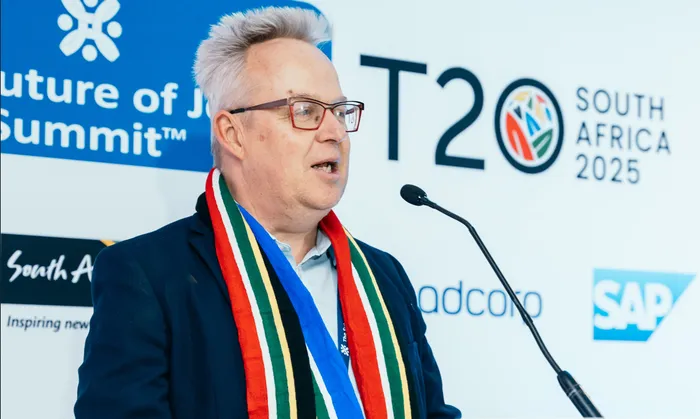
Dr Nik Eberl is the founder and executive chair: The Future of Jobs Summit™ (Official T20 Side Event). He is also the author of Nation of Champions: How South Africa won the World Cup of Destination Branding).
Image: Supplied
Sixteen years ago, South Africa achieved something extraordinary.
The 2010 FIFA World Cup was more than a sporting event. It was a nation-building project, a tourism campaign and a global rebranding exercise rolled into one. For one unforgettable month, the world saw a different South Africa: confident, capable, welcoming and united.
As South Africa, Zimbabwe and Namibia prepare to jointly host the 2027 ICC Cricket World Cup, Southern Africa finds itself standing before another once-in-a-generation opportunity. The question is not whether the tournament will be successful. It almost certainly will be.
The real question is whether we can transform a cricket tournament into a tourism legacy that benefits the region long after the final ball is bowled.
The encouraging news is that Cricket South Africa appears to understand precisely what is at stake.
Unlike many sporting events that focus solely on stadiums and logistics, the 2027 World Cup is increasingly being viewed as a regional tourism platform.
Cricket South Africa's collaboration with tourism authorities across the three host nations signals an important shift in thinking: this is not simply about hosting cricket matches. It is about showcasing Southern Africa to the world.
That distinction matters.
The modern traveller is not looking for a single destination. They are looking for experiences. They are looking for stories. They are looking for journeys. The unique advantage of the 2027 Cricket World Cup lies in the fact that it offers exactly that.
Visitors will have the opportunity to experience South Africa's vibrant cities, world-renowned wine routes, wildlife reserves and cultural heritage.
They can combine this with Namibia's spectacular desert landscapes and adventure tourism offerings.
They can then extend their journey to Zimbabwe and experience one of the world's great natural wonders, Victoria Falls. Few regions anywhere in the world can offer such diversity within a single travel experience.
This presents Southern Africa with a powerful proposition: one tournament, three countries and countless unforgettable experiences.
The economic implications are significant.
Tourism remains one of the most effective industries for generating employment, stimulating local economies and supporting small businesses. Unlike many sectors, tourism spreads its benefits widely across society. Hotels, restaurants, transport providers, tour operators, retailers, entertainment venues and local communities all share in the economic impact.
Cricket South Africa has correctly identified major cricket markets such as India, the United Kingdom and Australia as priority targets.
This is particularly important in the case of India, which today serves as the financial engine of global cricket.
Indian cricket fans are among the most passionate and engaged sporting audiences in the world. Their presence at major tournaments drives sponsorship value, hospitality demand and tourism expenditure. Attracting larger numbers of Indian visitors to Southern Africa should therefore be viewed as both a tourism and economic development priority.
Yet perhaps the most underappreciated opportunity lies elsewhere.
Millions of cricket-loving South Asians now live in the United States, particularly in cities such as New York, Chicago, Houston and Dallas.
This diaspora market has demonstrated a strong willingness to travel internationally for major sporting events and possesses significant purchasing power.
For many of these travellers, the appeal extends far beyond cricket.
The prospect of combining World Cup matches with a safari experience, a visit to the Cape Winelands, cultural tourism in Johannesburg or Cape Town, and regional travel across Southern Africa creates a uniquely compelling tourism offering.
The challenge now is converting interest into bookings. This is where Cricket South Africa's collaborative approach becomes particularly important. The organisation's engagement with airlines, tour operators, hospitality providers and tourism authorities reflects an understanding that visitor experiences begin long before supporters arrive at the stadium.
The 2010 FIFA World Cup taught us that the fan experience extends far beyond the venue itself. Visitors remember how they were welcomed.
They remember the people they met.
They remember whether travel was easy, whether service exceeded expectations and whether they felt safe and valued. Those memories ultimately determine whether visitors become ambassadors for a destination. This is where the greatest long-term opportunity lies.
Too often, countries measure the success of major events by visitor numbers alone. That is a mistake.
The true measure of success is repeat visitation.
Every first-time visitor who returns with family and friends years later represents a far greater economic contribution than a once-off tourist. Every visitor who shares positive stories and images with their networks becomes part of a destination's marketing engine. The objective should therefore not simply be to attract visitors in 2027. It should be to create lifelong advocates for Southern Africa.
The region already has reason for optimism. Johannesburg alone attracted approximately 4.29 million visitors in 2024, generating an estimated R69 billion in tourism-related economic activity.
The World Cup presents an opportunity to build significantly on that foundation while distributing tourism benefits across multiple cities and countries.
The tournament may last only a few weeks. The tourism impact, however, can last decades. In 2010, South Africa changed how the world saw our country. In 2027, Southern Africa has the opportunity to change how the world sees an entire region. That is the real prize.
And if we get it right, the 2027 Cricket World Cup may become not only a sporting success, but the greatest tourism success story Southern Africa has produced since the FIFA World Cup captivated the world sixteen years ago.
Dr Nik Eberl is the founder and executive chair: The Future of Jobs Summit™ (Official T20 Side Event). He is also the author of Nation of Champions: How South Africa won the World Cup of Destination Branding).
Follow Business Report on Facebook, X and on LinkedIn for the latest Business and tech news.