

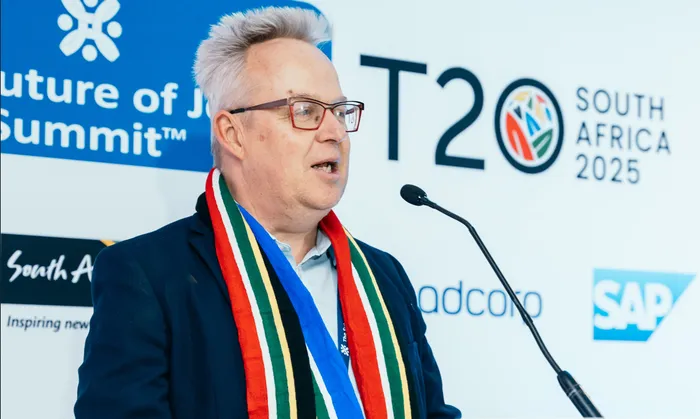
Dr Nik Eberl is the founder and executive chair: The Future of Jobs Summit™ (Official T20 Side Event). He is also the author of Nation of Champions: How South Africa won the World Cup of Destination Branding).
Image: Supplied
South Africans often ask what is wrong with our country. Perhaps a better question is: What are we building together? Throughout history, the world's most successful nations have not been defined by the challenges they faced, but by the projects they chose to pursue.
In 1961, United States President John F. Kennedy challenged America to put a man on the moon before the end of the decade. At the time, the goal seemed impossible. Yet the Apollo programme became far more than a space mission. It united a nation around innovation, ambition and belief in the future.
After the fall of the Berlin Wall, Germany embarked on one of the most ambitious nation-building projects in modern history: the reunification of East and West Germany. The task was not merely economic. It was social, cultural and psychological. It required a shared commitment to building a common future.
Singapore transformed itself from a small island with few natural resources into one of the world's most competitive economies. Rwanda rebuilt itself after one of the darkest chapters in modern history through a deliberate focus on national renewal and citizen participation.
These countries differed in their circumstances, cultures and political systems. Yet they shared one important characteristic. They gave their citizens a common mission. Great nations are rarely built by government alone. They are built when citizens believe they are part of something bigger than themselves.
This is where South Africa faces a challenge.
We have no shortage of plans, policies or strategies. What we often lack is a unifying national project that inspires participation across society.
Too often, our national conversation revolves around what is broken. Crime. Corruption. Unemployment. Load shedding.
These are serious challenges that require urgent attention. But people do not rally around problems. They rally around possibilities.
The remarkable thing about South Africa is that we already know what national unity looks like. We saw it during the Rugby World Cup in 1995. We saw it during the FIFA World Cup in 2010. We see it whenever Bafana Bafana, the Springboks or the Proteas compete on the global stage.
For a brief moment, race, politics and division fade into the background. We become South Africans first. The lesson is not that sport creates unity. The lesson is that sport reveals a unity that already exists. The challenge is sustaining that spirit beyond the final whistle.
We also know that great national projects can deliver tangible returns. The 2010 FIFA World Cup was far more than a sporting event. It was a nation-building project, a tourism project, an infrastructure project and a global reputation project rolled into one.
As a result, not only did South Africa earn the highest Net Promoter Score of all World Cups, a resounding 92% NPS from the visitors (which still stands as the best world cup to date), but FIFA rated our Project Management & Service Delivery 9/10, Major Infrastructure Upgrades (Airports, Roads, Hotels, Gautrain) showcased South Africa’s engineering prowess, our visitors experienced Zero Major Crime in 31 Days, Leisure Tourism went up 31% year-on-year (and Business Tourism by 47% for the City of Cape Town), Business Confidence was rated highest since 1995 (RWC), and we co-created 500,000 New Jobs Every Year from 2004 to 2010, a total of 3 million plus as all stakeholders were working towards one common goal – and the Exchange Rate strengthened to R7/$ (July 2010).
Perhaps the greatest return on investment, however, was less tangible.
For a month, South Africans experienced what it felt like to be united by a common purpose. We believed in ourselves. We welcomed the world. We demonstrated that when government, business, civil society and ordinary citizens align behind a shared goal, extraordinary things become possible.
The true legacy of 2010 was not the stadiums.
It was the confidence that comes from achieving something together.
Perhaps what South Africa needs most is a new national project. Not a government project. A national project. One that business, labour, civil society, communities and citizens can all support.
The specific project matters less than the principle behind it.
People need a reason to believe. They need a vision of the future that is bigger than today's headlines. They need to feel that their contribution matters.
The most successful nations understand that nation-building is not an event.
It is a continuous process of creating shared purpose and shared identity. South Africa's democratic miracle was built on a powerful vision of what was possible.
Thirty-two years later, perhaps the time has come to ask a new question. What is South Africa's next great national project?
Because until we can answer that question, we may continue to drift from one crisis to the next.
But once we do, we may rediscover something that has always been one of our greatest strengths: the ability to achieve extraordinary things when we move forward together. The future will not be built by spectators.
It will be built by citizens who choose to become part of a common mission. And every great nation begins with one.
Dr Nik Eberl is the founder and executive chair: The Future of Jobs Summit™ (Official T20 Side Event). He is also the author of Nation of Champions: How South Africa won the World Cup of Destination Branding).
Follow Business Report on Facebook, X and on LinkedIn for the latest Business and tech news.