

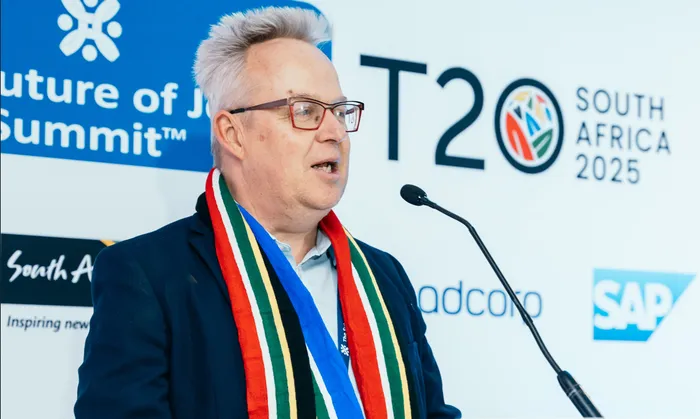
Dr Nik Eberl is the founder and executive chair: The Future of Jobs Summit™ (Official T20 Side Event). He is also the author of Nation of Champions: How South Africa won the World Cup of Destination Branding).
Image: Supplied
South Africa woke up this week to another sobering reminder of the scale of its unemployment emergency.
The latest Quarterly Labour Force Survey released by Statistics South Africa showed that the official unemployment rate rose to 32.7% in the first quarter of 2026, with more than 8.1 million South Africans unemployed.
Even more alarming is the youth unemployment rate, which now stands at 45.8%, while unemployment among those aged 15 to 24 exceeds 60%.
They represent deferred dreams, delayed dignity, growing frustration, and a generation increasingly uncertain about its future.
Yet the national conversation around unemployment remains trapped in old paradigms.
We continue debating industrial models designed for the 20th century while the world is rapidly reorganising itself around entirely new industries, technologies, and skills.
The uncomfortable truth is that many of the jobs our education system is preparing young people for today may not exist at scale in a decade’s time.
At the same time, entirely new industries are emerging globally — industries that could create millions of jobs if South Africa positions itself strategically and acts decisively.
This is precisely why platforms such as the Future of Jobs Summit and the forthcoming Next10: South Africa’s Future-Defining Industries initiative are becoming increasingly important.
They are not conferences in the traditional sense.
They are national strategy platforms designed to bring together business leaders, innovators, policymakers, educators, investors, and youth voices to answer one defining question: How does South Africa become a creator of future industries rather than merely a consumer of them?
The countries that will win the next economic era are not necessarily those with the most natural resources. They will be the nations that build ecosystems around future industries, future skills, and future talent pipelines.
The future of employment will increasingly be shaped by industries such as artificial intelligence, green energy, digital finance, cybersecurity, biotechnology, advanced manufacturing, creative economies, sports economies, agritech, health innovation, and space technologies. South Africa cannot afford to participate at the edges of these industries.
We must become builders within them.
One of the most promising and seldomly acknowledged industries to create jobs for South Africa’s youth at scale is agriculture.
Thanks to advancements of Agritech, agripreneurs are now able to increase production manifold and contribute meaningfully to the food security of the country.
In India alone, agriculture and allied sectors employ more than 43% of India’s workforce — representing hundreds of millions of jobs across farming, food processing, logistics, agri-tech, exports, and rural enterprises.
One initiative that has gained momentum recently is the farming project led by non-profit organisation Afrika Tikkun which is positioning small-scale agritech as a viable start-up opportunity for young people to earn an income and build sustainable livelihoods while contributing to local food security and economic growth.
Participants will work in a customer-designed retail space, gaining hands-on experience in sales and customer service alongside their farming training.
The enterprises enrolled are expected to produce annually:
“When skills development is combined with long-term mentorship, farming stops being just a chore and becomes a sustainable career. These youth aren't just farming for today; they are building the businesses of tomorrow, and it’s up to us to make sure that path remains accessible for them,” says Marc Lubner, Group CEO of Afrika Tikkun.
Lubner says the first intake was structured as an almost all-female cohort, aimed at women with limited access to formal employment or business opportunities.
“This focus reflects a wider economic reality. Women, particularly younger women, face higher unemployment rates, lower business ownership levels and weaker access to startup capital than their male counterparts,” he says.
Rather than placing participants into temporary work, the project is designed around ownership.
“Agriculture can be a powerful engine for jobs, entrepreneurship and community growth. By giving young people access to infrastructure, practical training and market opportunities, we are helping them build viable businesses and long-term income. At the same time, we are strengthening local food security and creating a model that can be scaled to reach many more young people in the years ahead,” Lubner adds.
Creating the job creators of the future means reimagining education around employability and entrepreneurship. It means building stronger public-private partnerships. It means accelerating youth access to internships, mentorship, and digital skills. It means helping small businesses scale into job creators. It means positioning South Africa as a destination for innovation investment.
Most importantly, it means restoring belief. Nations rise when their people believe they can shape the future rather than merely survive it. South Africa’s greatest untapped asset is not underground. It is human potential.
The latest unemployment figures should serve as a national wake-up call. But they should also serve as a national turning point.
The question is no longer whether the world is changing. It already has.
The real question is whether South Africa will lead the industries of the future — or arrive late to them once again.
The answer will determine not only the future of our economy, but the future of an entire generation.
Dr Nik Eberl is the founder and executive chair: The Future of Jobs Summit™ (Official T20 Side Event). He is also the author of Nation of Champions: How South Africa won the World Cup of Destination Branding).
Follow Business Report on Facebook, X and on LinkedIn for the latest Business and tech news.