

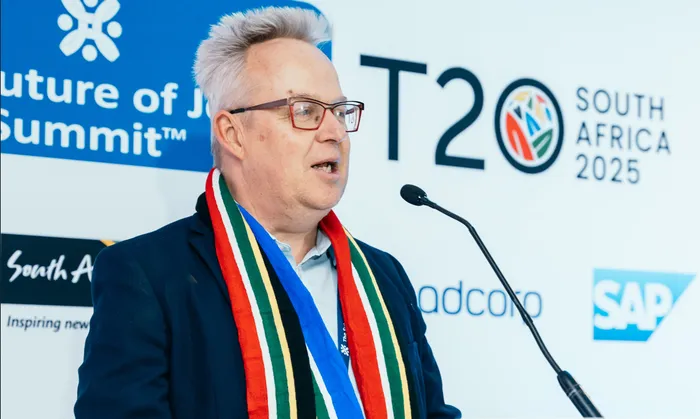
Dr Nik Eberl is the founder and executive chair: The Future of Jobs Summit™ (Official T20 Side Event). He is also the author of Nation of Champions: How South Africa won the World Cup of Destination Branding).
Image: Supplied
Yesterday’s 2026 Future of Jobs Summit™ highlighted an urgent national call to reposition South Africa around future industries, future skills, and future-ready leadership.
The 2026 Future of Jobs Summit™ in Sandton did not begin with optimism. It began with urgency.
Held against the backdrop of South Africa’s worsening unemployment crisis, the summit brought together business leaders, policymakers, educators, innovators, investors, and youth voices at a moment when the country is confronting one of the deepest employment challenges in its democratic history.
The latest Quarterly Labour Force Survey (QLFS) released by Statistics South Africa paints a sobering picture: official unemployment has climbed to 32.7%, more than 8.1 million South Africans remain unemployed, and youth unemployment among 15–24-year-olds stands at a devastating 60.9%.
But perhaps the most important insight emerging from the summit was this: South Africa cannot solve today’s jobs crisis with yesterday’s industries.
The global economy is reorganising itself at extraordinary speed around artificial intelligence, automation, renewable energy, digital services, biotechnology, advanced manufacturing, and entirely new forms of work and entrepreneurship.
New categories of jobs are emerging globally while traditional sectors face increasing disruption.
And yet much of South Africa’s national economic conversation remains anchored in the assumptions of the past. This is not simply a jobs crisis. It is a future-readiness crisis. That reality shaped the central focus of the 2nd Future of Jobs Summit™: Next10!, recognised in 2025 as an official T20 Side Event linked to South Africa’s G20 Presidency.
Rather than positioning itself as another conference filled with abstract policy discussions, the summit was designed as a national strategy platform focused on implementation, collaboration, and future industries.
Throughout the day, speakers repeatedly returned to one central theme: South Africa’s future competitiveness will depend on how quickly the country can align government, business, education, technology, and investment around scalable job creation ecosystems.
Gauteng MEC for Economic Development, Agriculture and Rural Development Hon. Vuyiswa Ramokgopa opened the summit by outlining how Gauteng is working to build a more inclusive growth economy capable of creating opportunities for young people.
Lance Williams, Public Sector Lead at SAP South Africa, challenged delegates to rethink how technology and human potential can collectively rewrite South Africa’s economic story in the age of artificial intelligence.
Melvyn Lubega, Head of the Digital Service Unit in The Presidency, highlighted the growing importance of digital infrastructure and the digital economy in expanding pathways to employment and entrepreneurship for young South Africans.
One of the strongest messages emerging from the summit was that no single sector can solve the unemployment crisis alone.
The 2026 CEO Dialogue™, CHRO Dialogue™, and CMO Dialogue™ brought together business leaders, HR executives, and marketing leaders to discuss practical interventions around youth employability, leadership development, skills alignment, and industry collaboration.
Additional contributions from leaders such as Prof Bismark Tyobeka of North-West University, Marc Lubner of Afrika Tikkun, Faith Mangope of the Faith Mangope Technology & Leadership Institute, and Barry Hendricks of SASCOC reinforced the importance of education, technology, sport, and social innovation in building pathways toward employment and inclusion.
Importantly, the summit was not positioned merely as a discussion platform, but as the beginning of a longer-term national movement around future readiness and collaborative action.
Among the key outcomes announced were:
But perhaps the summit’s most important contribution was psychological rather than technical. At a time when unemployment statistics dominate national headlines and pessimism increasingly shapes public discourse, the summit sought to reposition South Africa’s narrative from decline toward possibility.
Because despite the severity of the crisis, South Africa possesses many of the ingredients needed to compete in the future global economy: a sophisticated financial sector, globally respected entrepreneurs, expanding digital infrastructure, deep natural resources, world-class creativity, a strong tourism brand, and one of the youngest populations in the world.
What South Africa lacks is not potential. It lacks alignment.
One of the most powerful historical reminders referenced during the summit was South Africa’s preparation for the 2010 FIFA World Cup.
Between 2004 and 2010, the country created approximately three million jobs during a period of coordinated infrastructure investment, tourism growth, and national mobilisation.
The lesson remains relevant today: when South Africa aligns around a compelling national mission, progress accelerates. But the challenge facing the country now is arguably even greater.
South Africa is no longer competing only for tourists or investment flows. It is competing for relevance in a rapidly changing global economy increasingly shaped by technology, sustainability, innovation, and talent mobility.
Countries that fail to reposition themselves around future industries risk being left behind economically, technologically, and socially.
South Africa cannot afford to arrive late once again. Because ultimately, the future of jobs is not only about employment. It is about dignity. It is about inclusion. It is about restoring belief among millions of young South Africans that they still have a meaningful place in the future economy.
And perhaps the most important question raised by yesterday’s summit is this: Will South Africa continue defending industries of the past — or will it finally begin building the industries of the future?
Dr Nik Eberl is the founder and executive chair: The Future of Jobs Summit™ (Official T20 Side Event). He is also the author of Nation of Champions: How South Africa won the World Cup of Destination Branding).
Follow Business Report on Facebook, X and on LinkedIn for the latest Business and tech news.