

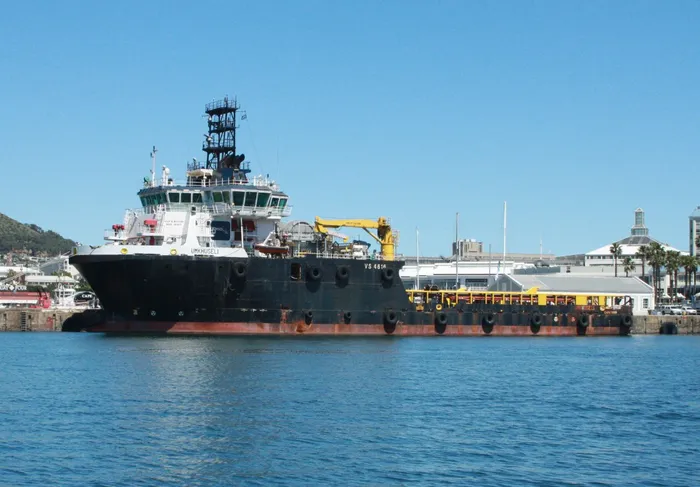
Transport Minister Barbara Creecy says the Transport Department has contracted vessel uMkhuseli for the prevention of oil pollution and to help vessels in distress as part of contingency measures amid the ongoing disruptions to shipping routes in the Middle East.
Image: File
For centuries, the Cape sea route shaped the destiny of global trade.
Today, history is repeating itself, but this time, South Africa risks becoming little more than a spectator to one of the biggest maritime shifts of the decade.
Shipping traffic around the Cape of Good Hope has surged dramatically since 2023 as geopolitical instability in the Red Sea and Strait of Hormuz forces global carriers onto longer routes around Africa’s southern coastline.
The world’s largest shipping companies, including Maersk, Hapag-Lloyd and CMA CGM, are rerouting vessels around the Cape in unprecedented numbers.
On paper, this should be a windfall for South Africa.
Instead, it has become a case study in how nations can possess strategic geography but fail to monetise it. The numbers tell a sobering story.
Cape diversions surged by more than 100% by early 2026. Transit times are now 10 to 14 days longer, increasing fuel consumption, insurance costs and demand for refuelling and logistics support along the route.
Global shipping is literally sailing past South Africa’s doorstep.
Yet while vessel traffic increased dramatically, South Africa’s bunker fuel volumes dropped from approximately 130,000 tonnes a month to just 80,000 tonnes. More ships are passing our coastline, but fewer are stopping to spend money in our ports.
That contradiction should alarm every policymaker, investor and business leader in the country. Because the issue is not geography. The issue is execution.
Other African nations have recognised the opportunity and moved aggressively to capture it.
Mauritius has transformed Port Louis into a growing bunkering hub, recording nearly one million metric tonnes in fuel sales last year.
Namibia is rapidly expanding Walvis Bay as a logistics gateway into southern Africa. Kenya is positioning Lamu Port as an East African maritime alternative, while even Togo is developing Port of Lomé into a strategic bunkering and transshipment platform.
Meanwhile, South Africa’s transshipment volumes have steadily declined over the past decade, with cargo increasingly shifting to ports such as Walvis Bay and Maputo.
Ships pass us, but they do not stop.
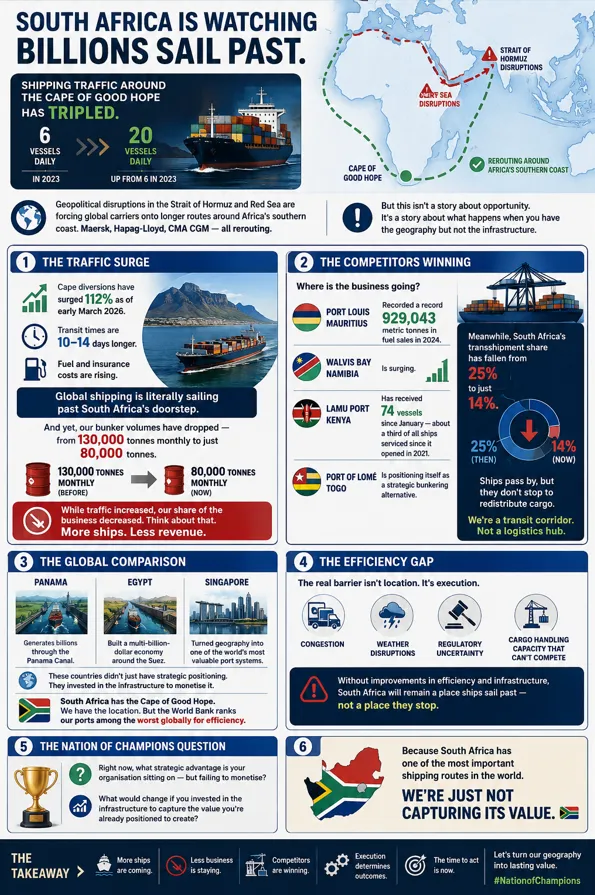
South Africa stands at a crossroads as global shipping traffic around the Cape of Good Hope surges, yet the nation risks becoming a mere spectator in this maritime shift, missing out on vital economic opportunities.
Image: Supplied.
This matters because ports are not merely transport assets. They are economic multipliers. Every vessel that docks creates secondary demand for fuel, maintenance, repairs, warehousing, customs services, food supply, hospitality, security and logistics support. Efficient ports stimulate manufacturing, attract investment and create jobs across entire value chains.
Around the world, nations that understood this dynamic built extraordinary economic ecosystems around maritime trade.
Panama transformed the Panama Canal into a multi-billion-dollar economic engine. Egypt built entire industries around the Suez Canal. Singapore turned strategic location into one of the world’s most sophisticated logistics economies.
These countries did not simply inherit advantageous geography.
They invested relentlessly in infrastructure, efficiency and systems capable of monetising that advantage.
South Africa, by contrast, has spent years underinvesting in port competitiveness while regulatory uncertainty, congestion, inefficiency and operational failures eroded confidence in our logistics ecosystem.
The World Bank consistently ranks South African ports among the least efficient globally.
Delays at key ports such as Durban and Cape Town have become internationally known. Adverse weather may be unavoidable, but outdated equipment, slow turnaround times and fragmented coordination are not.
The tragedy is that South Africa possesses almost every ingredient required to become a world-class maritime and logistics hub. We have one of the most strategically important sea routes on earth. We have industrial capacity. We have deep financial markets. We have engineering expertise. We have access to regional trade corridors into the rest of the continent.
What we lack is urgency.
Having interviewed hundreds of leaders across business, government and civil society over the years, one lesson consistently emerges: strategic advantage means nothing without the systems to convert it into value.
Right now, South Africa is behaving like a transit corridor instead of a logistics powerhouse. But this can still change — if the country acts decisively.
The first priority must be a national port modernisation programme with public-private partnerships fast-tracked across key terminals.
South Africa should immediately incentivise investment into bunkering infrastructure, ship repair facilities, cold storage, warehousing and transshipment services around Durban, Cape Town, Richards Bay and Ngqura.
Second, government and business must establish a dedicated Cape Maritime Growth Task Force bringing together Transnet, port operators, logistics firms, shipping lines and investors to coordinate reforms and remove operational bottlenecks in real time.
Third, South Africa should create a globally competitive maritime special economic zone model offering streamlined customs, faster turnaround times and tax incentives for shipping-related industries.
Fourth, skills development must become a national priority. Maritime logistics, port engineering, marine services and supply-chain management should be elevated as strategic growth sectors capable of creating thousands of jobs for young South Africans.
Finally, the country needs a bold national vision: to position the Cape route not merely as a passageway, but as the leading maritime services hub of the Global South. The ships are already coming.
The question is whether South Africa will finally build the infrastructure, systems and leadership needed to turn geography into prosperity — or continue watching billions sail past its shores.
Dr Nik Eberl is the founder and executive chair: The Future of Jobs Summit™ (Official T20 Side Event). He is also the author of Nation of Champions: How South Africa won the World Cup of Destination Branding).
Follow Business Report on Facebook, X and on LinkedIn for the latest Business and tech news.