

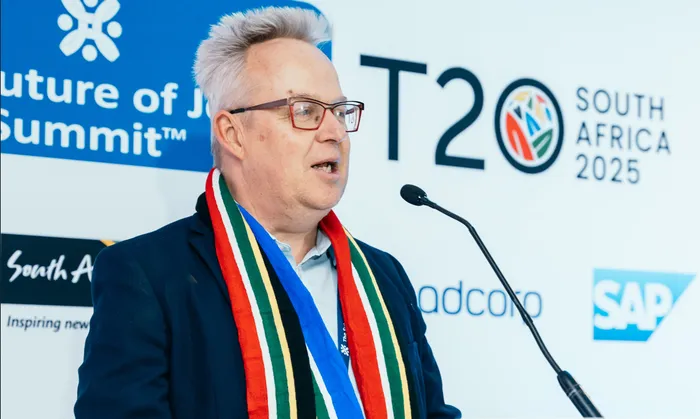
Dr Nik Eberl is the founder and executive chair: The Future of Jobs Summit™ (Official T20 Side Event). He is also the author of Nation of Champions: How South Africa won the World Cup of Destination Branding).
Image: Supplied
The world is witnessing more than a geopolitical conflict in the Middle East.
It is witnessing a profound reconfiguration of global talent flows. Wars have always shifted borders. Today, they are shifting brains.
The current conflict, centred around the escalating tensions involving Iran and the Gulf, has triggered not only a humanitarian crisis, but a silent, strategic migration of skills.
Tens of thousands of professionals are reassessing where they live, work, and build their future.
Entire ecosystems of talent are being disrupted, relocated, or redeployed. This moment presents both a warning and a once-in-a-generation opportunity for countries like South Africa.
Historically, globalisation enabled what we called “brain circulation”—talent moving fluidly between hubs like Dubai, London, Singapore, and New York. Today, that model is fracturing.
In the Middle East, once a magnet for global professionals, hiring has slowed sharply and expatriates are actively seeking relocation options due to rising instability.
At the same time, large-scale “reverse migration” is underway, with over 200,000 skilled professionals returning from the Gulf to countries like India in just weeks.
This is not low-skilled displacement.
It is engineers, executives, entrepreneurs, the very people nations compete for.
And herein lies the shift: Talent is no longer chasing opportunity alone, it is chasing stability, purpose, and long-term security.
Three forces are now redefining where talent goes:
At first glance, this may seem contradictory. On one hand, the world is facing a looming jobs crisis, with an estimated 800 million job shortfall in developing economies over the next decade.
On the other hand, companies across industries are desperately competing for critical skills—particularly in technology, energy, infrastructure, and healthcare. The truth is simple:The world does not have a jobs shortage—it has a skills mismatch. And in times of disruption, that mismatch becomes more pronounced.
South Africa now stands at a crossroads.
We are not in the conflict zone. We are geographically distant from the epicentre. And paradoxically, that distance may become one of our greatest strategic assets.
But opportunity without strategy is wasted potential.
To reposition South Africa as a destination of choice for global and local talent, five imperatives emerge:
Imagine designated zones in Renewable energy corridors, Tech innovation hubs, and Infrastructure mega-projects.
These zones should offer Tax incentives, Simplified regulation, and Integrated living ecosystems Talent moves to ecosystems—not just jobs.
The biggest risk is not failing to attract global talent. It is losing our own. South Africa must give its top talent a compelling answer to one question: “Why should I build my future here?”
This requires Clear national vision, Visible leadership, and Participation in nation-building. People stay where they feel they matter.
Government cannot win the talent war alone. Business must step up—not just as employers, but as co-creators of national competitiveness:
The countries that win will be those where business and government act as one system.
Every global disruption creates a redistribution of advantage.
The Middle East conflict is tragic.
But strategically, it is accelerating a global reshuffling of talent. The question is not whether talent will move. The question is: Where will it land?
South Africa has a narrow window to position itself as a sanctuary of stability, a platform for growth, and a nation of opportunity Or we risk becoming what we fear most: A country rich in potential, but poor in execution.
In the 21st century, nations do not compete on resources alone. They compete on their ability to attract, inspire, and retain talent. This is no longer a policy issue. It is a leadership test. And the countries that pass it will define the future.
Dr Nik Eberl is the founder and executive chair: The Future of Jobs Summit™ (Official T20 Side Event). He is also the author of Nation of Champions: How South Africa won the World Cup of Destination Branding).
Follow Business Report on Facebook, X and on LinkedIn for the latest Business and tech news.