

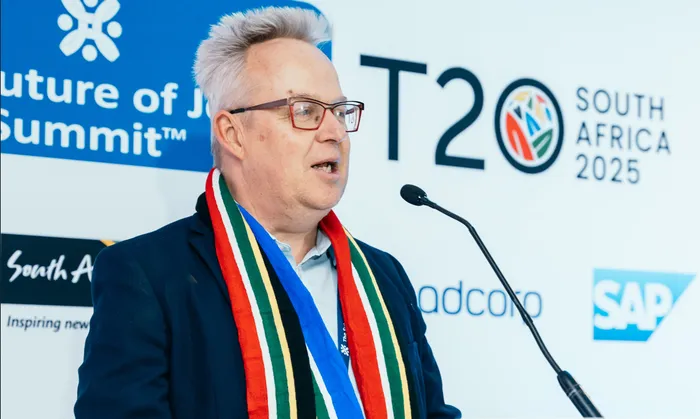
Dr Nik Eberl is the founder and executive chair: The Future of Jobs Summit™ (Official T20 Side Event). He is also the author of Nation of Champions: How South Africa won the World Cup of Destination Branding).
Image: Supplied
More than 3.4 million young South Africans are not in employment, education or training. It is a sobering number — but it does not have to define us.
In fact, it may be the clearest signal yet that South Africa stands at a moment of redesign.
At a recent National Education Summit, Higher Education Minister Buti Manamela offered a powerful reframing: “The crisis is not necessarily only unemployment. It is a crisis of pathways.” That insight shifts the national conversation. Because if the challenge is pathways, then the opportunity is design.
South Africa does not start from zero.
It has institutions, programmes, talent and ambition. What it needs now is alignment — and a renewed focus on building visible, scalable pathways that connect learning to earning, and potential to participation.
Over the past three decades, the country has made significant progress in expanding access to education. But access alone is no longer enough. The next phase must be about outcomes — about ensuring that every young person can see, and step onto, a credible path into the economy.
Equally, the structure of the economy demands a mindset shift.
The formal sector, on its own, cannot absorb the scale of youth entering the labour market each year. Preparing young people exclusively for employment is no longer sufficient. South Africa must become intentional about producing job creators.
Encouragingly, this shift has already begun. Technical and Vocational Education and Training (TVET) colleges are introducing entrepreneurship into their programmes, exposing thousands of students to the fundamentals of starting a business.
But entrepreneurship cannot be taught in isolation. It must be enabled. Young entrepreneurs need access to funding, to markets, to procurement opportunities and to experienced mentors. When these elements come together, entrepreneurship moves from theory to traction — and from small ventures to scalable enterprises.
The question then becomes: where are the most credible opportunities for job creation?
Several sectors stand out — not as abstract possibilities, but as immediate engines of growth if aligned with the right skills and support:
These sectors share a common characteristic: they require both skills and systems. Training alone will not unlock their potential. Nor will policy in isolation. What is needed is coordinated execution.
Minister Manamela’s observation that “our challenge is not lack of programmes but fragmentation” points to the heart of the issue.
South Africa does not lack ideas. It lacks integration. Education, industry and government often operate in parallel rather than in partnership. As a result, young people encounter a maze of opportunities that are difficult to navigate and even harder to translate into tangible outcomes.
The next phase of reform must focus on stitching these elements together into coherent pathways — clear journeys that a young person can follow from school, through training, into work or enterprise. This is not simply a policy challenge. It is a leadership challenge.
It requires business to step forward as co-creators of pathways, not just consumers of talent. It requires educational institutions to design with the end in mind. And it requires government to act as the integrator of the system, ensuring that incentives are aligned and outcomes are tracked.
On 28 May, South Africa’s Future of Jobs Summit will bring together leaders from across sectors to engage precisely on these questions. The opportunity is not to add another layer of programmes, but to accelerate alignment — to move from intention to implementation.
South Africa has done this before. At defining moments, the country has demonstrated an extraordinary ability to align around a shared goal and deliver against it. The challenge now is to apply that same collective focus to the question of youth pathways.
Because the stakes are clear — but so is the opportunity.
If South Africa can design and scale pathways that work, it will not only reduce unemployment. It will unlock a generation of builders, creators and contributors.
And in doing so, it will answer a far more important question: What does freedom look like when every young person can see a future — and step into it?
Dr Nik Eberl is the founder and executive chair: The Future of Jobs Summit™ (Official T20 Side Event). He is also the author of Nation of Champions: How South Africa won the World Cup of Destination Branding).
Follow Business Report on Facebook, X and on LinkedIn for the latest Business and tech news.