

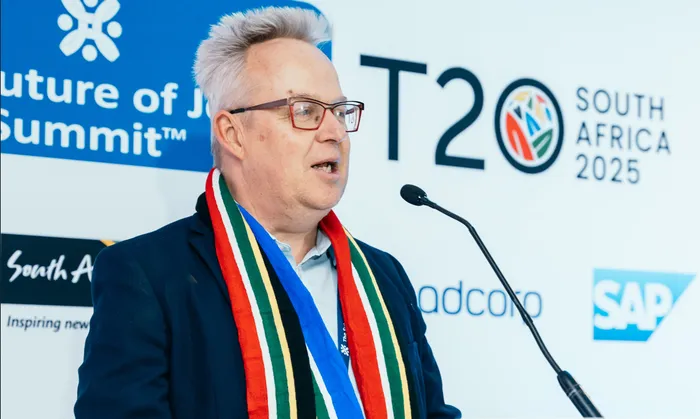
Dr Nik Eberl is the founder and executive chair: The Future of Jobs Summit™ (Official T20 Side Event). He is also the author of Nation of Champions: How South Africa won the World Cup of Destination Branding).
Image: Supplied
Every four years, the FIFA World Cup becomes far more than a football tournament.
It becomes the world's largest branding masterclass. While marketers focus on sponsorships worth hundreds of millions of dollars, the tournament quietly reveals a deeper truth: the strongest brands are rarely built through advertising alone.
They are built through identity, emotion and shared experiences.
Having had the privilege of covering Germany's nation-branding campaign during the 2006 FIFA World Cup and helping establish South Africa's Brand Ambassador Programme ahead of the 2010 tournament, I have seen first-hand how global sporting events reshape not only reputations but also the way nations—and organisations—see themselves.
This year's tournament has once again reminded us that branding is less about what organisations say and more about what people experience, remember and willingly share.
Two remarkable stories stand out. Neither involved a global advertising campaign. Neither required enormous marketing budgets. Yet both generated worldwide attention.
The first comes from Norway. As the country embarked on its most successful World Cup campaign in decades, an extraordinary ritual emerged among supporters.
Wherever Norwegian fans gathered—from stadiums in Boston and New Jersey to Times Square, schools, nursing homes and even Parliament—they performed what has become known as the "Viking Row."
Thousands of supporters sat shoulder to shoulder, rowing imaginary Viking longboats in perfect synchronisation while chanting a single word: "Ro." It is beautifully simple. Children can participate. Grandparents can participate. Even the Prime Minister joined in.
The brilliance of the Viking Row lies not in its choreography but in its accessibility. Every Norwegian instantly becomes part of something larger than themselves. It reminds us that culture is not created through slogans hanging on office walls. Culture is created through rituals.
Businesses spend millions attempting to build organisational culture through values statements, workshops and internal campaigns. Yet perhaps the better question is this: What is your company's Viking Row?
What simple, repeatable behaviour enables every employee—from the CEO to the newest recruit—to experience belonging? Great cultures are rarely built through grand gestures. They are built through small rituals repeated consistently over time.
The second lesson comes from an individual rather than a nation.
Every World Cup attracts the world's largest corporate sponsors, all competing for attention with spectacular campaigns.
Yet one of the tournament's most recognisable personalities has no sponsorship agreement, no advertising agency and no media budget. His name is Lumumba Vea from the Democratic Republic of Congo.
For ninety minutes he simply stands. Perfectly still. Dressed in the colours of his country, paying tribute to Patrice Lumumba and expressing unwavering belief in his national team, he has become one of the defining visual symbols of this World Cup.
Television cameras repeatedly find him. Photographers seek him out. Social media amplifies his presence. News organisations tell his story. Why? Because he understands one of the most important principles in modern branding. Distinctiveness beats volume.
In an age where organisations are obsessed with creating more content, buying more advertising and shouting louder than competitors, Lumumba Vea demonstrates the opposite. He doesn't interrupt attention. He becomes attention. Marketing scholar Byron Sharp argues that brands grow by developing distinctive assets that make them instantly recognisable and easy to remember.
Lumumba Vea has achieved exactly that without spending a single cent. He reminds every business leader that competitive advantage does not begin with bigger marketing budgets. It begins with greater clarity. Instead of asking, "How do we become louder?", leaders should ask, "What can only our brand own?"
The most memorable brands are those that stand unmistakably for something no competitor can credibly imitate. These two stories point to a larger truth. The world's strongest brands are built from the inside out. Identity precedes reputation. Culture precedes communication. Meaning precedes marketing.
Too many organisations begin with campaigns. The best organisations begin with conviction. Employees become ambassadors because they believe. Customers become advocates because they belong. Communities become loyal because they recognise authenticity rather than performance.
The FIFA World Cup continues to demonstrate that the most powerful brands are not necessarily those with the largest budgets. They are those that create emotional connections through symbols, rituals and experiences that people willingly adopt as their own. This lesson extends far beyond football.
South Africa has repeatedly demonstrated its own ability to unite people around powerful national symbols—from the spirit of 1995 to the pride generated by the 2010 FIFA World Cup.
As businesses navigate an increasingly uncertain future shaped by artificial intelligence, economic disruption and declining trust, the need for authentic brands has never been greater. Technology may transform products. It will never replace belonging.
The leaders who will define the next decade are not those who simply build better marketing campaigns.
They will be those who build communities. Because in the end, people don't remember every advertisement they see.
They remember how a brand made them feel. And whether it gave them something worth believing in.
Dr Nik Eberl is the founder and executive chair: The Future of Jobs Summit™ (Official T20 Side Event). He is also the author of Nation of Champions: How South Africa won the World Cup of Destination Branding).
Follow Business Report on Facebook, X and on LinkedIn for the latest Business and tech news.