

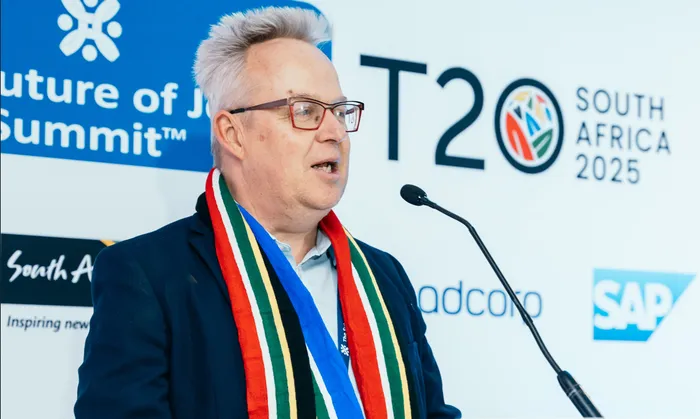
Dr Nik Eberl is the founder and executive chair: The Future of Jobs Summit™ (Official T20 Side Event). He is also the author of Nation of Champions: How South Africa won the World Cup of Destination Branding).
Image: Supplied
There are moments in a nation's history when the most important decisions are not about budgets, interest rates or infrastructure.
They are about trust. South Africa finds itself at such a moment.
The increasingly heated debate around immigration has become one of the defining public conversations of our time.
It raises legitimate concerns about border security, unemployment, crime and the rule of law.
Every sovereign nation has both the right and the responsibility to protect its borders and enforce its immigration legislation.
No serious economy can prosper without an orderly immigration system.
Yet while public debate has focused almost exclusively on who should enter South Africa and under what conditions, we have paid far less attention to another question: What is the economic value of trust?
Trust lies at the heart of every successful economy.
Investors place capital where institutions are stable.
Skilled professionals relocate where they believe they can build a future. Businesses expand where relationships are dependable. Tourists choose destinations where they expect to feel safe and welcome.
Countries, like companies, increasingly compete not only on infrastructure and resources, but on reputation.
Few industries illustrate this better than tourism. South Africa's tourism sector contributes hundreds of billions of rand to the economy annually and supports well over a million jobs.
Yet one statistic deserves far greater attention: nearly three-quarters of our international visitors come from elsewhere on the African continent. Our largest tourism market is not Europe or North America. It is Africa.
This changes the immigration debate. Every visitor arriving from Zimbabwe, Botswana, Mozambique, Namibia, Zambia, Kenya or Nigeria contributes to hotels, airlines, restaurants, conference venues, retailers and thousands of small businesses.
If legitimate visitors begin to feel unwelcome, the consequences will extend far beyond tourism. They will affect investment, trade and South Africa's standing across the continent.
I witnessed the economic power of trust during South Africa's preparations for the 2010 FIFA World Cup. Working on the country's nation-branding initiatives and helping establish the Brand Ambassador Programme, I came to appreciate that the tournament's greatest legacy was never the stadiums. It was the transformation of perception.
Millions of visitors arrived with uncertainty.
They returned home with stories of friendly immigration officials, passionate volunteers, generous strangers and a country that exceeded expectations. For one extraordinary month, South Africa reminded the world - and perhaps ourselves - that our greatest competitive advantage has always been our people.
That experience shaped a lesson reinforced through my interviews with more than 500 CEOs and public leaders over the past decade.
Successful organisations and successful nations operate according to the same principle: people rarely remember what you say; they remember how you make them feel.
The same is true of countries. Nation branding is not built through logos or advertising campaigns. It is built through behaviour. Every immigration officer, customs official, police officer, hotel receptionist, taxi driver, waiter, shop assistant and citizen contributes to the experience visitors take home. Every interaction either strengthens or weakens South Africa's reputation.
This is why the immigration debate requires a more sophisticated response than slogans or confrontation.
South Africa must strengthen its borders, modernise immigration administration and remove undocumented migrants through lawful and humane processes.
These are essential responsibilities of every sovereign state.
But enforcement and hospitality are not mutually exclusive.
The world's leading tourism destinations demonstrate that secure borders and welcoming visitors reinforce one another.
Professional border management builds confidence. Respectful treatment builds trust. Trust strengthens reputation, and reputation attracts tourists, investors, entrepreneurs and skilled professionals.
The greater danger lies not in enforcing immigration laws, but in allowing the perception to spread that South Africa has become hostile towards Africans.
Perception travels faster than reality.
A single incident shared online can influence travel decisions, discourage conference organisers and damage relationships that have taken years to build. Trust, once lost, is expensive to regain.
This matters because Africa represents South Africa's greatest growth opportunity. The continent has the world's youngest population, a rapidly expanding middle class and unprecedented prospects through the African Continental Free Trade Area.
South Africa should aspire to become Africa's preferred destination for business, tourism, education, healthcare and innovation.
That ambition will not be achieved through marketing alone. It will depend on the quality of our relationships.
In my own research, I describe this leadership capability as Motivational Intelligence™ - the ability to create environments where people choose to contribute because they feel respected, valued and inspired.
While developed as a leadership framework for organisations, the principle applies equally to nations. People invest where they trust.
They collaborate where they feel respected. They return to places where they experience belonging.
The challenge facing South Africa is therefore not whether we enforce our laws - we must - but whether we can do so in ways that strengthen rather than weaken our national brand.
That requires modern border management, stronger regional cooperation, clear distinctions between undocumented migration and legitimate visitors, and a renewed commitment to welcoming tourists, entrepreneurs, students and investors from across Africa.
This is not idealism. It is economic strategy. During the 2010 FIFA World Cup, the world did not fall in love with our stadiums. It fell in love with our people. Sixteen years later, that remains our greatest competitive advantage.
The countries that prosper in the twenty-first century will compete not only for capital, but for trust.
They will attract talent, ideas, entrepreneurs and visitors because people believe they are welcome.
South Africa's most valuable economic asset is not hidden beneath the ground. It is reflected in the confidence others place in us and in the everyday actions of millions of South Africans. Trust is not simply a social virtue. It is one of the most powerful economic assets a nation can possess.
Dr Nik Eberl is the founder and executive chair: The Future of Jobs Summit™ (Official T20 Side Event). He is also the author of Nation of Champions: How South Africa won the World Cup of Destination Branding).
Follow Business Report on Facebook, X and on LinkedIn for the latest Business and tech news.