

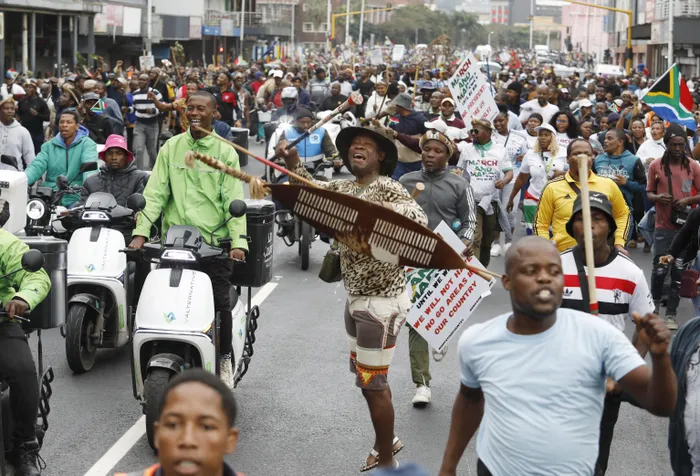
The 30 June protests caused a major economic impact this was according to the Road Freight Association and the KZN Premier Thamsanqa Ntuli on Thursday
Image: Doctor Ngcobo/Independent Newspapers
The 30 June protests caused a major economic impact, the the Road Freight Association and the KZN Premier Thamsanqa Ntuli said on Thursday.
Gavin Kelly, CEO of the Road Freight Association (RFA) said the fear of a repetition of the July 2021 fiasco was foremost in the minds of most businesses – especially the road freight logistics sector who were worried about staff, drivers, trucks, warehouses and stock.
Kelly added that during the day, protestors showed that South Africans can voice (display) their unhappiness with circumstances without resorting to violence, property destruction, personal attacks or senseless acts of brutality.
“However, in several places in Gauteng and KwaZulu-Natal, protesters (or opportunistic criminals) started looting shops and businesses owned by foreigners. This was both tragic and uncalled for.”
Kelly said that they commended the various structures, organisations and entities that combined to ensure that there were peaceful protests, with the rights of protest equally protected alongside the right to continue with everyday life and the activities related to that.
“Today (and in the days to come) – the inevitable “counting the cost” exercise will begin. We have a good idea of the bill that the taxpayer had to “foot” for the SAPS presence. Based on what transpired over the day and night - probably good money well spent,” he said.
Kelly said in the road freight and logistics sector, extra security was laid on, more surveillance teams and more shifts.
“Those who chose to hold their vehicles in depots or along safe places en route (there were many of our neighbouring country transporters who chose that route) – their large vehicles cost around R4,500 a day," he said.
"Smaller classes of vehicles are less. Perhaps, if you add the full cost of all the extra security, extra shifts, extended warehousing and control, delayed trips (especially from ports or across borders), paid days for employees told to stay at home (just in case) – the sector may have incurred a hundred million rand, or so,” he said.
Premier Ntuli said they condemned individuals who hijacked the protests for criminal purposes, by embarking on acts of looting, violence and vandalism. “We commend police for arresting 51 people implicated in looting and vandalism. This sent a stern warning to lawbreakers that they do not have a place in KwaZulu-Natal.”
Ntuli added that protests revealed underlying problems of joblessness and scarcity of jobs. “To address the pertinent issues pertaining to unemployment, I'll convene a Roundtable on local economic development in the form of spaza shops in due course. The aim of the round table is to turn people's frustrations into economic opportunities.”
Malcolm Hartwell, head of transport at Deneys said that many retail and manufacturing businesses closed on the 30th as no one had any idea how many people would march and whether there would be the outbreak of violence and chaos we saw in the 2021 riots.
“It transpired, in general, it would appear that it was not necessary for businesses to close, but of course the precautionary closures resulted in loss of income for the majority of those businesses who could not work remotely. This would have included those in the logistics sector although officially the ports, rails and roads were open for business and operated normally.”
Hartwell said that there is no doubt that the grossly exaggerated claims of the organisers and the many threatening messages that circulated in various communities on social media resulted in the marches having far more effect than they deserved.
“Presumably businesses will take this into account in deciding whether to close again if the threatened Thursday marches take place. Whether this movement has any real effect on the formal economy and the logistics industry in the medium term really depends on whether it can sustain or grow its support base.”
“The fact that the Rand remained steady reflects the international markets are not too concerned, but there is no doubt businesses must have suffered direct financial loss and will now face indirect losses with so many of their erstwhile customers chased over the borders,” he said.
Visit:www.businessreport.co.za