

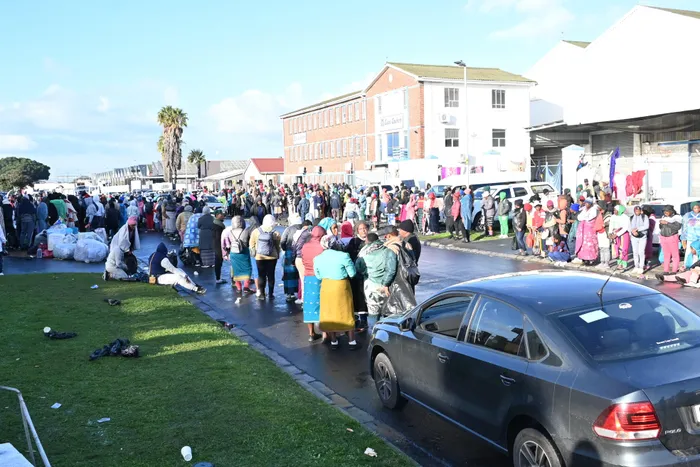
More than 2,000 Zimbabweans have been sheltering at a Cape Town processing centre as fears grew ahead of possible June 30 protests.
Image: Bheki Radebe
Many businesses will likely keep their doors closed on June 30 due to the threat of public violence from anti-immigration protests, but business and labour organisations say foreigners are incorrectly being blamed for South Africa’s tottering economy.
A National Economic Development and Labour Council (NEDLAC) coalition, comprising Cosatu, Fedusa, Saftu and Nactu, said their message from organised labour was clear: migrants are not to blame for the country’s economic malaise.
In a statement in response to growing tensions around migration and illegal immigration, and recognising the legitimate frustrations of millions of South Africans grappling with high unemployment, poverty, inequality, and crumbling public services, the organisations said “The economic crisis in South Africa is rooted in issues like economic stagnation, corruption, de-industrialisation, mass unemployment and weak governance,” rather than immigrants.
This concern was echoed by Pietermaritzburg Chamber of Business chief executive Melanie Veness, who said foreigners in South Africa had become the scapegoats to anti-immigration protestors for the weak state of the economy.
“Removing foreign nationals from workplaces, communities, or public spaces will not reopen factories or create sustainable jobs,” the labour organisations asserted, calling for a more comprehensive approach that addresses the underlying economic problems.
They warned the rising tide of anti-migrant sentiment was often politically orchestrated to divide the working class and distract from genuine grievances relating to poverty and inequality.
“The enforcement of immigration and labour laws is the responsibility of the state, and no individual or organisation has the right to act outside the law,” the unions declared.
Both the Johannesburg Chamber of Commerce and Industry (JCCI) and the Pietermaritzburg Chamber of Business did not advise their business owner members to close on June 30, or to allow their members’ staff to take the day off, but instead advised against unnecessary travel, and particularly to potential hotspots in city centres and near informal settlement borders where large numbers of people were congregating.
The government has said June 30 is not a national shutdown day, and that normal business should continue. Police and private security have identified Gauteng, KwaZulu-Natal, the Western Cape and the Eastern Cape as potential hotspots.
A spokesperson for the JCCI said they were in constant contact with a range of different organisations in the Johannesburg area, including police and private security services, to monitor the situation. The spokesman said they did anticipate members would experience lower trade on the day.
Veness said the economic impact of the protests was vast. For instance, the chamber ran a programme to increase export sales into other African markets by black-owned companies, and these protests had the potential to be a “total disaster” for increased trade with other African countries.
She said also of concern, particularly for KwaZulu-Natal, was the potential loss of annual tourists from other African countries, which represent a significant proportion of the province’s annual overall tourism numbers.
Ruan Vermaak, communication manager at South African emergency‑assistance and communication service CrisisOnCall, said simple steps such as checking your route before travelling, avoiding protest hotspots where possible, keeping loved ones informed of your whereabouts, and ensuring you have access to emergency assistance can make a significant difference if circumstances changed unexpectedly.
Stay informed by monitoring credible news sources and traffic updates before travelling. Allow extra travelling time in case routes need to be changed. Keep your mobile phone fully charged and ensure important emergency contact numbers are readily available. Let a family member, friend or colleague know your expected route and estimated arrival time.
The government has said private individuals and groups have no authority to demand documentation from members of the public, block access to schools, clinics, hospitals or businesses, or determine who may live in particular communities.
“The enforcement of immigration and labour laws is the responsibility of the state, and no individual or organisation has the right to act outside the law,” the unions declared.
“A properly resourced and accountable state is essential for addressing these pressing issues, including stronger labour inspection and effective border management,” they added, reinforcing the need for adequate staffing and the digitisation of processes related to migration control.
Neil Roets, CEO of Debt Rescue, highlights that the current economic conditions pose significant strains on consumer behaviour and business operations alike.
"When consumers feel secure about their financial situation, they generally exhibit a greater willingness to spend, travel, shop, and support local businesses," Roets noted. However, during periods of economic downturn, many households adopt a more conservative approach to discretionary spending, reflecting a cautious mindset amid uncertainty.
As South African households and enterprises navigate these tumultuous times, Roets emphasises the necessity for ongoing vigilance in financial planning. "In a challenging environment, the need for careful management of finances cannot be overstated," he advised. With the focus firmly placed on addressing the existing pressures, the path toward a more stable economic future remains a shared responsibility for consumers and businesses alike.
Follow Business Report on Facebook, X and on LinkedIn for the latest Business and tech news.